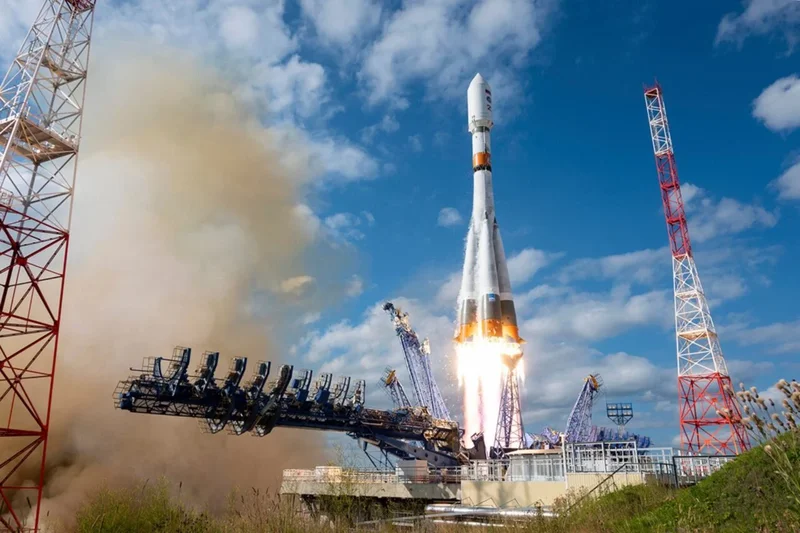
Russia’s space program just suffered a serious casualty in the war with Ukraine. On Saturday, Ukrainian President Volodymyr Zelenskyy confirmed that his forces carried out a missile strike that damaged the Progress Rocket Space Center in Russiaâs Samara region, which assembles Soyuz rockets for Roscosmos.
Soyuz is the primary workhorse for Russian spaceflight. In addition to transporting cargo and crew to and from the International Space Station, this family of rockets plays a critical role in satellite deployment, launching spacecraft for military, reconnaissance, Earth observation, and communications purposes into orbit. Soyuz-2.1b deploys the “Rassavet” satellite constellation, Russia’s analogue to Starlink.
According to Zelenskyy, Ukraine used FP-5 “Flamingo” missiles for the attack, describing it as “a good achievement.” He also confirmed strikes at the Savasleyka airbase, “where the carriers of Russian missiles that strike our cities and villages are based,” and an oil facility in Ust-Luga.
“I am grateful to all the units involved for their accuracy,” Zelenskyy said.
Today, there are new significant results from our deep strikes. In Russiaâs Samara region, one of the key enterprises within Roscosmos â the Progress Center, which was involved, among other things, in electronics production â was hit. Flamingo missiles were used. A good⦠pic.twitter.com/1BlZpmvKRN
— Volodymyr Zelenskyy / ÐÐ¾Ð»Ð¾Ð´Ð¸Ð¼Ð¸Ñ ÐеленÑÑкий (@ZelenskyyUa) August 15, 2026
Hitting Roscosmos where it hurts
Neither Soyuz rockets nor Soyuz spacecraft are reusable, so Roscosmos depends on a steady supply of new vehicles to maintain launch and ISS transport operations. A lasting delay in production would essentially bring Russian spaceflight to a standstill. More than 85% of Russian rocket launches since 2020 have involved the Soyuz-2 family of rockets, Ars Technica reports.
According to U.S.-based Russian space expert Anatoly Zak of RussianSpaceWeb.com, Progress Rocket Space Center is “a prime developer of rockets and spacecraft, including Soyuz-2 and Soyuz-5 launch vehicles, as well as military satellites.”
Citing the General Staff of the Armed Forces of Ukraine, The Kyiv Post reports that the Center suffered a “direct hit” that started a fire on the facility’s grounds. Officials have not confirmed which facilities were damaged, but according to Zak, an imagery analysis by the Ukrainian group CyberBoroshno shows that Building 106A, a clean-room facility for avionics, was hit. That facility is adjacent to Building 106B, used for vehicle integration.
The damage to Progress Rocket Space Center is just the latest setback for Roscosmos, which has been mired by funding shortages, technical problems, and isolation from international partners due to the war.
In January, Dmitry Baranov, the Roscosmos official responsible for launch systems and former head of the Center, said orders for Soyuz vehicles were exceeding production capacity by a staggering margin, Zak reports. Between 2027 and 2030, demand could exceed production capacity by 30% to 50%, Baranov said.
While the fallout from this Ukrainian strike remains to be seen, it could further hinder Russia’s efforts to catch up with and dominate space powers like the U.S. and China. It could also give Ukraine a leg up on the battlefield by disrupting Russia’s military space and satellite launch capabilities.