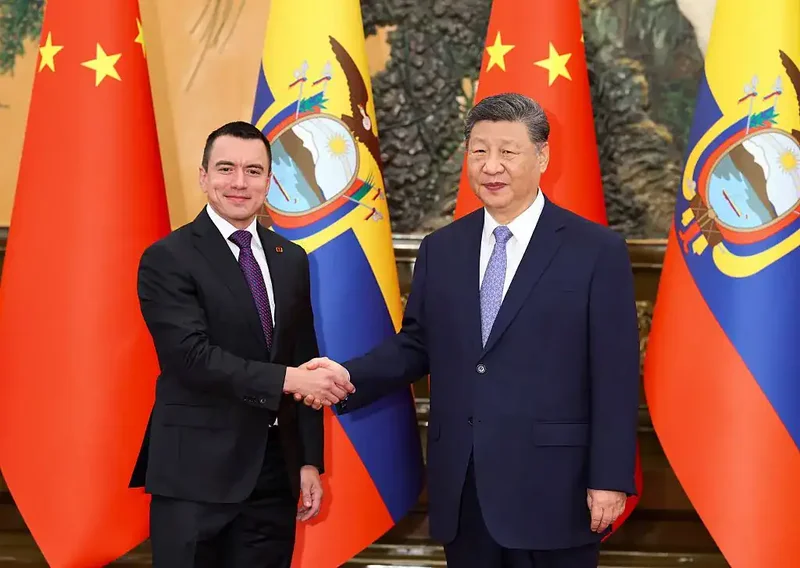
Noboa’s China agenda: energy, shrimp, and debt talks
Ecuador · Diplomacy
Key Facts
- State visit:Noboa is in China from 16 to 23 August, confirmed by China’s foreign ministry, before heading to Singapore and Vietnam until 28 August under Executive Decree 469.
- Trade volume:Bilateral trade hit $17.33 billion in 2025, up 24% year on year, with Ecuador posting a $1.77 billion surplus.
- Debt ask:Quito wants better terms on its Chinese debt, which stood at about $2.2 billion as of August 2025, down from $9.6 billion in 2016. No renegotiation is confirmed.
- Shrimp wrinkle:China suspended imports from 14 Ecuadorian shrimp companies in October 2025 over sodium metabisulfite residues and white spot virus. Noboa wants those restrictions lifted.
- Hydropower deal:A possible PowerChina operation and maintenance contract at Coca Codo Sinclair is reported at up to about $1.5 billion over 25 years — flagged as reported, not signed.
- No new package yet:No agreement, memorandum, or dollar figure has been announced from the August meetings; the Belt and Road framework and free trade agreement predate this trip.
Ecuador’s president heads to Beijing with a wish list: mining cash, relief for 14 suspended shrimp exporters, and softer terms on roughly $2.2 billion in Chinese debt.
If you have money in Latin American commodities or trade, this is a trip worth watching. Ecuador’s President Daniel Noboa is in China from 16 to 23 August on a state visit at Xi Jinping’s invitation, carrying an agenda that covers energy and mining investment, a lifeline for 14 shrimp exporters, and easier repayment terms on Chinese debt. The trip is the first leg of a broader Asia tour that runs until 28 August and includes Singapore and Vietnam, where Noboa is also scheduled to meet both countries’ prime ministers.
What Noboa wants from Beijing
Noboa’s agenda is a shopping list of Latin America’s classic asks: investment, trade access, and debt relief. He is scheduled to meet Xi Jinping, Premier Li Qiang, and NPC Standing Committee Chairman Zhao Leji — all confirmed in their posts. The meetings are the core of the state visit, and the stated purpose is to deepen bilateral ties and attract investment.
Ecuador wants Chinese money in energy and mining, to strengthen exports, and to sort out the shrimp suspension that hit 14 companies. There is also the matter of the Coca Codo Sinclair hydroelectric plant, where the government wants PowerChina to handle operation and maintenance. The shrimp issue is especially urgent for a sector that employs tens of thousands of people, and any delay in lifting the suspensions hits export revenues.
The numbers behind the trip
Trade is the headline. Bilateral trade hit $17.33 billion in 2025, up 24% year on year, with Ecuadorian exports to China at $9.55 billion and a $1.77 billion surplus. That surplus gives Quito some leverage in talks, though China’s sheer market size means the leverage cuts both ways.
On debt, Ecuador’s total to China is about $2.2 billion as of August 2025, down from $9.6 billion in 2016. Better terms on that would free up fiscal room for a government juggling security spending and a tough economic outlook. Debt is on the pending list, but no renegotiation has been confirmed.
On the shrimp front, China suspended imports from 14 Ecuadorian companies in October 2025 over sodium metabisulfite residues and white spot virus. Getting those lifted matters for a sector that is a major employer and export earner. Ecuador’s shrimp exports to China were worth billions of dollars annually, and the suspension has already disrupted supply chains.
The Coca Codo Sinclair angle
Coca Codo Sinclair is a 1,500 megawatt hydroelectric plant, built by Sinohydro, and transferred to Ecuadorian control in April 2026. It’s a key piece of Ecuador’s energy grid, and its operation and maintenance are on the table. The possible PowerChina deal is reported at up to about $1.5 billion over 25 years — that’s reported, not signed.
The plant, built with Chinese financing, has faced operational issues in recent years. A new contract would ensure its continued operation while transferring technical expertise. The plant’s output is critical for Ecuador’s electricity supply, and any disruption would have ripple effects across the economy.
Why it matters for Latin America
This isn’t just about Ecuador. China is the top trading partner for several Latin American countries, and the terms of its deals in Ecuador — whether on debt, mining, or infrastructure — set precedents that ripple across the region. If Ecuador gets softer debt terms, other indebted nations like Argentina, Bolivia, or Venezuela will be watching closely.
For investors, the outcome of the shrimp talks is a bellwether for how China handles trade disputes with smaller partners. For mining, any new Chinese investment in Ecuador’s copper or gold projects could shift the regional balance of extraction rights and export routes.
Ecuador joined the Belt and Road in 2018, and Xi and Noboa signed a cooperation plan in June 2025. The free trade agreement has been in force since May 2024. Ecuador’s experience — combining trade, debt, and infrastructure — is a microcosm of the complex relationship.
What is not yet agreed
The reporting is strong on the planned agenda and the existing trade framework, but as of 17 August no agreement, memorandum, or dollar figure has been announced from these meetings. The outcome of the Xi meeting has not been reported. The Belt and Road cooperation document and the free trade agreement were signed and in force before this trip, so they are not new from these meetings.
Treat the trip as a negotiation, not a done deal. If you are an investor, watch for concrete numbers on mining concessions or debt restructuring terms in the days after the visit. The absence of a signed package so far suggests the talks are still fluid, and any announcements will likely come in the form of joint statements or press releases from Quito or Beijing.
Frequently Asked Questions
Why does Noboa’s China visit matter for investors?
Because Ecuador is a major exporter of shrimp, oil, and minerals, and China is its top trading partner. Any deal on mining investment or debt relief could move the country’s risk premium and the outlook for its exports.
What is the status of the shrimp export suspensions?
China suspended imports from 14 Ecuadorian shrimp companies in October 2025 over sodium metabisulfite residues and white spot virus. Noboa wants those restrictions lifted, but no agreement has been reported from the August meetings yet.
How much debt does Ecuador owe to Chinese banks?
Ecuador’s debt to China is about $2.2 billion as of August 2025, down from $9.6 billion in 2016. Quito is seeking better repayment terms, but no renegotiation is confirmed.
What is the Belt and Road document mentioned in the reporting?
It is a cooperation framework under China’s Belt and Road Initiative. Ecuador joined in 2018, and Xi and Noboa signed a cooperation plan in June 2025. It is not new from the August meetings.
Connected Coverage
Sources: Noboa se reunirá con el presidente de China y los primeros m; Ecuadorian President Daniel Noboa to visit China – CGTN; Ecuadorian President Daniel Noboa to Visit China; Noboa lleva a China una agenda de pendientes que va más allá; Camaroneras suspendidas, Coca Codo Sinclair y …
This article was produced by The Rio Times’ automated newsroom system. How we use AI · Report an error