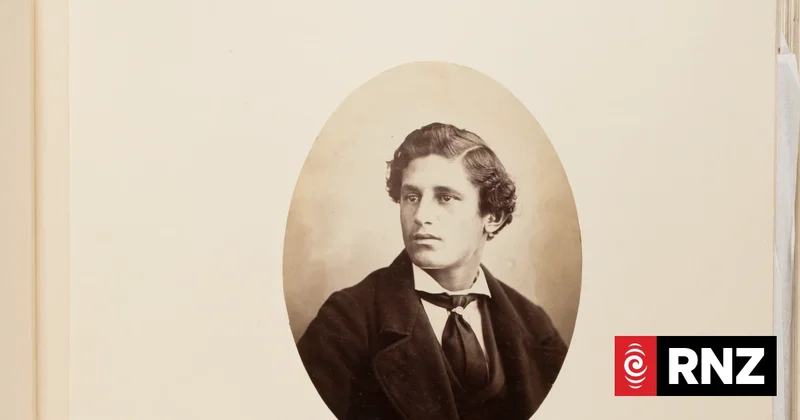
In the archives at Scotland's oldest university there is a single photo of a young Māori man, but who was he? And how did he end up on the other side of the world from Aotearoa?
The young man in the portrait is identified in the caption as a part-Māori student at St Andrews University in the 1860s, but without any name attached, the task of uncovering his identity is a difficult one.
Do you recognise the person in this photograph? Email Temanukorihi@rnz.co.nz
Luke Gartlan, a Senior Lecturer in Art History at the University of St Andrews, has been trying to establish the identity of the student.
"For me, this is important in many ways, both to return this photograph to Māori descendants and communities and to Pākehā, but also to rethink the university itself and who its students have been in the past in the Victorian era," he said.
The portrait is part of the Laurence Swan Thomson album, a collection compiled in the 1930s but containing portraits from the 1860s.
The only information about the photograph comes from the caption on the opposite page which reads: 'Portrait of a student. 1862/63 From a wet plate by Thomas Rodger. A student at St Andrews University. part Maori.'
"[Rodger] was the first commercial photographer to set up a studio to sell photographs, to have customers in St Andrews," Gartlan said.
"He set up the studio in 1849, and he died in 1884. So, this photograph, most likely taken in the early 1860s, is sort of at the midpoint of his career. And he photographed many local figures, of course, many residents, but he also photographed many people who came to St Andrews and left St Andrews for a variety of reasons. And so, this particular young man who had come to seemingly study at the university had his portrait taken,"
Given that the album was put together decades after the photographs were actually taken, it seems the captions were most likely put together from old accounts, he said.
However Gartlan believed the photograph was consistent with Thomas Rodger's portrait photography in St Andrews of the 1860s.
"Well, with this photograph, the way it's presented, three-quarter, the lighting, the clothing, the care of the hair and so on, we might not know what the name of this individual is, but we feel instinctively it is an individual. And to name this, therefore, in the context of being a student at the university, alongside all these other figures, is to kind of reinforce this person's place within the university and the town itself."
The context the album was created in was also important, for example, it was in a binding with an escutcheon, a design of the university itself, suggesting the album was put together deliberately to be given to the university and that the captions might be trying to emphasise the people and their relationship to the university, he said.
Gartlan said this photograph had a kind of power - "the photograph itself is its own evidence, an undeniable statement" of a young Māori in the height of the Victorian era in Britain.
"We're talking about a photograph which is now 160 years old, and yet you look at this photograph and... you're curious, who is this student? What is their story? What must it have been like to travel to the other side of the world on the steamships of the time and come to a small university on the North Sea, famous for its golf and for its weather and for its wildness."
Professor of Modern History at the University of St Andrews Aileen Fyfe and her team have trawled through the University's archival lists of students as well as researching the legacies of empire at the University in the 18th and 19th century.
The biggest imperial connection for St Andrews is to the areas controlled at that time by the British East India Company in the Indian subcontinent, she said.
Many 'international students' are recorded as being born in India, but to Scottish parents serving in the East India Company.
Fyfe said her team have recorded a "very small handful" of students of Indian ethnicity and one from West Africa at the University in the 1850s and 60s.
"So we know that there were a few students who would have been visibly different at St Andrews in the very late 1850s, early 1860s, all of them studying medicine, by the way. We've very few that we know of from Australia or New Zealand. In fact, I have not found anybody who's recorded as being from New Zealand before 1900."
Fyfe and her team have since found a small handful of New Zealand born students at the university at the beginning of the 20th century, but nothing so far which would help identify the Māori student.
The majority of the research Fyfe's team did was based on names in the University's registers, which can be a challenging task if that was the only thing they had to go on.
"We do have some photographic records, but we don't always have names associated with the photographs, as this particular photograph is a classic example of that. But we've also got things like class photographs or sports team photographs and those kinds of things, particularly once we get into the early 20th century and some of them have names and some of them don't."
Ideally having a name, photo and some correspondence or other documentation from the student they were researching made them easier to trace. Fyfe said they had been able to identify one student from India who left behind correspondence on overdue book fines.
"But if people don't do that, and to be honest, most students haven't left that sort of trace, then it's difficult. You're trying to trace a name in the same way as family history enthusiasts would be doing, trying to find out who this person was. And sometimes you have luck, especially if it's an unusual name. Doing it from a photo alone, that's really difficult."
Fyfe said the person in the photo might still be in the university's records, but might not have been recorded as coming from New Zealand - there were only birth locations for about 60 percent of the university's students.
It was also likely that the student would have used an Anglicised name rather than an identifiably Māori name.
"We also don't know for certain that this is a university student. It's potentially possible that this is a student at the local secondary school, which is called Madras College. Equally, he could be a student somewhere else who happened to be visiting St Andrews when he had his photograph taken. So, yeah, there's a lot of uncertainty about it.
"So if anyone does recognize the photo or has a family story about it, then it would help."