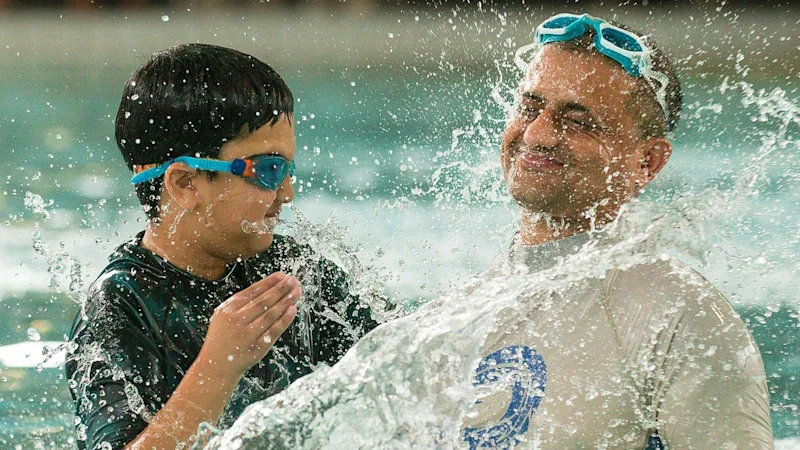
When everyone else celebrates New Year’s Eve, former Nepalese Australian Association president Rishi Acharya prays to Buddha that someone in his community won’t die in the water.
“I always pray because in last few years it’s repeatedly happened.”
After one of his good friends fatally drowned in the Kangaroo River, Acharya learnt to swim.
Now his 11-year-old son, Suyog, is doing lessons at Blue Fit’s Hurstville Aquatic Leisure Centre, near where about one in 10 Nepalese live in Australia.
The federal government and Royal Life Saving Australia will on Tuesday announce $5 million in funding for We Swim, a program to be led by community leaders, including those from India, China and Korea, who understand the particular risks and the culture of their people.
Royal Life Saving chief executive Justin Scarr said being able to swim on a hot day was a quintessential part of being Australian.
Yet for too many refugees and migrants, accessing a local pool to build those skills can be daunting, and the consequences of not knowing how to swim were tragic.
Scarr said the new program recognised communities talk more to each other than they listen to outsiders.
People born overseas represented about a third of the 357 fatal drownings in Australia in 2025, and those born in the landlocked country of Nepal are nearly three times as likely to perish.
Acharya has seen grief first-hand in his small community of about 220,000 people: 31 people from Nepal have drowned in Australia over the past 10 years, including 10 deaths between 2023-25.
He has organised the logistics and fundraising of sending the bodies of mostly young Nepalese home for cremation.
Federal Sport Minister Anika Wells said We Swim would save lives, cut barriers for multicultural communities and avoid preventable death. Swimming and water safety education were critical skills for everyone, she said.
We Swim includes a new dashboard by Royal Life Saving that shows who fatally drowned and where. We Swim will focus on local government areas such as Georges River, home to 8700 Nepalese Australians, and close to beaches and rivers they visit.
Acharya would like the program to recognise important differences: Nepalis expected rivers to be predictable, but Australian rivers were often muddy and had snags.
Acharya said his community loved to gather by a beach or river, yet most water safety programs do not recognise the beach and the ocean is a new experience for someone from Nepal.
He would like to see signs warning of dangers in Nepalese, Mandarin, Cantonese, Korean and Hindi in high-risk spots.
In 2017, Nepalese students Christi Bhandari, 23, and Sudeep Uprety, 26, were swept off the rocks at Maroubra and died.
Bhandari had been in Australia for 17 days and did not know anything about the beach or ocean. Acharya said she had been “so surprised by the waves, the smell, the people, she couldn’t control her excitement, and jumped in”.
Blue Fit, which manages the Hurstville pool, runs community programs. Zoe Kassianou, Blue Fit’s Georges River community engagement manager, said: “There is a special joy when we see kids and adults from a multicultural community learn to swim and develop water safety skills.”