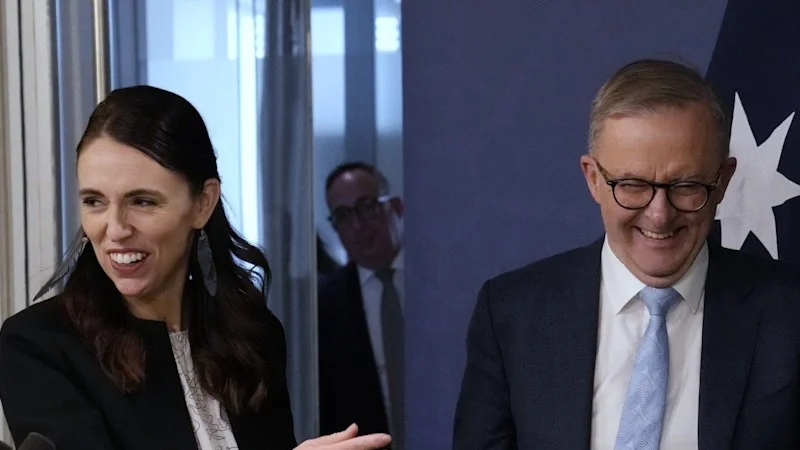
The Albanese government overlooked internal warnings there would be an influx of New Zealanders under plans to give them easier access to welfare and citizenship, which has turned into one of Labor’s thorniest challenges in driving down the migration rate.
The burst in Kiwis coming to Australia has been one of the biggest blowouts in the net overseas migration rate since the pandemic, a prospect that was raised by top officials at the time Prime Minister Anthony Albanese made the key policy move early in his first term.
Sources familiar with cabinet deliberations at the time, not permitted to speak in public, said officials from Treasury and Home Affairs expressed serious concerns that the move would create too big an incentive for Kiwis to move to Australia, particularly if Australia had a healthier job market and economy. New Zealand subsequently went into recession, sparking more movement.
The net intake of New Zealanders surged to 38,000 per year in the two years after Albanese widened benefits and citizenship pathways in July 2023 – compared to about 8000 or fewer before the pandemic. Consistent demand and uncapped places meant New Zealanders on special visas made up 12.5 per cent of the net migration figure in the 2024-25 financial year.
Labor is now scrambling to find ways to reduce net migration after consistently overshooting its targets, while the Coalition and One Nation have tied themselves in knots advocating for more drastic cuts.
As migration and its interplay with the cost of living rise to the top of the political agenda, this masthead revealed in recent days that the government is mulling increasing deportations for visa overstayers. It also quietly paused backpacker visas from 24 countries. Treasurer Jim Chalmers warned about the costs of lowering migration on Monday, arguing the Coalition was intent on “dividing the country” and crashing the economy.
The New Zealand surge coincided with Albanese’s decision in 2023 to reverse a Howard-era policy by allowing New Zealanders to gain citizenship after four years without becoming permanent residents first. It also gave New Zealanders quicker access to Medicare and the family tax benefit once they arrived.
Albanese said at the time that the Howard-era changes had made citizenship harder for Kiwis and that the 2023 change harmonised rules between the nations.
But department officials feared that even if the economies were about as healthy as each other, the relaxed rules would still create a large incentive for New Zealanders because Australia is a bigger and wealthier country.
Labor warmed relations with Jacinda Ardern’s government after the progressive leader sparred with Scott Morrison over deportations of criminal dual citizens. The Albanese government policy to grant access to Medicare stopped short of offering the same access to the NDIS and other welfare items.
Migration expert and former department official Abul Rizvi said the 2023 policy change was “made with total disregard to the impact on [net overseas migration].”
Asked about the bureaucratic alarm bells, a spokesman for Burke said Labor reversed the Howard-era rules because the old settings created “intolerable circumstance where young people would spend their whole life in Australia only to reach uni and discover they were ineligible for HECS.”
Data from the Australian Bureau of Statistics shows around 30,000 New Zealanders were arriving each year before the pandemic, while between 22,000 and 27,000 left. This meant their overall impact on the net migration figure was small – between 2.5 per cent and 3.5 per cent of the annual migrant intake.
Numbers surged from July 2023. In the two years since then, more than 50,000 Kiwis have arrived annually on a special 444 visa, while fewer than 15,000 departed. It means that New Zealanders as a share of the net migrant intake has increased – from 4.9 per cent in 2022-23, to 8.7 per cent in 2023-24, and 12.5 per cent in 2024-25.
Even as the government has lowered arrivals under other temporary visa classes, consistent and uncapped demand from Kiwis has offset these efforts to drive down the net overseas migration rate. The 2024-25 net intake of Kiwis was 30,200 above the 2018-19 level, which is the largest increase in raw numbers during that period of any individual visa class, just above backpackers and students.
Students remain the largest migrant group, comprising 32 per cent of the net intake last financial year. But while many of them live in special accommodation, New Zealanders tend to live in the mainstream part of the housing market where supply is strained.
But the Australia-New Zealand arrangements would be difficult to reverse for Labor given the close relationship between the nations. Albanese has tasked Burke with finding new ways to cut net migration from 300,000 to 225,000 as Hanson surges off the back of anti-establishment sentiment and voter anger about migration.
Treasurer Jim Chalmers used question time on Monday to highlight the sharp trade-offs in the mission to cut back on migration, which Labor is balancing against the need to attract tradies, farmworkers, and doctors.
“You can get net overseas migration down as we are doing, at the same time as you can recognise and not diminish the really important role played by migrants in our economy and in our society,” Chalmers said, referencing RBA research showing that migrants were beneficial to the economy.
Working holidaymakers have been another area where migration has blown out since the pandemic, this time under Morrison government changes that expanded age eligibility and added a third year visa. Their contribution to NOM in 2024-25 was up 29,400 compared to the pre-pandemic intake.
Labor has slowed down backpacker visa processing and quietly paused applications from 24 countries, while the Liberal and National parties have been at odds on backpackers, which are key to Nationals’ agricultural seats. Backpackers made up 17.5 per cent of the net migration figure last year, up from 10 per cent in 2018-19.
Former Labor adviser Henry Sherrell on Monday raised the alarm on Australia’s migration program, cautioning that “a few tweaks and some sentimental rhetoric will do little to win hearts and minds.”
Sherrell noted that about 30 per cent of people aged 25 to 29 living in Australia were temporary visa holders, underlining the explosion in backpacker and student visas.
The researcher called for a cap on population growth stemming from migration of one per cent per year, after Australia’s yearly growth outstripped all similar nations this century.
“Without immigration, today’s populists would be impotent. To some, this reality has meant simply ignoring the topic, and attempting to elevate other issues in order to dominate the public debate. This approach is failing. Keeping our heads in the sand will only delay the inevitable backlash,” he said in an article published by Inflection Points.
“These people are not racist. A full 46 per cent of overseas-born Australians say that immigration is too high. They are making a judgement about the pace of immigration and whether the system is working for them.”