- See more Daily Mail on Google - save us as a Preferred Source
Russian taunts toward Nato have grown following the deployment of a warship armed with hypersonic missiles past a German tourist island.
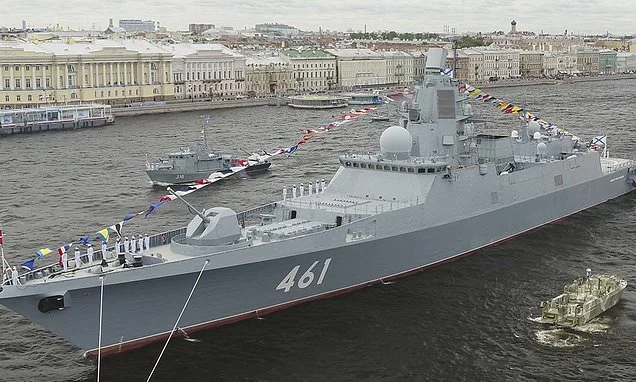
Last week, the Admiral Kasatonov - a frigate fitted with nuclear-capable Zircon hypersonic missiles - was spotted close to Fehmarn, a small tourist island in the Baltic Sea off the northeast coast of Germany.
Its presence in the vital shipping area marks the latest escalation between the Kremlin and Nato and comes only months following Vladimir Putin's threats to seize British and EU ships in response to European operations against Russia's 'shadow fleet' tanker.
Constructed in 2020, the Admiral Kasatonov is among the Russian navy's most advanced vessels, capable of long-range strikes and submarine warfare.
It is the second Russian warship to be spotted in European waters in recent months, after the Admiral Levchenko was redeployed from the Northern Fleet to the Baltic Sea.
It is not known if the vessel remains close to Fehmarn on Monday afternoon; however, a recent US intelligence report warned an attack by Russia on the Western alliance to test its resolve could be launched within weeks.
This is likely to be through a small-scale attack on Poland or a Baltic state.
Speaking last week, Russian President Putin warned the Kremlin was ready to hit back against British and EU ships that aim to seize his vessels.
The Admiral Kasatonov, a Russian warship fitted with nuclear-capable Zircon hypersonic missiles, was spotted close by a German island last week
Fehmarn, a small tourist island in the Baltic Sea, is a vital shipping area
Of ship seizures, he said: 'It's nothing but piracy and robbery.
'If this is done, we will be forced to respond in kind... [Russia can retaliate] in any area where we see it as necessary and appropriate.'
Dmitry Medvedev, the deputy chairman of the Russian national security council, also previously threatened attacks on European ships.
In response to Nato countries in support of Ukraine, Mr Medvedev said: 'Russia has the right to attack any merchant ship belonging to an enemy state, whether in our or neutral waters, if there is sufficient suspicion that it is transporting cargo in the interest of the enemy.'
In June, the first British-led seizure of a Russian vessel occurred after Royal Marines swooped on the Smyrtos off the coast of Dorset.
Video footage released by the Ministry of Defence showed helicopters intercepting the tanker, with heavily armed forces making their way down to the deck, before taking control and checking through paperwork on the bridge.
The National Crime Agency, Britain's law-enforcement body, also boarded the vessel - which was stopped at anchor on suspicion of violating international sanctions.
Writing on X, former Prime Minister Sir Keir Starmer said of the seizure: 'In the early hours of this morning, I directed our Armed Forces to intercept a shadow fleet oil tanker attempting to pass through the English Channel.
Vladimir Putin previously warned the Kremlin was ready to hit back against British and EU ships that aim to seize his vessels
In June, the first British-led seizure of a Russian vessel occurred after Royal Marines swopped the Smyrtos off the coast of Dorset
'This successful operation delivers yet another blow to Russia and reminds those fueling Putin's war in Ukraine that we will not let them hide.
'I want to thank those involved, including our Armed Forces and law enforcement officers who keep this country safe 24 hours a day, 365 days a year.'
Ukrainian President Volodymyr Zelensky praised the UK's 'principled resolve' in the operation, adding it brought 'peace closer'.
At the time, UK officials claimed to have sanctioned almost 600 Russian shadow fleet vessels, however, resolved to harden its position on Moscow by boarding and seizing its ships.
They said: 'Responsible for carrying 75 per cent of Russia's sanctioned oil, the shadow fleet of over 700 vessels provides a critical lifeline for the Kremlin, generating a war fund that supplies missiles and drones targeting innocent Ukrainian civilians and sustaining Russia's illegal war.
'By disrupting the shadow fleet, we and our international partners are directly bearing down on the resources sustaining Russia's aggression in Ukraine and reducing its capacity to threaten security across Europe and beyond.'
Russia's shadow-fleet network has been in operation since February 2022, following the country's invasion of Ukraine - seeing a series of international sanctions imposed on the country.