At the center of almost every large galaxy lies a behemoth: a supermassive black hole. Even our Milky Way contains one, called Sagittarius A*.
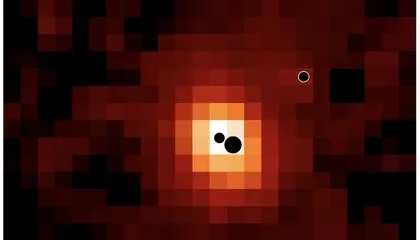
Now, for the first time, astronomers may have spotted an extremely distant galaxy with a whopping three supermassive black holes. The findings, described in the journal Astronomy & Astrophysics on August 12, mark the first time black hole triplets have been seen so soon after the universe began. The discovery offers new clues about how these strange celestial objects grow, particularly how they did it in the ancient cosmos.
“This system is in the very, very early universe,” says Dougal Dobie, an astrophysicist at the University of Sydney in Australia who wasn’t involved in the study, to James Woodford at New Scientist. “So, how have we ended up in a situation where these three supermassive black holes have formed and come close together in only a billion years or so since the Big Bang?”
The researchers behind the new work began their search two years ago. They were hoping to find galaxies from the early universe that contained two black holes, reports Amanda Schupak at the New York Times. That’s because the team wanted to better understand how the objects become bigger. Scientists suspect that black holes typically slowly gain mass by consuming gas, but they can sometimes quickly balloon by merging with one another.
To understand how the latter may have happened soon after the Big Bang some 13.8 billion years ago, the team pointed JWST toward a galaxy called J0148-4214. Identified as an extremely distant object in a previous survey, it’s so far from us that its light took about 12.5 billion years to reach the telescope, meaning the researchers were observing what the galaxy looked like around the dawn of the cosmos.
The data showed that light emissions from the galaxy’s center “had a peculiar shape,” says study co-author Hannah Übler, an astrophysicist at the Max Planck Institute for Extraterrestrial Physics in Germany, to New Scientist.
JWST can see a wide range of wavelengths of light, thanks to an instrument that separates them like a prism. The patterns of light it observed hinted at hydrogen atoms moving so fast their speeds could only be explained by a black hole—although, in this case, the structure looked more like two black holes near each other.
A technique for measuring distances helped the team determine that the galaxy’s heart held two black holes merely 620 light-years apart, which might combine within a few hundred million years. Another black hole sat some 5,500 light-years away from the duo.
Fun fact: Other strange black hole sightings
In July, researchers reported seeing a supermassive black hole more than 30,000 light-years from its host galaxy’s core, offering long-awaited evidence of a “wandering” black hole.
Additionally, “the JWST data allowed us not only to identify the three black holes, but also to estimate their masses, accretion rates and the stellar mass of the galaxy,” says study co-author Giovanni Mazzolari, an astronomer at the Max Planck Institute for Extraterrestrial Physics, in a statement.
The two central black holes have masses of 80 million and 0.6 million suns, the team found, while the farther one contains the mass of two million suns. The largest black hole is accreting, or adding to the surrounding disk of matter that it consumes, at a much slower rate than its much smaller neighbor. What’s more, it seems like the smaller black hole is accreting faster than current theories predict is even possible.
The loner black hole might also one day join the celestial collision, or it may have been flung there as part of an even earlier merger, Julie Comerford, an astrophysicist at the University of Colorado Boulder who was not involved in the study, tells the *Times. *
Overall, the findings shed light on how common black holes may have been—and what they did—at the beginning of the cosmos.
“This discovery shows us that processes in the early universe were efficient at bringing massive black holes together,” Übler tells New Scientist. “It also suggests that black hole merging may have been an additional, fast route for their rapid growth in the early universe.”