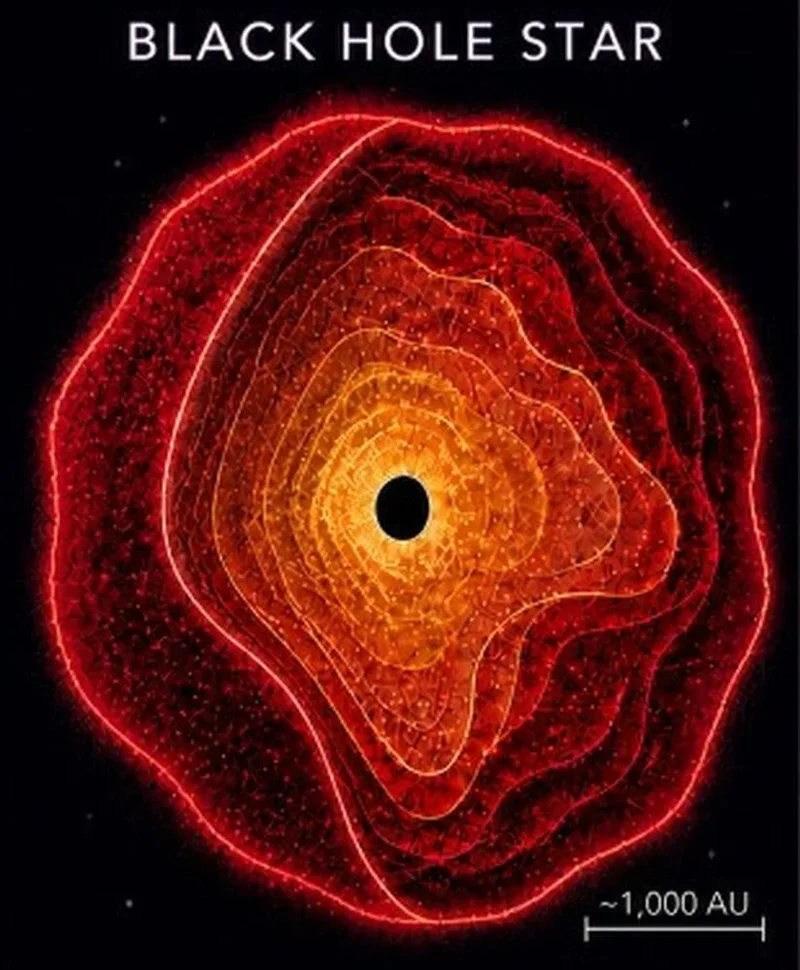
The early Universe's Little Red Dots (LRD) could be the JWST's strangest discovery. LRDs are small, red, astronomical objects that existed between about 600 million and 1.6 billion years after the Big Bang. About 300 have been found, and their surprising discovery challenges our understanding of the early Universe and how galaxies and supermassive black holes (SMBH) formed.
Since their discovery, researchers have been trying to understand what exactly LRD are. Different researchers hypothesized that they could be a type of early AGN holding a SMBH, examples of low-metallicity Population III stars, or some new type of stellar object. But in each of these cases, the evidence didn't line up exactly with observations, leaving questions behind.
New research in Nature suggests that LRDs could be black holes shrouded in dense gas. These early black holes have been dubbed 'black hole stars.' According to the authors, they could explain another of the JWST's puzzling findings: confoundingly massive SMBHs in the very early Universe.
The research is "A gas-enshrouded and gas-reddened black hole at cosmic dawn," and the lead author is Rohan Naidu. Naidu is an assistant professor at the University of Hawaiâiâs Institute for Astronomy.
âSomething spectacular must have happened in the early Universe." - Rohan Naidu, University of Hawai'i.
"The physical processes that led to the formation of billion-solar-mass black holes within the first 700 million years of cosmic time, a period known as cosmic dawn, remain a puzzle," the authors write in their research. "Several theoretical scenarios have been proposed to seed and rapidly grow black holes, but direct observations of these mechanisms remain elusive."
In the local Universe, a SMBH makes up about 0.1â0.5% of the stellar mass in its galaxy. But the JWST found SMBHs that make up 10% to 30% of their galaxy's stellar mass. Either the SMBH mass measurements are wrong somehow, or some unknown mechanism spurred on their growth. One explanation says that some type of heavy seed like a direct-collapse black hole spawned these SMBHs. Other explanations involve super-Eddington accretion.
But a clear answer for these early behemoths, including quasars with one billion solar masses, has been elusive.
âUntil now, we have known very little about how these supermassive black holes formed. In addition, some quasars found in the early Universe seemed far too massive to exist, which led astronomers to call them âproblematic quasars,ââ says Jorryt Matthee, study co-author and assistant professor at the Institute of Science and Technology Austria (ISTA).
âAstronomers have never lacked imagination: since the discovery of quasars, there has been no dearth of theories to explain how these black holes grew so massive so fast,â says Naidu. âSomething spectacular must have happened in the early Universe. Now with JWST, we can directly observe this era and see for ourselves which scenarios actually occur.â
This research centers on MoM-BH*-1, an object that stood out for its striking appearance in the JWST's Ultra Deep Survey (UDS) extragalactic field. It was the reddest source in the field and was singled out for deeper observations in the JWST's âMirage or Miracleâ (MoM) observing program.
This image shows how the black hole star MoM-BH-1 appears to the JWST. It looks like one of the telescope's Little Red Dots, but was singled out for deeper observations because of its extreme redness. Image Credit: NASA, ESA, CSA, STScI, DAWN JWST Archive, PRIMER Survey (PI: James Dunlop); Visualization: Rohan Naidu (University of Hawaiâi)*
âThe Mirage or Miracle survey was designed specifically to target sources considered ârisky,â meaning they could either be amazing discoveries or just interlopers, such as some cold nearby stars that look like distant galaxies," Matthee said. "The survey also yielded the most distant galaxy ever confirmed, MoM-z14.â
Scientists have wondered if LRDs could be overmassive or enshrouded black holes, but the evidence has been mostly circumstantial. This work presents what the authors say is a spectroscopic signal supporting the idea.
"Here we present a source 660 million years after the Big Bang that exhibits singular properties: among the largest hydrogen Balmer breaks reported at any redshift, broad multi-peaked Hβ emission, and Balmer line absorption in several transitions," the authors write.
Balmer breaks and Balmer line absorptions show up in spectroscopy and tell astronomers how hydrogen is behaving. They're critical diagnostics for understanding things like stellar atmospheres, star formation histories, and how old galaxies are. Combined with Hβ emissions, they paint a picture of a new kind of object.
âThe break we observed in this object is the deepest break we have ever observed in any object, ruling out âordinaryâ stars as the source,â Naidu said. âBut it made us wonder if we were seeing a new kind of âstellar atmosphere,â but on a spectacular scale.â
This image shows spectroscopy from the nearby star Vega (left) and from MoM-BH-1 (right). The Balmer break is labelled in each panel. "Black Hole Stars (right) display star-like features such as Balmer breaks. These features are imprinted by their shrouds of dense gas that are in some ways analogous to the outer layers and winds of stars," the authors explain. But in other respects, these black hole stars are extreme. "MoM-BH-1 shows one of the deepest Balmer breaks ever observed (a ~7.7x drop in light across the Balmer break compared to ~2.6x for Vega)," the researchers write. This supports the idea that LRDs are actually SMBH surrounded by a gaseous envelope instead of a dusty accretion disk. Image Credit: Naidu et al. 2026. Nature.
âWhen we see something very red in the universe, we often assume that it is surrounded by dust, like soot or ash,â explained co-author Robert Simcoe from MIT. âThe same way that the wildfire smoke from Canada recently made the sky in Boston look bright red, astronomical objects can also appear redder than their intrinsic color when you see them through a veil of dust.â
The overall spectroscopic pattern shows that the light from the object is interacting not with just a dusty accretion disk, but with an enveloping cocoon of hydrogen. So instead of the light reddening because of dust, gas is responsible. It also supports the idea presented by other researchers that the Universe's early SMBH grew so large because of super-Eddington accretion.
âWe started to ask: Could you make something that red using just hydrogen, without any dust?â Simcoe said. âTo our surprise, it turns out you can, if you have an extremely dense screen of hydrogen, so dense that it looks more like the surface of an enormous star than a wispy interstellar nebula.â
This led to the term "black hole star." The light is coming from the black hole accreting material. But instead of the light passing through a dusty accretion disk, it's passing through a cloud of hydrogen.
The sheer amount of light also shows that it can't come from stellar fusion. âYou have something that looks a bit like a star but is 100 billion times brighter,â Naidu said. âThat means you canât be powering this by nuclear fusion, which is the energy source that sits at the heart of all the stars we have.â
But black holes can emit this much light. In fact, astronomers routinely find SMBH emitting this much light. In this case, the SMBH is about 100,000 times more massive than the Sun.
"We model this source as an enshrouded black hole in which the Balmer break and absorption features are a result of extremely dense, turbulent gas forming a dust-free envelope around a supermassive black hole," the researchers write. "This source may provide evidence of an early black hole embedded in dense gasâa theoretical configuration proposed to rapidly grow black holes by super-Eddington accretion."
The Eddington limit describes the maximum luminosity of an astronomical object when its outward radiative force is in balance with its inward gravitational pull. This puts a limit on its accretion rate. When the limit is exceeded, a star will emit a powerful stellar wind from its outer layers. Super-Eddington accretion is when an object breaks this theoretical maximum accretion limit.
âWe modeled MoM-BH*-1 as a miniature supermassive black hole in the earliest phases of its evolution, enshrouded by extremely dense, turbulent gas that forms a dust-free envelope around it,â says Naidu. âTheoretical models have already predicted that early black holes embedded in dense gas can grow rapidly through what is called super-Eddington accretion.â
This figure compares a star, a black hole accretion disk, and a black hole star. The JWST's Little Red Dots may be what astronomers are calling black hole stars. They're early SMBH surrounded by gas rather than an accretion disk. LRDs may be red because their light is travelling through a thick dusty envelope instead of a dusty disk. Image Credit: Rohan Naidu (University of Hawaiâi)
This research also shows that scientists may have been overestimating the mass of the LRDs.
MoM-BH-1 is pretty close to another, brighter galaxy, and the pair will probably merge within about 100 million years. The researchers took the spectra from both and superimposed them, and their combined spectra is a close match for the spectra from LRDs. âIf embedded in similar host galaxies, black hole stars like MoM-BH-1 might well serve as the central engines of baby quasars. Considering the black hole star as a template for the black hole component of little red dots helps clarify many of the uncertainties about them,â says Matthee.
"The redness of the black hole is due to gas, not dust, and scattering, not kinematics, gives rise to the complex line shapes and luminositiesâblack hole masses of these sources may therefore be overestimated by orders of magnitude," the authors write.
In the past couple of years, researchers have published hundreds of papers on LRDs, each one contributing to the effort to understand them. Has this one nailed it? It's too soon to conclude. First, we need more observations of similar objects that can be explained the same way.
In any case, the discovery of LRDs and the ongoing effort to explain them has energized the research community. "These are incredibly exciting times with nearly a thousand papers and preprints on little red dots in the past two to three years," Matthee said.
âEvery little red dot is consistent with being a black hole star, embedded in a generic early galaxy,â Naidu said. âBut what is special about MoM-BH*-1 is, the black hole star is essentially completely outshining its surrounding host galaxy, such that weâre seeing pure black hole star light.â