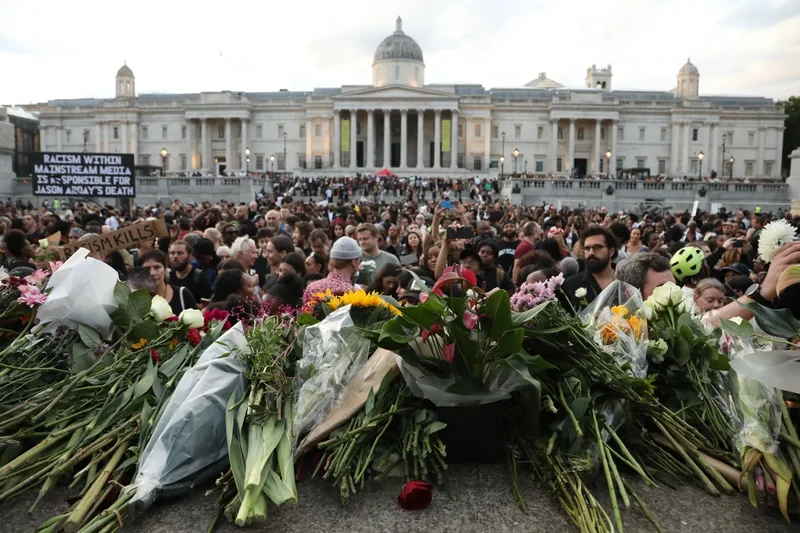
Thousands are standing in Trafalgar Square holding flowers, dressed in black and carrying placards. “Rest in Power Professor Jason Arday,” read the majority, while others quote Arday himself: “I would take a thread and a needle and I'd interweave love into our society” - something the professor himself previously said when asked how he would change the world.
They have gathered in memory of Jason Arday, 41, who was found dead in Battersea, south London, on Friday.
Prof Arday, who became Cambridge University’s youngest Black professor in 2023, resigned from his post as professor of sociology last week after accusations of plagiarism were made against him.
Despite being cleared of any wrongdoing by an investigation at Liverpool John Moores University, Prof Arday came under intense media scrutiny, in what Cambridge University’s chancellor, Lord Chris Smith, called a “racist feeding frenzy”.
His family said he was “subjected to a campaign of sustained abuse” adding “the campaign of misinformation was too much for Jason, who was a gentle man and who always wanted to see the best in everyone.”
“This wouldn’t have happened to a white academic,” says a voice in the crowd, creating a ripple of murmurs in agreement.
The thousands here to support Prof Arday on a Monday evening, just 72 hours after his death, are representative of London - diverse in terms of race, age and background. There are families, young children, elderly people, those who knew Prof Arday, and those who have travelled for miles to stand in support at the vigil organised by the group Stand Up to Racism.
“I didn't know him, I never met him, but I almost feel a responsibility - what could I have done differently?” says the Reverend Brunel Jones, a former Cambridge graduate from Yorkshire whose son is also now studying at the university. He’s standing next to a Muslim man holding a sign reading: “Racism within mainstream media is responsible for Jason Arday’s death.”
“I’m just so sad because nobody deserves to be in this situation,” says Reverend Jones. “It just makes you feel what could we have done… There doesn’t seem to be any limit or decency to some people’s behaviour and irresponsibility. I just pray that somehow people will take some sense of caution and responsibility because we’re all responsible for one another.”
Sadness is the main feeling in the air at the vigil - but there is also anger. When MP Diane Abbott takes the stage to talk about the media hounding Arday to his death, the crowd roars in support.
She points out that 249 articles about Arday were written in the press in the last three weeks, while Lord Simon Woolley, principal of Homerton College at Cambridge and Arday’s friend, shocked the crowd into silence when he said what Arday told him last week: “They hounded me to death and I cannot see a way out."
Anger underlies the grief at the vigil. “I’d rather not talk to journalists,” is the main response from attendees I approach - while others are more explicit with their anger.
Weyman Bennett, co-convenor of Stand Up to Racism, addressed this directly when he introduced the event saying: “We are here to honour Jason’s life and his legacy and stand together united against racism he faced.
“This is not a demonstration; it’s a vigil. I understand we’re angry, we’re distraught, but we have to remember why we are here.”
Thousands nodded together. “We’re just here to support,” says one woman. While Anda Okondu, 37, who works in cybersecurity for the government, adds: “For me personally, as someone who is trying to have a family in this country, knowing that my nephew has just graduated from Birmingham University with a first class degree, I’m shocked to hear that this is the scenario outcome, regardless of whether he was guilty or innocent of the accusations of plagiarism. That’s why I’m here.”
One South Asian woman stood at the front with her children aged eight and ten, clutching flowers. “I’ve educated my children about this and tried to tell them about it in a way they understand,” she explains.
“We’ve come down in support like everyone here, but where was the support then? Why does it have to be that someone has to lose a life and only then we acknowledge things could have been done better?”
Everyone falls silent when Bell Ribeiro-Addy, Arday’s MP, reads out a statement from his family, describing their love for Arday, and their hopes now.
“Above all, we wish for Jason to be remembered for the wonderful person he was and all that he achieved. A selfless and gentle soul, he tirelessly uplifted others through his words and actions. His achievements were great and we do not want misrepresentations about his character to overshadow them.”
Despite the tensions and obvious anger, the focus above all is, as his family hoped, on Arday himself.
Photographer and activist Misan Harriman, who was with Arday just days ago, says: “The grace of this man, the kindness to give space even in the hardest time of his life, is something I will never forget.”
Tears are shed, with people handing tissues to strangers around them, during the speeches. And the crowd comes together to chant in unison: “I am Jason Arday. We will stand strong and we will win. We will ensure your memory will live on.”
The vigil ends with Arday’s words, shared by his family: “Every human life has a purpose. Imagine what might happen if we're all united in the just cause of valuing human beings equally. Then maybe, just maybe, all kinds of great things might be possible.”