Look, Iâm going to give it to you straight here. This game starts with cult stuff. I love cult stuff; those dancing lunatics with their uniform robes and a deep, starry-eyed belief that doing the worst, most despicable evil is a Good Idea? Yes. Give it to me. You get a little fanaticism, a touch of murder, almost always some weird cosmic comeuppance, and then the nagging feeling that something even worse than these guys is at play here. Mortal Shell II starts like this, almost as if signposting to people that are hopelessly devoted to this kind of experienceâyou might say the cultlike Souls crowdâthat they are in the right place.
And folks, not for nothing, but this isnât even the only cult in the game.
Review writing can be funny. In general, building out an argument about why someone should or shouldnât play a game has to have a thesis, or at least a unifying theory. I was not expecting to have one from the second I started playing Mortal Shell II. Try as I might, I cannot shake this one unifying thought: Mortal Shell II is the most metal video game I have ever played.
I donât mean âha ha dark fantasy is metal there are always skeletons someoneâs getting impaled itâs like an album coverâ metal. I mean, this is fucking metal metal. Proof? Look at this, for Godâs sake:
And this:
And Jesus Christ:
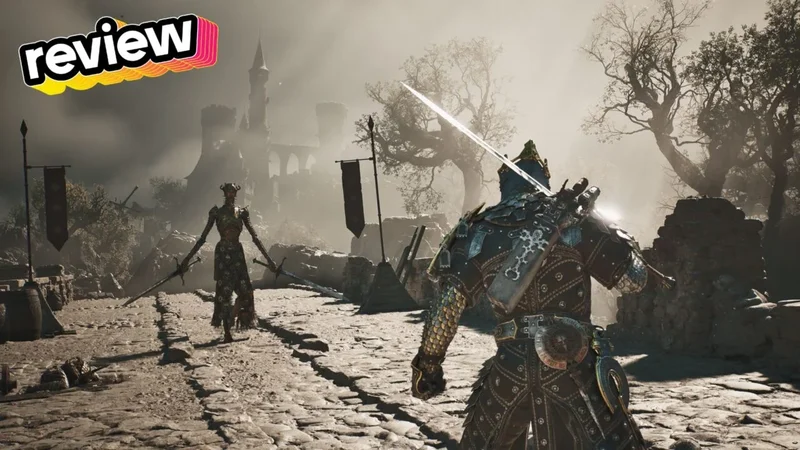
Every frame of animation in this game was made with the painterly hands of a person that desperately wants it to be cloudy above their abandoned 19th-century mansion all the time. It is a game that demands to be played in a dark room, large candles lit, in stark silence while a thunderstorm raging with a biblical fury rattles the foundation of the dilapidated church you might be playing it within.
In a crowded field of Soulslikes, a genre often obsessively dour, Mortal Shell II dares to ask the question of âwhat if this, but way moreâ when it comes to an ever-present sense of creeping evil. The sequel to developer Cold Symmetryâs 2020 release Mortal Shell, this game shares with its predecessor the core hook of shells; essentially character classes with unique abilities that can be swapped out at each rest location. While the first Mortal Shellâs biggest strength was in how tight and compact it was, the sequel is a much more sprawling game, with plenty to see and uncover throughout an open environment littered with weapons, small dungeons, and Tarstones that augment your character, giving you options for different character builds.
Mortal Shell II, also like its predecessor, is a game in the proud tradition of such sunny affairs as the Blasphemous series, which takes itself so heart-attack serious that it borders on comedy. I mean this as a compliment. Thereâs plenty to love about, you know, playing Mortal Shell II, but the mood of this game? It drips, with all the viscosity of blood. And I am buying everything that it is selling, the drippy viscosity of it all. I cannot get this out of my head. There will be times that youâll think, damn, Mortal Shell II. Pump the breaks a bit. Mortal Shell II will tell you to eat shit. There are no brakes. There are only double bass kick drums. Glance out at the vistas of this world and youâll drink in a hellscape straight out of a Wayne Barlowe painting. I couldnât get enough of just looking around. Killing monsters? Finding new weapons and shells? Stumbling into another minor boss fight in yet another bespoke mini-dungeon? Absolutely. These are the things that drive me, because I love exploring these places.
- Back-of-the-box quote: âThe lute, the lute, the lute is on fire.â
- Developer: Cold Symmetry
- Type of Game: Third-person doom metal Soulslike
-
Liked: Hilariously eerie tone, great spacing and pace of combat, exploration is very satisfying
-
Disliked: Scarcity of upgrade materials and currency made character builds restricting and grindy, occasionally getting stuck in the environment super sucks
- Platforms: PS5, Xbox Series X/S, PC (Played)
- Release Date: Preorder early access starts August 17
- Played: 40 hours. Completed the main campaign and several dozen dungeons, found all the shells but missed a couple of weapons. Dinked around in Night (Hard) mode, but played the campaign in normal conditions.
Your goal is essentially to collect a series of MacGuffins which will unlock endgame activities, but thatâs not the joy of an experience like this. That lies in wondering if you should head up a hillside to fight it out with a snail who has a bell on its back, or take that weird warp over to the black-robed lady with a couple of knives in her hands. This is a densely packed game, and with very little offered in terms of clear direction as to what might be found where, my lingering questions about what the knife lady might be defending or what might be behind Mr. Snail is why I will run this whole experience again until I have all of those answers for myself.
Nearly every checkpoint has a small dungeon attached to it, with plenty more peppering the landscape. I found that the best of these werenât simply skill checks, but fun little brain teasers that often hid extra goodies like forging materials and experience point dumps as rewards for my thorough searching. I like basking in how smart I am as much as I like cackling at the screen for how well I kill things. Both things can be true.Â
But those skill checks are there, of course. Games in the loose Soulslike subgenre are bound to a certain reputation. Thankfully, for people who find such demanding, often parry-heavy combat unpalatable, developer Cold Symmetry offers a few elegant solutions. First is an item found very early in the game, the Slayer Seal, a defensive implement that augments your abilities to, among other things, deal more stagger damage to enemies for special attacks that will also heal you, which none of the other shields will. This is a well-implemented way to offer an âeasy modeâ for this game because, while youâre enjoying buffs only applied to this specific object, you still have to engage with combat on the gameâs terms.
And then thereâs the combat itself, which introduces what is perhaps Mortal Shell IIâs most controversial design decision: The elimination of the Souls-standard stamina meter. In Mortal Shell II, you can attack, run, and dodge with impunity. In the early phases, this meant that I could overwhelm smaller enemies as long as I could plant well-timed attacks before they got to me first, like an elaborate game of catch. I admit that I turned my nose up at this. Taking away one of the key design tenets of the genre felt like backward thinking. Over time, and after many hundreds of enemy encounters and tinkering with character builds, I came around to the weightiness of the game, how movement and spacing were more important than managing yet another meter onscreen. Do I want this abolished in games like this forever? Not a chance. But for Mortal Shell IIâs lumbering protagonist, it is the right decision.Â
And this kind of combat, coupled with the variety of abilities afforded by the shells you occupy and the weapons and personal augmentation items that are practically everywhere in this game, means Mortal Shell II pulls off the neat trick of straddling the line between Soulslike combat and that found in other, arguably more traditional action games. This isnât to say that the game will change into something of the more high-flying, combo-heavy variety on a dime, but there was a point near the endgame when I sussed out the right set of abilities and weapons to practically musou through the environment. Pretty satisfying.
This is gamey stuff. Youâll notice that I didnât get deep into the minutiae of character builds, finite special items, boss encounters and the like. To be sure, there are people on the internet right now preparing you for these things if that is what is most important to you. What I can say is that there is a robustness to character building that is not found in the linear, predictable increases to your statistics as you level up. That each shell has varied skill trees that unlock alongside sometimes satisfying, sometimes shrugworthy narrative beats. That I found this game perhaps less challenging overall than others in this genre (though this will likely be balanced and adjusted over time with patches). That you can crank the game up to a harder difficulty mode if things get a little too easy (and with additional content within). That both money and upgrade materials for your Tarstones felt way too scant by the midgame, such that I had to force myself to grind enemies for cash.Â
And yet these things, cool as they are, are not why you should play this game. You should play Mortal Shell II because it might, before your very blistered eyes, be conjuring something from a nether dimension with too many consonants to feasibly pronounce. The reward for the experience is the experience itself, and thereâs a sense of place, tone, and presence in this game that I cannot get enough of. The cult is satisfied.