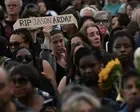
Tens of thousands of people gathered in Trafalgar Square in London to remember and pay tribute to Jason Arday, the former Cambridge professor who died on Friday.
Stand Up to Racism, which organised the vigil, estimated that 30,000 mourners had gathered in the square to listen to emotional speeches from MPs, friends and campaigners on Arday’s life and legacy and join in a minute’s silence. Many were dressed in black and held flowers, which they were asked to leave beneath Nelson’s column. People also carried placards reading “rest in power”.
Arday, 41, was pronounced dead after emergency services were called to his home in south London on Friday. He had just resigned from his role as professor of sociology of education at Cambridge, after widespread scrutiny over accusations of plagiarism, which he rejected, and inconsistencies in statements about his career and achievements.
Opening the event, Bell Ribeiro-Addy, the local MP for Arday’s family in Clapham and Brixton Hill, said: “I’m going to look around you and look at how many people have come tonight.
“That tells you what Jason meant. He held doors open behind him. He kept them open and thousands of us walked through. That is why this place is full tonight. And I know that all of you are grieving. I know there are many people that aren’t even here.”
Ribeiro-Addy asked that people respect the privacy of Arday’s family, who “lost their son, their brother. Not a professor, not a headline, not a symbol.” She asked that they be given “time, space and quiet” to grieve.
She concluded the vigil by reading out a statement from Arday’s family. They said: “The public cruelty Jason was subjected to was too much for any man to bear. The outpouring of love, support, and grief since his death means so much to us. Although it is bittersweet now, kindness is needed in life, not just in death.”
Many speeches focused on the role of the media in Arday’s death. Diane Abbott, MP for Hackney North and Stoke Newington, said there had been 249 articles about him within three weeks. “He must have felt that if he resigned, the attacks on him would stop. But in fact, they got even worse,” she said. “This is a vicious campaign.”
The British singer Beverley Knight performed her song Keep This Fire Burning and Jermain Jackman, who won The Voice in 2014, performed a cover of Coldplay’s Fix You, requested by Arday’s family. The MPs Zack Polanski and Jeremy Corbyn were also in attendance.
Simon Woolley, who was a mentor to Arday at Cambridge, said that when he had seen Arday shortly before his death, “we knew Jason was suffering” and feeling “hounded”, and he had hugged him. “We told him he was loved,” Woolley said.
Remembering Arday as a “wonderful man [who] never stole a bag of crisps”, he urged that there “be some reckoning” after Arday’s death.
Windrush campaigner Patrick Vernon said the evening was the time to “pay our respects and to stand in solidarity with his grieving family”. “Let’s remember his life, his scholarship, his achievements, his determination and his humanity and the people that he inspired,” he said.
But he added that it would be important to reflect on the role of “racism, institutional responsibility, accountability and the treatment of black families and black men” in Arday’s death, as well as why the “duty of care” to an autistic man known to be vulnerable had failed, potentially through a public inquiry.
Samira Ali, an organiser at Stand Up to Racism, read out a statement from a close friend and colleague of Arday, which said: “Prof Jason, the words kind, beautiful and gentle seem to orbit so many dedications to him and they are not wrong. But in truth, words will never quite capture the type of person Prof Jason was or what he meant to people.”
The statement referenced Arday’s work setting up mentoring schemes and mental health support for students and academics of colour. It said: “He worked tirelessly to inspire all students from marginalised backgrounds to believe that academia could also belong to them. He did not inspire one or two people to do a PhD; there are dozens of us over generations who have dreamed and are now doctors and soon-to-be professors because of him.”