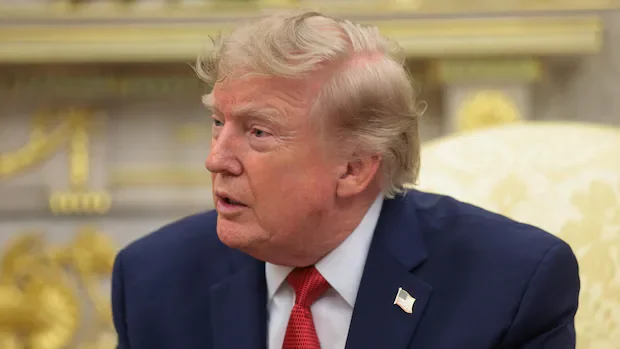
Trump threatens to bomb Oman if it 'gets in the way' with Iran
Not the first time that Trump has threatened Oman during the current Iran conflict
U.S. President Donald Trump has again threatened Oman as Iran says it is working with the Gulf Arab country on a plan to manage shipping through the Strait of Hormuz. Fully reopening the waterway has been a key U.S. demand.
Meanwhile, the 60-day negotiating period to find a peace deal between the United States and Iran was expiring, with no word of an extension and both sides seemingly as far apart as they were at the start.
Here's a look at the latest developments Monday in the Iran war.
Iran nearing deal with Oman
Iran said it has reached an agreement with Oman over a plan for ships to transit the Strait of Hormuz, which runs between the two countries, and they are now working to finalize details for a joint statement.
Iranian Foreign Ministry spokesperson Esmail Baghaei told reporters in Tehran, Iran's capital, that "an understanding has been reached regarding the map of the transit route."
He did not elaborate, but details that have previously emerged suggest the deal would reopen the strait with ships entering through a route close to Iran and exiting through a route close to Oman. Ships would transit without paying fees or tolls during an interim period.
The U.S. has sought an acceptable deal on opening the strait before ending its blockade of Iranian ports.
Iran effectively closed the strait — through which roughly one-fifth of the world's traded oil supplies passed before the war — after Israel and the U.S. attacked the country on Feb. 28.
Baghaei conceded the talks with Oman have gone slowly, "but we had planned, and still plan, to finalize the understanding in the form of a package: the map plus a joint statement."
Previous Trump threat against Oman
Trump told Fox News reporter Trey Yingst that the U.S. would bomb Oman if it "gets in the way," using an expletive for emphasis.
Fox News did not provide audio of the interview.
This is not the first time that Trump has threatened Oman. In May, he told reporters during a Cabinet meeting that "Oman will behave just like everybody else, or we will have to blow them up."
Trump also said the expiration of the 60-day deadline on talks to end the war was irrelevant and said there was no timeline, Yingst said. Trump said the U.S. has a back channel for talks with the Islamic Revolutionary Guard Corps, Yingst added.
Houthi rebels claim attacks
Yemen's Iran-backed Houthi rebels claimed that they attacked a ship and four military boats on Monday in the Red Sea off the Yemeni city of Mokha, near the strategic Bab el-Mandab Strait.
WATCH | Trump responds to reports of U.S. military running low on munitions:The rebels fired a number of ballistic missiles at the vessels, resulting in the capsizing and burning of the boats, Yahya Saree, a military spokesman for the Houthis, said in a statement.
The rebels claimed that the vessels belonged to Saudi Arabia, without providing evidence. There was no immediate comment from Saudi Arabia, and The Associated Press could not independently verify the Houthi claim.
Saree also said the rebels launched a drone attack on government forces in the central province of Marib.
Drone attacks target Iraqi officials
Two officials in northern Iraq were targeted in drone attacks that the regional counterterrorism service said were launched from the border with Iran.
One was fired at the office of Masrour Barzani, prime minister of Iraq's semi-autonomous northern Kurdish region, and the other targeted the home of a top regional intelligence official, the counterterrorism service said.
There were no casualties. There was no immediate claim of responsibility.
Since the beginning of the U.S. and Israel-Iran war, Iran and Iranian-backed Iraqi militant groups have launched regular attacks on U.S. military and diplomatic facilities in Iraq and on bases of exiled Iranian Kurdish dissident groups, but Monday's direct attack on regional government buildings was unusual.
Barzani on X called the attack "a dangerous escalation and a direct threat to the security and stability of the Kurdistan Region."
U.S. forces currently stationed in the Kurdish region of Iraq have begun withdrawing ahead of a Sept. 30 deadline agreed upon between Washington and Baghdad to end the U.S. military presence in Iraq.