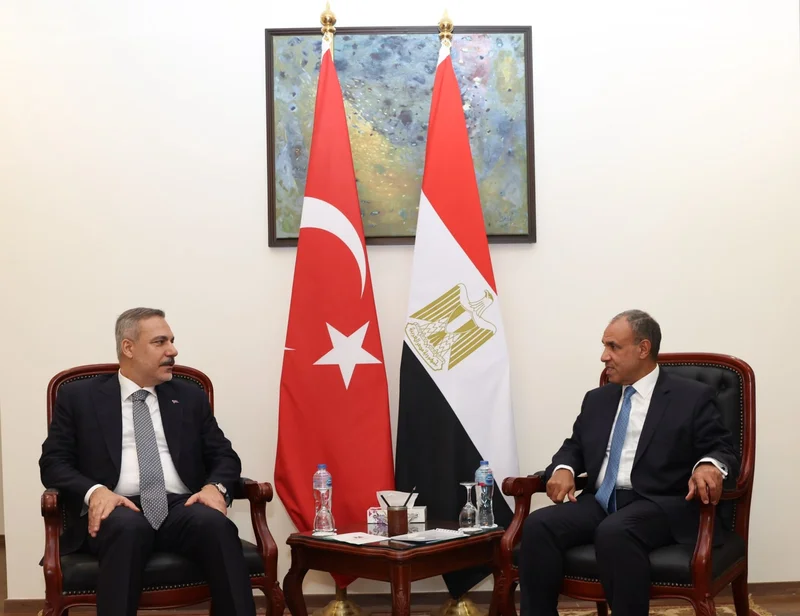
Foreign Minister Hakan Fidan’s remarks in recent days can be regarded as one of the strongest warnings Türkiye has delivered to Israel to date. Fidan warned Israel not to undermine the Gaza agreement, stating that Türkiye, Qatar and Egypt could take “radical measures” if Israel attempts to derail the agreement. His remarks offer an important indication of how Ankara intends to approach the Gaza issue in the period ahead.
The key question is how Israel will interpret this message. Fidan’s statement was not simply a unilateral political warning from Türkiye. It made clear that Türkiye could act in coordination with Qatar and Egypt, and that the measures he referred to should not be viewed solely through a political or diplomatic lens, they could also have a military dimension.
A similar debate emerged following the signing of the Mecca Joint Defense Alliance. The fact that Türkiye, Saudi Arabia and Pakistan joined the alliance, while Qatar and Egypt were not among its signatories, was questioned by various circles. Some even sought to portray this as evidence that the Islamic world remains divided and unable to act collectively in response to regional challenges.
Some voices in Israel, in particular, questioned whether the alliance was truly a reliable one. They asked why five countries that broadly share common positions on Gaza, have similar concerns about developments in Syria, and have faced Iranian attacks or share concerns about Iran’s regional military activities were not all part of the same alliance. Differences between Türkiye, Saudi Arabia, Pakistan, Qatar and Egypt were presented as a problem for the wider Islamic world.
Yet it would be misleading to assess the regional picture simply by asking which countries belong to which alliance. Regional actors can cooperate through different platforms, with different instruments and within different security frameworks.
Against this backdrop, Fidan’s meeting in Cairo with his Egyptian counterpart was particularly significant. Even more noteworthy was the participation later that evening of Saudi Foreign Minister Faisal bin Farhan, followed by a photograph of the three officials together at dinner. The image conveyed a broader message to the Islamic world: The fact that Qatar and Egypt are not currently members of the "Mecca alliance" does not mean they are acting separately from the signatories on regional issues.
On the one hand, Türkiye is developing a new defense mechanism with Saudi Arabia and Pakistan. On the other hand, it is strengthening its political and diplomatic coordination with Qatar and Egypt over Gaza. If these two tracks increasingly converge, they could create a much more substantial regional deterrent vis-a-vis Israel. Türkiye’s recent moves across the region should also be viewed in this broader context.
President Recep Tayyip Erdoğan’s offer to provide military support to Lebanon, Türkiye’s military capabilities and presence in Syria, and recent reports concerning the possible establishment of a military base in the Saudi city of Tabuk all point to Ankara’s increasingly active role in the region’s security architecture.
Tabuk is particularly important. Located in northwestern Saudi Arabia, Tabuk is approximately 400-500 kilometers (250-310 miles) from Israel. If Türkiye and Pakistan were to establish a military presence there, make use of existing Saudi military facilities, or develop a joint military structure, the implications would extend beyond Saudi Arabia’s own defense. Such a presence could also become an important element of regional deterrence against Israel. The combination of Türkiye’s military capabilities, Pakistan’s military strength, and Saudi Arabia’s strategic position could force Israel to reconsider its military calculations in the region.
The possibility of Egypt joining the Mecca alliance is also highly significant. Egypt is directly involved in the Palestinian issue, particularly because of its geographical proximity to Gaza and its control of the Rafah border crossing. The improvement in Turkish-Egyptian relations in recent years, together with growing coordination between the two countries over Gaza, raises the possibility of new forms of cooperation in defense and security as well.
Should Egypt eventually join the Mecca alliance, the regional equation could shift considerably by bringing together its military capabilities with those of the other signatories within a common security framework. If Qatar is also included, leveraging its political and diplomatic influence could help create a broader regional deterrence structure.
It is precisely in this context that Fidan’s reference to “radical measures” should be understood.
The issue is not limited to diplomatic pressure. If Israel were to undermine the Gaza agreement, resume attacks on Hamas, or continue its military operations in Gaza and the West Bank, Türkiye, Qatar and Egypt could respond not only through political and diplomatic means but also by strengthening regional military deterrence and taking concrete military steps.
For Türkiye, the issue is therefore no longer simply a matter of condemning developments in Gaza through diplomatic channels. Ankara is entering a period in which its military capabilities, diplomatic partnerships and defense alliances can potentially be brought together as instruments of regional policy. Therefore, it would be a mistake to view the Mecca alliance simply as a defense agreement between three countries. It could become the military pillar of a broader regional security architecture.
Fidan’s remarks can be regarded as one of the strongest warnings Türkiye has delivered to Israel in recent years. How Israel interprets this warning, and how it chooses to act regarding the Gaza agreement, could prove decisive, not only for Gaza, but for the wider security balance of the Middle East.