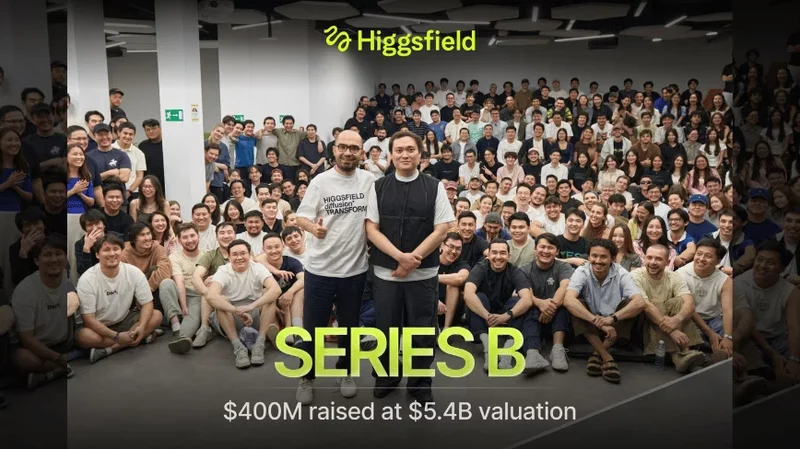
Higgsfield has raised $400mn at a $5.4bn valuation. DST Global led the round. Goldman Sachs, Intel Capital, and Liberty Global Tech Ventures all took part, alongside Tribe Capital, Smash Capital, Fifth Wall, Valor Capital, Mirae Asset Capital, and NTT DOCOMO Ventures.
The company was valued at $1.3bn in January. That is roughly four times higher in eight months.
We reported in July that Higgsfield was in talks at $5bn. It closed above that.
The number that matters is not the valuation
Higgsfield says its annualised revenue reached $700mn this month. A year earlier the figure was about $20mn.
Read that carefully, because it is a run rate rather than booked annual revenue. It takes current performance and extrapolates forward. A company growing this fast will flatter itself by that measure, and a company that stalls will look worse than its accounts.
Even so, the direction is not in doubt. At $5.4bn against a $700mn run rate, the multiple is under eight. By the standards of AI valuations in 2026, that is restrained.
Consumer to enterprise, again
The Higgsfield Series B is really a story about who is paying. In January, business customers accounted for less than a quarter of revenue. Most of it now comes from businesses.
“The new funding will help us accelerate our move upmarket,” founder Alex Mashrabov told the Financial Times.
That crossover should look familiar. OpenAI told shareholders this month that its enterprise revenue had overtaken consumer. Two AI companies of very different sizes crossed the same line within weeks of each other.
Higgsfield now says it serves 390 of the Fortune 500. When we covered its enterprise agents in June, the claim was 78% of the Fortune 500. Those are the same number, stated two ways.
What the money is actually buying
The detail worth holding onto is not the round. It is what customers do with the product.
Since May, Mashrabov says, brands including Dollar Shave Club have been building systems that generate several marketing videos a day. Not one asset per campaign. Several a day, continuously.
Reuters lists the tools behind it: Soul 2.0 for image generation, and Keyframes for storyboards. Global users have doubled since January.
Mashrabov is explicit about what this displaces. Social media teams are using the tools to keep up with the churn of online content while reducing their reliance on expensive creative agencies.
That is the business underneath the valuation. An agency retainer is a recurring cost that a subscription can replace, and the people who lose that work are not in the press release.
It also runs a free training programme, Higgsfield Academy, which it says has drawn more than 400,000 course visitors and 67,000 completed lessons. Teaching people to use a tool is cheaper than selling it to them.
The cap table is doing work
Look at who bought in. Intel Capital sells compute. Liberty Global Tech Ventures and NTT DOCOMO Ventures sell connectivity and distribution. Smash Capital was co-founded by Kevin Mayer, formerly of Disney, which puts media on the register too.
Higgsfield describes these as strategic investments spanning compute, connectivity, distribution, media, and advertising. That is a company buying its supply chain and its route to market at the same time as it raises cash.
Accel, Menlo Ventures, and GFT Ventures all followed on. So did Natalia Vodianova Arnault, the model and investor, who joins as an adviser.
The founder, and where he built it
Mashrabov ran generative AI at Snap. Before that he co-founded AI Factory, the computer vision company behind Snapchat’s face filters and Cameos, which Snap bought in 2019.
“At Snapchat, the face filters I built were primarily used by teenagers for entertainment,” he told the FT. He said the company is now changing how larger businesses run marketing campaigns.
The platform launched in 2025 and has passed 30 million users across 238 countries and territories. The United States is its largest market. Co-founder and chief technology officer Yerzat Dulat is running a STEM programme across eight rural schools in Central Asia, which is a reminder that this is not a Palo Alto story by origin.
Three things that could go wrong
Compute is the first, and Mashrabov named it himself. He told the FT that compute is scarce, and that part of the raise will fund reservations so the service holds up. That is a cost line which grows with success.
The second is the layer Higgsfield occupies. It builds on models it does not own. Our own reporting found that China quietly won AI video at the model level, which leaves application companies dependent on whoever is cheapest and best that quarter.
The third is the reception. Higgsfield has supported AI-generated films, and that has unsettled parts of Hollywood worried about creative jobs. A company selling faster, cheaper video production to brands is selling the same thing that makes an industry nervous.
The market they are betting on
Goldman Sachs reckons the creator economy covers about 50 million people, and could grow from $250bn in 2023 to $480bn by 2027. Global digital advertising spending is forecast to reach $1.1tn by 2030.
Those are the numbers that make a $5.4bn valuation look small rather than large. They are also forecasts, and forecasts are how AI rounds get priced.
The test is narrower than the market size. Higgsfield says users of its agentic products grew 42-fold in three months after a launch in May, generating more than 20 million pieces of content a month. If those customers are still there in a year, the run rate becomes revenue. If the churn shows up first, $700mn was a peak rather than a floor.
Get the TNW newsletter
Get the most important tech news in your inbox each week.