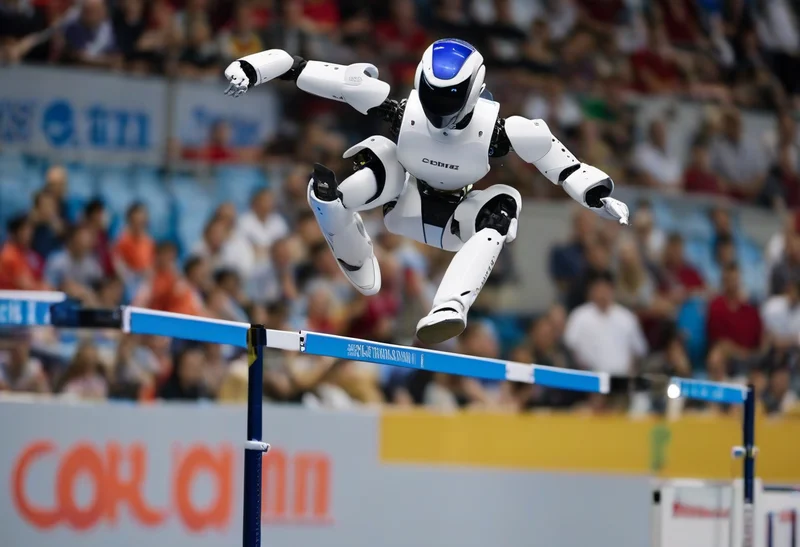
A position paper by Google DeepMind researcher Tom Zahavy, LLMs can't jump, makes a specific claim about the limits of current AI: models are good at induction (finding patterns in data), increasingly good at deduction (formal logic and proof), and bad at abduction — proposing a genuinely new explanation for a phenomenon, often before there's much data to explain it (OpenReview).
Abduction is the part that matters for scientific breakthroughs. It's the move where someone posits an unobserved cause: germs, continental drift, curved spacetime. The paper's argument is that LLMs can't do this because they have no embodied experience of the physical world. A model that has never fallen, never held a weight, never watched an object accelerate has no grounded intuition to draw on. It manipulates symbols about the world without ever having been in it.
I think the paper is probably right about the limitation. I think it's asking the wrong question about what follows from it.
Einstein didn't work in a vacuum either
The standard version of the story has Einstein producing relativity through isolated insight. The historical record is messier and more interesting.
From 1902 to 1909, Einstein worked at the Swiss Patent Office in Bern, reviewing applications for electromechanical devices — including a steady stream of patents on synchronizing clocks across distances, a live commercial problem at the time given railway timetables and telegraph networks. Historians of science, notably Peter Galison, have argued that this exposure was not incidental to special relativity. The central thought experiment of the 1905 paper is about how two distant clocks can be said to read the same time. That was, quite literally, Einstein's day job.
How much the patent work caused the theory is debated, and I don't want to overstate it. But the weaker claim is hard to argue with: Einstein spent years immersed in a dense, unusual corpus of technical material about time, signals, and mechanical coordination, and that corpus was clearly available to him when he needed it. The jump was his. The material he jumped from was environmental.
LLMs are good at building that environment
This suggests a different use for the technology than "scientist in a box."
The bottleneck in a lot of research isn't the quality of anyone's reasoning. It's that the relevant paper is in a field you don't read, published eleven years ago, using different terminology for the same mechanism. Cross-domain connections don't get made because no one person is reading across the domains.
That's a retrieval and synthesis problem, and it's the thing LLMs are actually good at. A model can read across biology and materials science, surface a contradiction between two literatures that don't cite each other, and put the tension in front of a person who knows enough to recognize it as significant. It doesn't need to feel gravity to do that. It needs to collapse the distance between ideas that are already written down.
The compute argument
There's also a practical case against the monolithic approach.
Training ever-larger models to brute-force their way toward new physics is expensive and speculative. Compute, power, and capital are finite, and the returns on scale are increasingly contested. Spreading capable, smaller models across a large number of researchers is a cheaper bet with a clearer mechanism: it doesn't require the model to be the discoverer, only to be useful to one.
This is roughly the case Meta has made for open-weight models — that broad distribution beats concentration, and that the useful unit is a person with a good tool rather than a single system that does everything. You don't have to accept the whole argument, or Meta's motives for making it, to think the distribution logic holds for scientific work specifically.
What the workflow actually looks like
Chess offers the useful precedent. In "centaur" or advanced chess, human–engine teams outperformed both unassisted humans and, for a period, engines alone. The advantage came from division of labor: the engine handled tactical calculation, the human handled long-horizon judgment about which positions were worth calculating. (Worth noting: modern engines have since closed that gap in chess. The analogy is about the division of labor, not a permanent guarantee.)
For research, the division falls out naturally along the paper's own three-way split:
Induction — the model. It reads the literature at a volume no person can, and surfaces anomalies, contradictions, and unexplained residuals. The output is a well-posed puzzle rather than an answer.
Abduction — the person. You propose a mechanism. This is the step that depends on physical intuition, taste, and the accumulated sense of which explanations tend to be true, and it's the step the paper says models can't do.
Deduction — the model again. You hand the hypothesis back for formalization and checking. Systems like AlphaProof are aimed at exactly this: taking a stated claim and determining whether it follows.
The point
The DeepMind paper reads as a limitation. It's more useful read as a specification.
If models are strong at aggregation and verification and weak at the creative leap, then the sensible thing to build is not a system that tries to do all three badly, but tooling that handles the first and third well enough that researchers spend more of their time on the second. Most scientists don't lose their good years to a shortage of ideas. They lose them to literature review, dead-end replication, and grinding through math.
That's the work worth automating. The jump was never the bottleneck.