Two years ago, testing an image-to-3D model meant looking for the obvious failures: a mesh with a hole in it, a character with three arms, a shape that made no sense. Those failures are now rare across the leading models, and the question worth asking has changed. It's no longer whether a model can produce a usable 3D asset. It's whether that asset actually matches the object the user asked for.
We call that geometry alignment: how closely the shape, structure, and surface of a generated model agree with the input image. With Meshy 7, our new image-to-3D model, we made alignment the primary target for the first time, and built our own dedicated benchmark to measure it across Meshy 7 and five other AI 3D models.
Meshy 7 Leads Where It Matters Most
Most real workflows hand a model a single reference image, not four. Under that condition, Meshy 7 leads across all three alignment metrics we measure, under both single-view conditions we test, against our previous generation and four other leading image-to-3D systems.
The lead isn't even across those three metrics, and that unevenness is the interesting part. It's smallest on overall proportion, where the whole field is already fairly strong, and largest on surface details, the hardest dimension in the benchmark and the one that decides whether a model reproduces an object or just something like it. That's where the real competition is now: not whether the silhouette is right, but whether the fine structure survives.
How We Measured It
Comparing renders of the generated model against the input image doesn't work on its own: a single 3D object produces very different images depending on camera angle, lighting, and focal length, and guessing the camera mixes camera-estimation error into geometry error.
So we started from the other direction. We took reference 3D models held out of our own training data, rendered images from them using cameras we already know, and fed those images into each model being tested, ours included. Because we hold the original 3D model, every test case has a known correct answer. We align the generated mesh to the reference using only translation, rotation, and uniform scale — never stretching individual axes — so a model can't cover up a proportion error by getting scored on an axis where it's allowed to cheat the fit.
We score three things, moving from coarse to fine:
- Overall proportion— does the model occupy the same rough region of space as the reference: silhouette, major limbs, overall mass.
- Spatial distribution— a finer check on where the geometry sits, measuring how far generated material has to move to land where the reference puts it. A torso too thin on one side, or a handle mounted slightly off, shows up here even when the broad proportions already look right.
- Surface details— whether the surface itself agrees with the reference: a hallucinated bump, a carved pattern smoothed flat, a missed bolt.
We test each object under three input conditions — a single front view, a single elevated top-quarter view, and four views (front, back, left, right) — to separate how aligned a model is from how much more it can do once it has more to work with.
The Numbers
Single view (top-quarter), % alignment score:
| Metric | Meshy 7 | Competitor1 | Competitor 2 | Competitor 3 | Competitor 4 |
|---|---|---|---|---|---|
| Overall Proportion | 81 | 79 | 76.7 | 72 | 79.1 |
| Spatial Distribution | 79.7 | 78.4 | 73.7 | 71.4 | 76.5 |
| Surface Details | 59.8 | 51.7 | 54.5 | 49 | 55.2 |
Four views, % alignment score:
| Metric | Meshy 7 | Competitor1 | Competitor 2 | Competitor 3 | Competitor 4 |
|---|---|---|---|---|---|
| Overall Proportion | 84.4 | 85.4 | 79.2 | 82.6 | 86.5 |
| Spatial Distribution | 81.8 | 81.7 | 73.5 | 79.6 | 81.8 |
| Surface Details | 60.6 | 62.8 | 57.5 | 53.9 | 61.8 |
Scored against reference 3D models excluded from training; 100% is the reference model measured against itself. Current as of August 2026 — every model here ships updates on a roughly monthly cycle.
Meshy 7 leads on all three metrics under both single-view conditions, and by the widest margin on surface details, where there are several points ahead of the next closest model.
Four views close that gap for everyone — every model improves and the field bunches up, though not evenly: one competing image-to-3D foundation model moves ahead of Meshy 7 on surface details, another leads on overall proportion and ties Meshy 7 on spatial distribution. Meshy 7's single-view lead is wide enough that extra views let the closest models catch up rather than clearly overtake it.
What is more telling is the comparison across conditions. Meshy 7's single-view surface-detail score is higher than what three of the five other models reach with four views, and within two to three points of the best four-view score in the field. Most workflows hand a model one image, not four.
Why Meshy 7 Gets This Right
Three things changed in how we built Meshy 7, and each targets a different part of the alignment problem.
- It reads the input image more carefully.We rebuilt the image encoder to read features at multiple scales and accept higher-resolution images, so finer shape information in the source image survives into the generated model instead of getting lost early.
- It learned from more precisely aligned data.We rebuilt the training data around a stricter standard: every sample corresponds exactly to its target geometry, with the effects of style, lighting, and background systematically removed so the model isn't learning shortcuts from them.
- Alignment was a training target, not just a launch metric.We used geometry alignment as a direct evaluation signal throughout development, across training cycles — the capability we wanted to improve was also one of the things we measured while building it.
Those changes show up directly in the outputs, not just in the score. Across a set of bust portraits with different expressions — smiling, stern, eyes-closed, laughing — Meshy 7 doesn't just reproduce a generic face for each one. The smiling portrait lifts the cheeks and narrows the eyes. The stern portrait tightens the brow, pulls the mouth down, and sharpens the creases around the nose and mouth. The headscarf and clothing stay stable across all four generations; only the face changes, in the same direction as the reference image. The difference from Meshy 6 shows up clearest on that stern portrait: Meshy 6 keeps the overall likeness but smooths over the tightened brow and deepening frown, so the expression flattens. Meshy 7 models both in real geometry.
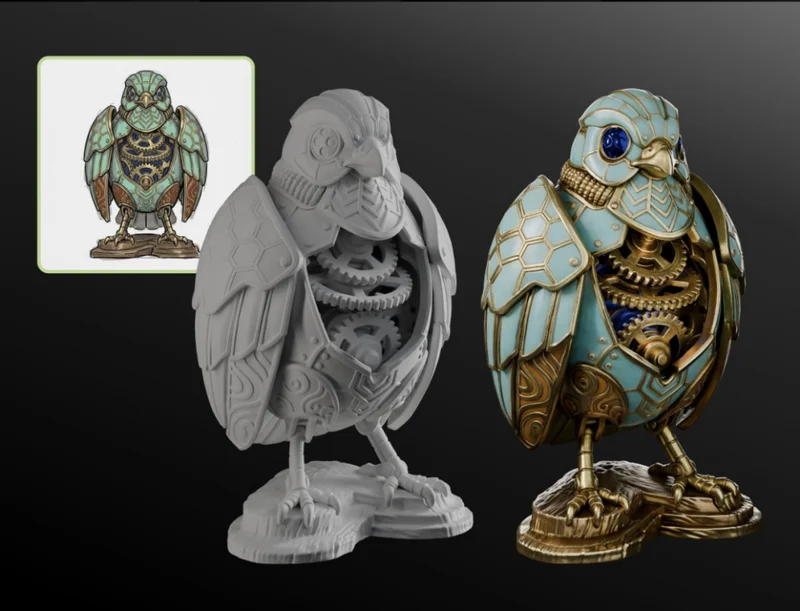
On a mechanical owl built from layered wing plates, a circular eye housing, exposed gears, and a sculpted base, Meshy 7 keeps the object as a structured assembly instead of collapsing it into a simplified bird shape — the gear cavity stays centered in the torso, the eye housing stays prominent, the wing panels wrap cleanly. That's the spatial distribution metric made visible: the object only reads correctly if each part stays where it belongs, not just in the right general area.
On a carved jade coin, where the entire shape is defined by shallow relief packed onto a nearly flat surface, the dragon motif stays continuous around the rim instead of breaking into fragments, and the central character remains legible as an embossed feature rather than smoothing into the disc. That's the surface-details metric at its most demanding: nothing here depends on large-scale shape, only on whether many small features survive together.
What's Next
This benchmark covers geometry only. Texture, whether color, material, and pattern match the reference, is a separate alignment problem that fails in its own ways, and we're building a dedicated benchmark for it next, publishing it the same way: methodology first, scores as a snapshot we know the field will move past.
Meshy 7 is generally available starting August 10, 2026, open to all registered users; downloading models generated by Meshy 7 requires Pro tier or above. The geometry alignment benchmark used in this piece will be released separately so other teams can run their own models through it. A generated 3D model can be clean, plausible, and technically valid, and still disagree with the image that inspired it. Meshy 7 is our biggest step yet toward closing that gap.