Millions of guns, repeated shootings: Thailand confronts limits of firearm control
Thailand eyes tougher firearms rules after deadly shootings, but a CNA probe finds illegal weapons easy to buy. Experts say gun control is an elusive target.
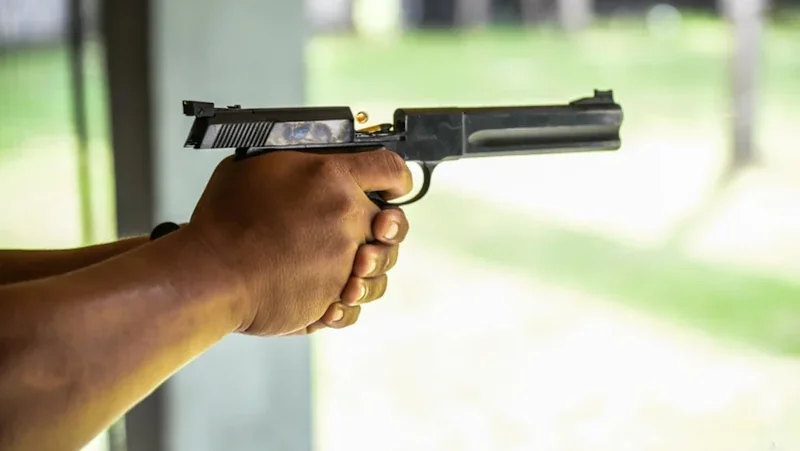
BANGKOK: At a shooting range just outside Bangkok, a solitary shooter stands under a rusting awning and fires at a paper target about 10m away.
Krisakorn Boonwan wears flip flops and no ear protection as he fires round after round, shells bouncing at his feet. The only sounds are that of a creaking fan and the rhythmic punch of his handgun.
This is a sport for him. And despite the country still reeling after a pair of deadly shootings this month in Nonthaburi province, just north of Bangkok, he has little hesitation to keep training his skills with a firearm.
“I enjoy it because it helps my focus, composure, emotional control and physical readiness,” he said, adding that he has already introduced his 10-year-old daughter to shooting.
Still, the 41-year-old mechanic accepts that in the wake of recent violence, gun enthusiasts like him might be viewed differently in society and keeps his shooting activities off his social media accounts.
On Aug 7, a 14-year-old student used a 9mm handgun to kill his grandparents, five school staff members and a fellow student at Debsirin Nonthaburi School before killing himself. Three days later, a former politician allegedly shot and killed a local official over a purported financial dispute.
In the wake of the shootings and amid a society-wide fallout, Thailand's government is again promising tougher gun controls.
This time, Prime Minister Anutin Charnvirakul has promised sweeping changes to the way firearms are bought, owned and monitored. “I can’t please everyone, but we must ensure safety, especially for innocent victims and children,” he told the media last week.
Among the initial measures are a suspension of new firearm purchase permits, more weapon checkpoints and inspections as well as tighter restrictions on carrying guns. There are also proposals to review existing weapons and licences, a possible firearm amnesty and a push for broader legal reform.
But with millions of legal and illegal firearms circulating through the country, weak oversight after guns are licensed and deeper problems around violence and young people, experts question whether the latest measures can address the actual causes.
Thailand is stuck in a cycle of reactive reform, said Trynh Phoraksa, a criminologist and lecturer at Mahidol University.
“Authorities issue measures immediately after high-profile incidents, but structural reform stalls once public attention fades,” he said.
‘OUTDATED, IN NEED OF AN OVERHAUL’
In October 2023, a 14-year-old armed with a modified blank-firing pistol killed two people at Bangkok’s Siam Paragon mall, leading the government to temporarily halt the issuance of new gun licences to the general public and target the loophole around blank-firing weapons.
These weapons could be bought much more easily than conventional firearms because they were not regulated in the same way, even though some could be modified to fire live ammunition.
Police also launched a nationwide “Gun Clearance Operation” against illegal, modified and blank guns, as well as online sellers.
A year earlier, a former police officer killed 37 people, including 24 children, in a gun-and-knife rampage centred on a childcare centre in Nong Bua Lamphu province in northeastern Thailand. The incident remains Thailand’s worst mass killing by a single perpetrator in its recent history.
Then-prime minister Prayut Chan-o-cha ordered tighter gun-ownership controls and a review of existing licence holders and applicants. The Interior Ministry also instructed authorities to check whether gun owners continued to meet licensing requirements.
And in 2020, after a soldier killed 29 people in a rampage in Nakhon Ratchasima province in northeastern Thailand, the army said it would scrap its welfare gun programme. The programme had allowed personnel to buy firearms at discounted prices, and authorities further tightened approval for soldiers purchasing personal weapons.
Despite all of these measures, Thailand's firearm legislation is “outdated and requires a complete overhaul”, said Krisanaphong Poothakool, an independent criminologist.
“Accessibility remains remarkably easy, particularly through black markets and modified replica weapons,” he said. “Furthermore, legal penalties remain inadequate and require decisive, swift and guaranteed enforcement.”
While illegal gun possession can carry up to 10 years in prison, the maximum fine under Thailand's decades-old firearms law is just 20,000 baht (US$600) - one of the penalties the government is now seeking to toughen.
Thailand is awash with illegal firearms. It has also struggled to keep account of where they are and who owns them, said Krisanaphong.
Data from 2017 - the most recent, but unofficial, gun estimate in Thailand - showed that Thais own approximately 10.3 million firearms.
That consisted of 6.2 million legal and 4.1 million illegal weapons, according to the Small Arms Survey, an independent global research project based in Switzerland.
No other Southeast Asian country comes close to Thailand's estimated rate of civilian gun ownership. Per capita, Thailand's stock was more than four times the Philippines' and about 20 times Malaysia's, according to the 2017 survey.
Experts cautioned that the true number is difficult to determine and could be substantially higher.
“Beyond the inability to register or track firearm locations, there is an overly accessible path to acquiring guns, loopholes between legal and illegal firearms and a severe lack of post-licensing oversight,” Trynh said.
Thailand’s porous international borders that help facilitate weapons smuggling alongside local illegal production are part of the reason gun numbers are so high, said Krisanaphong.
There are other factors deeply embedded into Thai society too, such as a lack of trust in emergency response to crime, social normalisation and past welfare gun programmes for military, police personnel and other civil servants that allowed them to buy weapons below market prices
“Ownership is frequently perceived as a status of power,” Krisanaphong said.
For Paween Arunno, 54, having a weapon at home for the past decade has been purely for safety and self-defence.
He said he keeps his gun in a discreet location and believes the issue of legal gun ownership should not be conflated with rare mass shooting incidents.
“I completely disagree with the government's proposal to periodically inspect gun owners and require regular license renewals. Obtaining each firearm is already no easy task,” he said.
However, if the government wants to implement stricter regulations for prospective buyers before they acquire a firearm, Paween said he would support that approach.
But incidents like the one at Debsirin Nonthaburi School highlight “broader negligence” in monitoring access not only to firearms but also to knives, Trynh said.
“Gun owners frequently fail to restrict access, despite safe storage being a fundamental necessity before purchasing a firearm,” he said.
He urged the government to mandate locked safes or secure storage at home, keeping ammunition separate from firearms.
Anutin has proposed making registered gun owners legally accountable if their weapons fall into someone else's hands and are used in a crime, a measure with relevance to the Debsirin shooting, where the gunman allegedly used a weapon registered to his grandfather.
Owners would be expected to store firearms securely and out of children's reach, and immediately report a weapon missing.
GUNS FOR SALE ONLINE
Buying a firearm in Thailand through back channels online seems simple and fast, based on CNA’s checks.
Multiple firearm models are openly advertised for sale on platforms like Line and X. Weapons appear readily available, despite the government having already announced a suspension of new gun permits and vowing previously to crack down on illegal sales.
After CNA posted an anonymous enquiry, an online account purported to offer CNA an unregistered weapon with a magazine and ammunition for 5,500 baht, claiming express delivery within one to two days was possible.
The seller described it as ready for use and sourced from a pawn shop and therefore not able to be legally registered.
They also stated that registered firearms could be sourced separately and would generally cost approximately between 10,000 baht and 20,000 baht.
On paper, gun ownership in Thailand is tightly regulated. Before the current permit suspension, buying a legal firearm in Thailand involved a months-long process. Under Thai law, citizens 20 years and older can apply to purchase and own a gun.
There is no constitutional right to bear arms and applicants must establish a reason for ownership, undergo criminal and eligibility checks and obtain a purchase permit before acquiring a firearm. The weapon must then be inspected and separately registered to its owner.
That process could usually take around two months. But unregistered guns available online can be in the hands of any buyer within a day or two.
There are other ways to buy a gun without visiting one of the many firearm stores in the capital, especially around Wang Burapha, an old district in central Bangkok.
Tu, a driver in Bangkok who asked to go by only his nickname, said he is just a month or two away from receiving a gun arranged for purchase from a police officer friend.
Thailand has long allowed members of the police force and other officials to acquire subsidised firearms through government welfare schemes.
The programmes have repeatedly been suspended and restricted amid concerns about weapons being resold or leaking into the illicit market, and the government has again ordered them suspended following the latest shootings.
Tu is still hopeful he will receive his gun soon, and wants it for his own protection at his home in the capital’s south.
“In my area, it doesn’t feel that safe. I need it to protect my assets. Protect my family. It’s better to have it than not have it,” he said.
Trynh argued that measures like suspending new purchase permits or reviewing existing licenses offer partial relief but fail to address one root cause - that mass shootings can stem from access to firearms inside the household.
Systemic weaknesses appear once a gun has been legally acquired, he said.
“While Thailand’s written firearm laws are among the strictest globally, the core failure lies not in the text of the law, but in the lack of enforcement, checking, and follow-through regarding existing firearms,” he said.
The lack of controls over the country’s millions of unaccounted for guns is one of the reasons some Thais see greater preparedness and responsible gun ownership as part of the answer, rather than aiming for fewer guns.
Top (not his real name) is a tactical firearms trainer and supplier of protective equipment in Bangkok.
He defended the right of ordinary Thais to own firearms to protect themselves, their families and their property, provided they are trained to use them safely.
There are “wolves” out there who prey on innocent people, he said in the aftermath of the Debsirin shooting. But Top fears Thailand’s pro-gun community will increasingly be viewed as part of the problem.
“Just saying no guns, I don't think that solves anything. And in a country where there's 10 million guns, how do you even go about solving that problem?
“You're saying, ‘good people, you don't have your guns anymore’, but you really can't do anything about the illegal guns,” he added, disagreeing that more rules to govern guns would do much to stem shootings in the future.
Krisanaphong said Thailand's estimated stock of about 15 civilian firearms for every 100 people was already a “concerning ratio” and that more had to be done to keep firearms away from high-risk individuals.
‘UNCHECKED’ SCHOOL VIOLENCE
Restricting access to guns may reduce deadly violence but does not necessarily address the conditions that give rise to it in Thailand, experts said.
There are broader social issues the country has to contend with, especially at schools, where “unchecked violence among young people” continues.
Research by Peson Chobphon, an assistant professor at the Faculty of Education, Chulalongkorn University, found that abuse is often normalised in large urban schools, not only among peers but between school staff members and students as well, signalling to young people that aggressive behaviour is acceptable.
School violence is heavily amplified by sensational media coverage, he said, with Thai news programmes frequently broadcasting loops of raw video clips about school and street fights, road rage, robberies and homicide incidents.
“I think it desensitises cruelty and it also sparks dangerous copycat behaviour for some students who might want to express their anger,” he said.
This fear has already had resonance since the Debsirin school shooting. Classes were suspended at a school in Loei province on Aug 14, after a student allegedly told a friend that he was planning to carry out a shooting at the school, inspired by the Aug 7 attack.
But Peson argues schools are often poorly equipped to intervene before problems escalate.
His research found teachers lacked the tools to tackle bullying and conflict, while traditional hierarchies can make it difficult for students to seek help and for younger teachers to challenge how problems are handled.
The result, he said, is rather than intervening in complex behavioural issues like bullying or social exclusion, many schools adopt a hands-off approach.
“Teachers are so terrified of being exposed online or facing public backlash on social media. They become highly risk aversive,” he said.
Laponpat Wangpaisit was among a generation of students who challenged Thailand's traditionally rigid school hierarchy.
As a leader of the Bad Student movement in 2020, he campaigned against physical punishment, harassment and rules that activists said gave teachers extensive authority while leaving students with little voice.
Six years later, he said students lack spaces to talk about bullying or unfair treatment at schools.
“That does not mean that an imbalance of power directly causes violence. But when a system leaves people feeling that they cannot speak, negotiate, or be heard, frustration can build up,” said Laponpat.
“This is not only a school issue. It is connected to the wider culture around power, violence, access to weapons, and the way we teach young people to deal with anger, conflict and rejection.”
He urged the government to make dangerous weapons harder to access, and make sure people have real, accessible alternatives for dealing with problems before a situation reaches a point where the damage cannot be undone.
“I think it is necessary to talk about the perpetrator and gun control. But if the discussion stops there, we risk turning the incident into a story about ‘one disturbed individual’, which allows the institutions and society around that person to avoid asking difficult questions about themselves,” said Laponpat.
Satita Boonsom was at a school on one of Thailand’s darkest days.
The country was shocked when an attacker entered Uthai Sawan Child Development Centre in the northeastern province of Nong Bua Lamphu in October 2022, and committed a horrifying massacre of staff members and dozens of young children asleep in a nursery.
Satita, a childcare teacher, witnessed and survived the attack. Today, whenever she hears loud noises, she said she is transported back to the shock and terror of that day.
“Sometimes I suddenly think about the children and the people I used to see every day, and it still feels as if it happened not long ago,” she said.
Her heart sank when she heard that another shooting involving schoolchildren had taken place this month, understanding the pain that will linger with survivors and their families for a very long time after the day of the incident.
There was a deep realisation too, she said, that children are still not truly safe in this country, despite greater awareness of gun issues and school violence.
“At the time, I really hoped that after such a devastating loss of life it would be the last time something like this happened. I hoped it would make everyone take gun violence and access to firearms more seriously,” she said.
“I don’t want every tragedy to end with people saying, ‘We won’t let this happen again,’ only for us to find ourselves saying exactly the same thing again after another incident.”