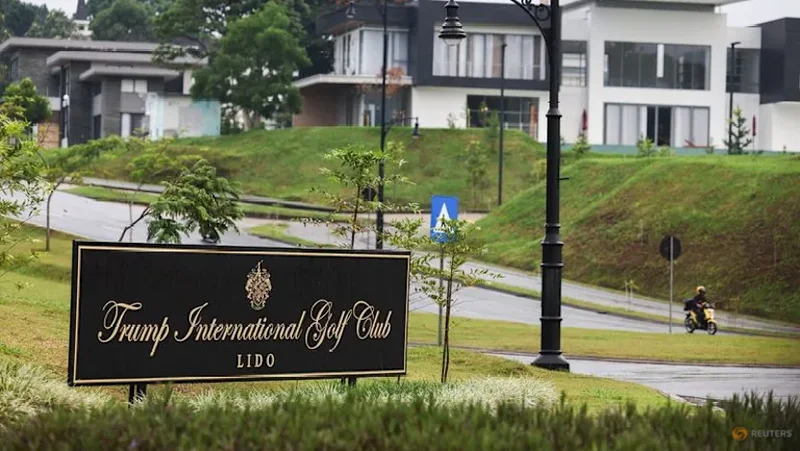
LIDO, West Java: Construction of Indonesia's Lido Special Economic Zone (SEZ) in West Java - including a clubhouse for a Trump Organization-branded golf course already in operation there - is back on track after a year in limbo.
In February last year, Indonesia’s environment ministry sealed parts of the Lido SEZ and ordered development activity to stop, citing concerns over water management and sedimentation at Lido lake located within the zone.
The move had raised questions about the future of the broader 1,040 ha Lido SEZ development, which was long promoted as an entertainment and resort hub less than 60km from Indonesia’s capital Jakarta.
CNA has learnt that the ministry has since lifted its suspension order against Lido SEZ.
In response to CNA’s question on Aug 1 on the status of the Lido SEZ, Environment Minister Jumhur Hidayat said that any suspension order by his ministry is meant to compel errant parties to comply with certain rules or orders.
"Every sealing or sanction involves government enforcement. Government enforcement is: 'You have to do A, B, C, D, E’,” said Jumhur.
“If they fulfil the requirements, the sanction can be lifted. If not, then it's impossible to remove it (the seal).”
When asked whether it means that there is no longer a suspension against the Lido SEZ, he said, without elaborating: “They have already fulfilled our orders for those mistakes.”
Separately, an official at the secretariat-general of Indonesia’s national council for special economic zones had told CNA that the prohibition was removed earlier this year.
When CNA visited the area in May, construction could be seen next to the Trump golf course that has been operational since last year. According to a staff member, the construction was for the Trump clubhouse.
There was also some construction work at Lido Lake Resort, which is currently being expanded and which also lies within the Lido SEZ. The resort is owned by MNC Hotel, part of Indonesian conglomerate MNC Group that owns and manages the area.
The official at the secretariat-general told CNA that MNC Land Lido - an arm of MNC Group - had taken remedial steps, including measures to prevent soil and sediment from flowing into the lake.
While there were media reports that the issue would end up in the courts, the official said that did not take place.
WHAT’S IN STORE AT THE CLUBHOUSE AND SEZ?
The clubhouse at 3.3ha, or the equivalent of 4.5 football fields, is billed as the largest under the Trump Organization, according to the Facebook page of MNC Tourism, a tourism and hospitality arm of MNC Group.
The clubhouse would house several restaurants, a large ballroom, meeting rooms and a 5,000 square metre (0.5ha) semi-outdoor ballroom, and is expected to be completed this year.
It is part of Trump International Golf Club Lido, a luxury golf development inside the Lido SEZ, also often dubbed MNC Lido City.
On Trump Organization’s website, it said that the Lido project is the first Trump Golf property in Asia and “will showcase the Trump brand's standard of excellence by featuring world-class facilities, including an immaculate lifestyle country club, luxurious spa, high-end residences and five-star white-glove service, among many other amenities”.
According to the Facebook page of MNC Tourism, the Trump projects occupy 216ha out of the 1,040ha Lido SEZ and include an 18-hole golf course that has been operational since last year, as well as further developments such as a five-star hotel, a wellness centre, and residences.
The project is linked to the American president through the Trump brand, and to Indonesian business tycoon and politician Hary Tanoesoedibjo through his MNC Group.
MNC is one of Indonesia's largest business groups, which focuses mainly on the media and entertainment sector, financial services, and tourism and hospitality.
It was founded in 1989 by Hary, who later also founded the political party Perindo in 2014.
MNC Group began developing the Lido area around 2014, after it had previously been owned by another Indonesian conglomerate, the Bakrie Group.
Lido was promoted as a major tourism and entertainment destination, with plans over the years that included a golf resort, hotels, film production facilities, residential areas, other leisure attractions, and even the world’s largest theme park.
The Lido tourist area officially became the Lido SEZ in 2021 during the presidency of Joko Widodo, popularly known as Jokowi.
Since then, the main development that has been completed in the area is the 18-hole golf course.
SEZ SUCCESS FACTORS
Made Supriatma, a political analyst and visiting researcher at the ISEAS-Yusof Ishak Institute in Singapore, said Lido SEZ has a shot at success because it is near Jakarta and there is now a new highway connecting it with the capital.
“It could become an integrated entertainment centre for Indonesia's elites,” said Made.
“Its location, just an hour from Jakarta, its prestige as a ‘Trump property’ and its various entertainment options (golf resort, music concert venue and so on) will satisfy Jakarta’s elites.”
Wawan Mas’udi, dean of the faculty of social and political sciences at Gadjah Mada University in Yogyakarta, said that designating an area as a special economic zone typically means the state provides supporting infrastructure, simplifies licensing, and creates a more favourable business environment.
“The state allocates resources to support it, licensing becomes simpler, and there are other forms of facilitation,” he said.
He said that the institutional set-up matters because SEZs are designed to reduce bureaucratic bottlenecks and support investments.
But he added that while the state may create the enabling environment, the development's actual business success depends on investors and market conditions.
“It could be things like the business model or (potential) social problems that the developers could prevent beforehand,” Wawan said.
Environmental property expert Syarifah Syaukat from property consultant Knight Frank said Lido has commercial appeal because of its green landscape, large land area and accessibility through a new toll road.
She added that Indonesia could be an attractive market for golf resorts and clubhouses because the segment targets high-income consumers, and Indonesia has a growing wealthy class, but there are several things developers must consider.
“Developers must consider the local culture, prevailing policies, the stability of national economic growth, and applicable spatial planning regulations (for the resort to succeed),” she said.
“They must also consider the benefits of regional development for the surrounding communities, both in terms of environmental sustainability and livelihood sustainability.”
This was perhaps an issue with a Trump-linked golf resort on the Indonesian island of Bali.
TRUMP BRAND A DOUBLE-EDGED SWORD
Virdika Rizky Utama, executive director of PARA Syndicate, a political think tank based in Jakarta, said that any project bearing Trump’s name is politically sensitive but the question is whether the Trump brand is enough to make the project work.
“An international brand may confer prestige, but without adaptation to the Indonesian context, the project's sustainability is highly questionable,“ he said.
“The Bali project demonstrates that Indonesians don't always embrace Trump's symbolism enthusiastically.”
The Trump-linked golf resort in Bali was operational for a while a few years ago, but when CNA visited it in April, it was not open to the public.
Security staff guarding the premises did not respond to CNA’s request for information. According to a local official who spoke to CNA on the condition of anonymity, the golf club ceased operations sometime during the COVID-19 pandemic.
He said the golf club was set to be revamped last year, but as of recently, it has yet to undergo any renovation work.
Nicky Fahrizal, a political expert from the think tank Center for Strategic and International Studies (CSIS), said growing debate over overtourism and environmental protection in Bali shows that premium tourism projects cannot rely on branding alone.
There are also questions about whether a luxury clubhouse will benefit surrounding communities.
“We have not benefited from the past development. Most workers were not locals,” said a 45-year-old local resident who wanted to be identified as Andra.