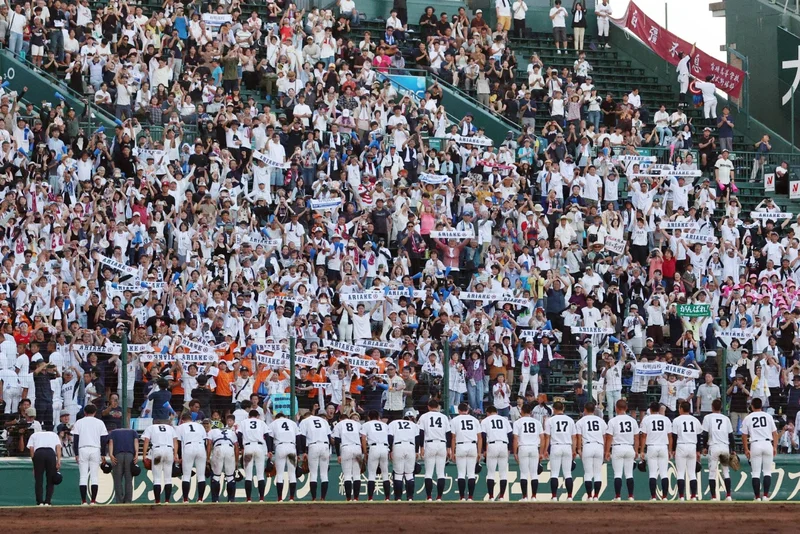
Nishinomiya, Hyogo Pref. – A siren blares, cutting through the sticky August air as two teams bow in a show of respect before the biggest game of their young lives.
As the air raid-like alarm begins to fade, players from Hachiman Commercial High School and Kendai Takasaki High School part and the typical sounds of Koshien Stadium become audible once again: vendors advertising sales of beer and snacks, the murmur of the crowd, the thud of baseballs hitting leather and the fluttering of thousands of hand fans as spectators desperately try to keep cool under the unrelenting afternoon sun.
The mercury at 1:30 p.m., the time of the game’s first pitch on Day 3 of the National High School Baseball Championship, reads 36 degrees Celsius. A thermometer placed in direct sunlight just above one of the concrete stadium’s plastic outfield seats, however, shows the extent of the danger: 45 C and climbing.
Experienced fans bring a cushion to sit on — not for a softer seat, but to avoid burning their rear ends on the historic ballpark’s scorching dark-green bleachers.
As human-caused climate change makes Japan’s summers ever hotter, one of the country’s most cherished summer traditions is under threat.
While organizers have enacted a number of measures in a bid to improve the safety of players and fans, some observers are now raising a question that once seemed unthinkable: Is Summer Koshien, as the tournament is commonly known, compatible with a rapidly warming world?
Summer tradition
It’s a stage unlike any other.
Each summer, 49 high school teams from across Japan do battle over 2½ weeks in a bid for baseball immortality and it all happens inside a 102-year-old ballpark that is as revered as the nation’s thousands of shrines and temples.
The tournament has a unique power to draw in even nonbaseball fans by evoking images of youth through the exuberance and innocence of the players, who give it their all in what serves as the high point of their high school athletic careers.
Games are televised nationally and top players become household names before they ever suit up for a pro team. The tournament’s place within the fabric of Japanese society is such that one could argue it sits right alongside fireworks shows, yukata and Bon odori (dance festivals to honor ancestors) in the realms of summer traditions.
Osaka Prefecture native Tatsuki Tanaka is a former high school player who follows the Spring and Summer Koshien tournaments religiously. He carries fond memories of his time playing youth baseball and says that helps fuel his fandom for the high school game even now.
“You can learn teamwork and things like that through baseball, and it makes for three incredibly fulfilling years,” he said.
Taking place during summer vacation and over the Bon holiday period, fans regularly pack Koshien Stadium, located a short train ride away from Osaka in Nishinomiya, Hyogo Prefecture, filling in the seats not already occupied by each team’s boisterous cheering sections.
“Of course, there are errors since it’s amateur compared to the pros … but that’s part of the charm,” Tanaka said. “There are a lot of come-from-behind wins and moments like that, so I think it’s fun to watch.”
After a team is eliminated, teary-eyed players fill up bags with dirt from Koshien’s hallowed infield to bring home as a final souvenir of their time in the spotlight, highlighting the stadium’s leading role in making the tournament special.
But for the players, coaches, cheering squads and thousands of fans who attend each year, one unsettling truth is becoming increasingly clear: soaring temperatures caused by climate change are making Koshien increasingly uncomfortable and, at times, downright dangerous.
“We brought plenty of frozen drinks and cold towels,” mother Eri Ishijima said as she fed shaved ice to her children on Day 3 of the tournament.
Like many fans, Ishijima and her three children left their seats to take shelter in the concourse, where large air conditioning units were a popular spot for people to get some relief from the heat.
“It’s too hot so we can’t watch now. … The little one just stays here,” she said, pointing to her 4-year-old.
Growing safety concerns
Japan endured its hottest summer on record in 2025, rewriting the record books for a third consecutive year.
This year, a later end to the rainy season meant cooler temperatures in early to mid-July, but temperatures in the high 30s and even “brutally hot” days — declared on days in which the mercury hits 40 C or higher — arrived in many parts of the country by late July.
The danger is clear: Japan marked an average of more than 1,500 heatstroke deaths per year in the five years through 2024.
While the large majority of deaths are elderly patients who are more susceptible to the worst outcomes of heat-related illnesses, young people, even in-shape athletes, are far from immune.
The recent death from suspected heatstroke of professional rugby player Saimoni Vunilagi, a 26-year-old from Fiji who played with Fukuoka-based Kyushu Electric Power Kyuden Voltex, served as a grim reminder of the dangers of physical activity in high temperatures.
“When something bad really occurs and we look back, there are so many obvious points, like ‘why did you host this to begin with?’” said Yuri Hosokawa, an associate professor at Waseda University’s Faculty of Sport Sciences and an expert on heatstroke, during an interview a day before Vunilagi’s death. “It’s not just Koshien. There are a lot of (youth sports) contexts in Japan … where some of those obvious risks are already there, but the adults, the organizers aren’t swift enough to make the decision.”
While baseball is not as grueling as rugby or soccer, Hosokawa highlights the fact that players tend to spend a prolonged period of time in direct sunlight as a cause for concern. And in high temperatures, any physical activity carries a certain degree of risk.
Case in point, Nippon Professional Baseball teams largely avoid day games in outdoor stadiums during the summer, while earlier this month the Korea Baseball Organization went on a six-day hiatus amid a record-breaking heat wave in South Korea.
In the case of Koshien, Hosokawa also highlights the player’s youthful exuberance as an obstacle for heatstroke safety.
“Because they are giving all that they have … they’re not gonna say, ‘Oh, I give up,’ right? Because there is no second chance for them,” she said. “It could be their last day for their entire high school baseball career. So all that motivation too is also putting a lot of strain on them, both physically and mentally.”
Essentially, with all that’s at stake on the field, players can hardly be expected to protect themselves from heatstroke — and that’s where the Japan High School Baseball Federation comes in.
Mitigating measures
Traditionally a daytime tournament, the 2024 edition of Summer Koshien saw the introduction of a limited split schedule as an anti-heat measure, with two games scheduled for the morning and two more scheduled from late afternoon into the evening in order to avoid the hottest part of the day.
The split schedule was expanded for 2025 and then modified for 2026, marking a fairly significant shift for a tournament that had long scheduled early-round matches to run back-to-back for a nearly continuous day of action. In fact, before technology made it somewhat obsolete, the stadium’s famous siren was traditionally used to notify players and fans outside the stadium when a game was either starting or ending.
Despite this momentum, the sheer number of games means it’s unlikely that organizers can avoid 35 C heat altogether through scheduling tweaks alone. This year, games have regularly taken place between 10 a.m. and 4 p.m., when temperatures typically peak and the sun is at its highest point, meaning shade provided by the stadium is scarce.
Cooling breaks after the fifth inning have been the norm since the 2023 season, while stadium improvements could soon serve to protect more fans and student cheering sections from the sun. Koshien Stadium’s partial roof, which currently covers the infield seats, is due to be extended down the foul lines by 2028.
The biggest change under consideration — shortening games to seven innings — has garnered significant opposition from baseball purists and some of the sport’s biggest names, including Ichiro Suzuki.
But that shouldn’t stop the federation from doing what’s needed to safeguard against heat, former Samurai Japan manager Hideki Kuriyama said during a panel discussion earlier this year.
“If you think about protecting the kids, you have to consider their physical well-being,” he said, adding that decision-makers should listen carefully to people not involved in baseball.
“By taking proper precautions in advance and showing what we’ve done … sending a message to society might actually be a positive thing. We should discuss these issues together, do everything we can, and do it for the sake of the kids.”
Hosokawa gives Summer Koshien, which is co-organized by the Asahi Shimbun newspaper, credit for taking the heat issue seriously, but questions whether any of it is enough to avoid an even bigger debate: In its current location and timing, can the tournament as it looks in 2026 remain viable at all?
“In the past few years they’ve made substantial changes in making sure that these athletes have means to cool their body, take rest,” she said. “I think they are making a lot of progress. But the next step, I think, needs to be drastic. It can’t be this little prevention added here and there. It needs to be a total change in scheduling or shift in location.”
Long-term future
Like the proposal for shorter games, moving Summer Koshien to a different season or location would almost certainly be met with strong opposition from baseball traditionalists, but it’s a conversation that may become inevitable.
The tournament is intrinsically linked with the stadium, which was built specifically to host the high school tournament. The importance of having it at Koshien Stadium is such that the ballpark’s primary tenant, the uber-popular Hanshin Tigers, are evicted from their home every August in order to prioritize the high school players.
“Of course it sucks that it’s so hot, but this stadium has history,” said Naoki Kato, a Tigers fan who attended Day 3 of the high school tournament. “I want them to keep playing at Koshien if possible.”
Finances also play a key role in keeping the tournament at Koshien. According to a report by the Nikkei daily, the federation uses the historic stadium free of charge. And because the organization doesn’t collect broadcast fees, it is heavily reliant on ticket sales for its funding, which helps subsidize travel costs for participating schools. Of the federation’s ¥1.6 billion in revenue in fiscal 2024, ticket sales at the Spring and Summer Koshien tournaments accounted for ¥1.4 billion.
Hosokawa notes the prefectural tournaments that immediately precede Summer Koshien and determine its participants are equally problematic, so simply moving the main tournament indoors wouldn’t solve all of high school baseball’s problems, either.
Moving the tournament to another time of the year might seem like an easier solution, but that would create other problems given these are student athletes and the current tournament conveniently falls during summer break.
With those obstacles in mind, momentum could remain on the side of the status quo for some time yet.
“The one thing that I fear the most is that they won’t (act) until they see an actual catastrophic case,” Hosokawa said. “They have all the successes. … They know that they can host it and they know that they haven’t had a true catastrophic, fatal outcome. But do we need to have that to realize it’s dangerous?”
Back at Koshien, cloud cover provides some welcome relief for the latter half of Kendai Takasaki’s 7-1 win over Hachiman Commercial.
As the two teams line up to pay their respects after a hard-fought contest, the sun re-emerges, blasting the stadium with another dose of heat.
Then the players bow and the familiar siren blares, marking the end of one game and, soon, the start of another.
At least for now, Summer Koshien’s daily rhythm is just the same as it’s always been.