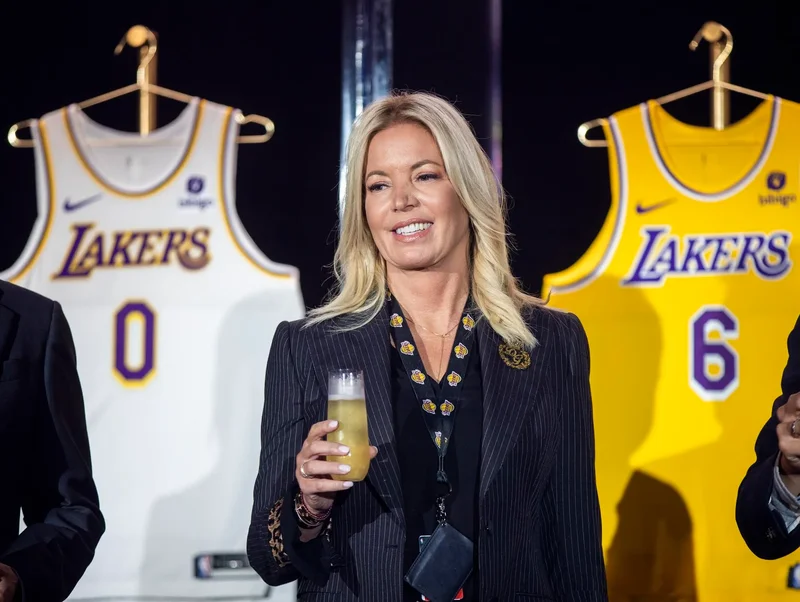
For two consecutive years, the Buss family agreed to something that once seemed unthinkable.
Last year, the Buss family sold the majority of its ownership stake to Mark Walter for a record-setting $10 billion. On Monday, the Buss family plans to sell its remaining ownership stake (17.8%) to new majority owners Josh Kushner and Bob Iger after they recently purchased Walter’s stake for $12.5 billion.
The reasons appear to go beyond wanting to rake in a handsome profit. Buss’ father, Jerry, first purchased the Lakers, the Forum, the NHL’s Kings and various real estate for a combined $67.5 million in 1979. With this latest deal, Jeanie, Jim, Janie, Johnny, Joey and Jesse individually will bring in more than their father’s original purchase price.
With Jeanie as the lone Buss sibling still with an active role as the Lakers’ team governor, this move solidifies her eventual exit by choice instead of by eventual force from either her siblings, new ownership or both.
"We have decided as a family to sell the remaining Buss Family Trust shares to the Bob Iger group as part of the ongoing transaction," the Buss family said in a statement to ESPN. "We love the Lakers, Laker fans and will continue to support Los Angeles; but it is time to use this opportunity to move on and exit gracefully while we still can."
Why Jeanie Buss felt compelled to sell her Lakers’ shares
The Buss’ family has hardly been graceful following Jerry’s passing in 2013. By then, he had established that Jeanie would become the team’s governor while Jim would be in charge of basketball operations. Four years later, Jeanie fired Jim at her post amid her dissatisfaction with how he managed the team’s roster during its worst stretch in history. She also successfully averted a coup that Jim and Johnny pursued to remove her as the Lakers’ governor.
Shortly after Walter’s majority share purchase was finalized, the Lakers fired Joey and Jesse Buss amid their effort to reorganize the team’s basketball department. Joey and Jesse Buss were not in favor of the team selling its majority ownership shares to Walter. But the move also represented a pivot after the Lakers valued Joey and Jesse Buss for their roles with overseeing their G League team (Joey) and the Lakers’ scouting department (Jesse).
Jeanie stayed put amid Walter’s plans to retain her as the team’s governor for at least the next five years. The NBA also affirmed that expectation after the league’s Board of Governors approved the sale. Even with Iger and Kushner agreeing to purchase Walter’s shares last week, it initially appeared that Jeanie Buss would stay with the organization. Iger confirmed to the California Post that he intended the honor the agreement that Walter and Jeanie Buss made with her Governor role staying intact for at least the next five years. Iger stressed, “If things change, things change.” But at that point, Jeanie Buss still had the league’s requisite for controlling governors to own at least 15% of the franchise.
After various firings and lawsuits involving her brothers, Jeanie’s brothers facilitated her own exit. Jeanie Buss has fielded mixed reviews for how she has managed the organization since her father’s passing, including hiring and retaining Rob Pelinka as the Lakers’ general manager, her dynamic with her siblings and for being deliberate with the organization’s spending on support staff, coaches and role players. But Jeanie is also widely respected for her business acumen and amenable leadership style within league circles. She arguably could have become a valuable resource with helping Iger and Kushner during their ownership transition. Instead, the Jeanie ceded control preemptively by selling her shares instead of risking the possibility that her tenure would end involuntarily.
Jeanie Buss initially thought family would own the Lakers ‘forever.’
These developments surely mark a stark departure from Jeanie’s position over a decade ago. In a wide-ranging interview during the Lakers’ worst stretch in franchise history (2014-15), Jeanie sat in her office and told me she could never imagine any scenario in which she and her siblings would feel compel to sell their share of the Lakers out of respect for her father overseeing 10 of the Lakers’ 17 NBA championships.
“He worked very hard to be in a position so that our family could keep this team forever,” Jeanie Buss said. “We’re committed to doing that.”
Circumstances eventually changed.
In 2021, AEG owner Philip Anschutz sold his 27% personal stake to Todd Boehly and Walter, a move that sparked speculation that Walter would want to assume majority control eventually. With Guggenheim Group, Walter had both the commitment and wherewithal to spend more lavishly on the Dodgers’ front office, support staff and roster. With increasing valuations with the Dallas Mavericks ($3.5 billion in 2025) and the Boston Celtics ($6.1 billion in 2025), it became clear the Buss family should sell. Not only would they bask in those earnings. With the Lakers’ franchise as their role revenue stream among six siblings, the Buss family did not have the same financial means to spend as wealthier ownership groups.
More surprises awaited after Walter sold the franchise less than a year after purchasing it. It’s fair to wonder if any of the reasoning had to do with Walter being under federal investigation for unpaid loans. Regardless, the recent sale also put Jeanie in a precarious position. Instead of holding out hope that she would remain as the Lakers’ governor at least in the short-term, Jeanie accepted lavish payout and a more graceful exit.