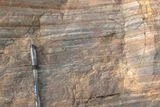
A striped rock from eastern India contains carbon that may have been left by microbes when Earth was roughly 1 billion years old. Dark, carbon-rich bands alternate with pale silica, preserving a layered record of the environment in which the rock formed.
According to a new study in Proceedings of the National Academy of Sciences, researchers date the Bhitardari chert, a hard, silica-rich rock from the Bhitardari area, to 3.497 billion years ago. Although the rock contains no recognizable bodies or cells, the relative amounts of different forms of carbon point toward material made by living organisms.
Zircon Crystals Date Possible Evidence of Early Life
The Bhitardari chert comes from the Singhbhum Craton in eastern India, a region of ancient continental crust.
The region was then covered by a sea where volcanoes and hot water moving beneath the seafloor supplied silica and iron. As sediment hardened, carbon-rich material became trapped between bands of quartz less than a millimeter thick.
Because chert rarely contains minerals that geologists can date directly, eight zircon crystals embedded in this sample gave the team a way to determine its age. Their shapes and chemistry indicate that they arrived with volcanic material while the sediment was accumulating.
When zircon crystallizes, it traps uranium, which slowly turns into lead. Four grains preserved that record clearly enough to narrow the margin of error to about 5 million years. Because the zircon and carbon were sealed into the same deposit, the measurements date the carbon-rich bands themselves rather than a neighboring formation.
Read More: Earth Formed 4.54 Billion Years Ago – How Do Scientists Know?
Carbon Chemistry Points to Ancient Microbes
Carbon comes in several forms, called isotopes. Living organisms tend to use more of the lighter carbon-12 than the heavier carbon-13, leaving a chemical pattern behind. The balance in the Bhitardari chert matches a pattern often left by carbon fixation, the process organisms use to turn carbon dioxide into material for growth.
The pattern could fit the Calvin cycle, which many organisms use to capture carbon, or a different microbial process called the acetyl-CoA pathway. The chemistry cannot identify the organisms or process. But if the carbon came from life, microbes had already developed ways to process it.
The thin, carbon-rich layers may be remnants of a microbial mat, a community of microorganisms that spread across the seafloor. Silica settling from the water could have enclosed the material and helped preserve its chemistry.
Testing Carbon Altered Over Billions of Years
Over billions of years, heat, pressure, shifting rock, and moving fluids can change organic matter or introduce carbon later. That makes traces of early life difficult to identify.
The team used Raman spectroscopy, a laser technique that reveals how carbon is arranged, to compare carbon in the original layers with graphite in younger quartz veins cutting across them. The layered carbon retained the less organized structure of kerogen, organic material changed by heat and pressure. Graphite in the veins was more crystalline, indicating that it formed under different conditions.
The contrast supports the idea that carbon in the layers was there when the rock formed. Still, nonliving chemical reactions can leave signals that resemble those made by life.
In this case, zircon dates, rock layers, carbon chemistry, and heat-induced changes strengthen the biological interpretation. Together, they indicate that microbes capable of processing carbon may have lived in volcanic, iron-rich seas by 3.5 billion years ago.
Read More: First Evidence From Proto Earth May Be a Chemical Imbalance Hidden Inside Ancient Rocks
Article Sources
Our writers at Discovermagazine.com use peer-reviewed studies and high-quality sources for our articles, and our editors review for scientific accuracy and editorial standards. Review the sources used below for this article:
- This article references information from a study published in Proceedings of the National Academy of Sciences: Direct dating of 3.5 Ga biogenic carbon in a microbial mat remnant, Singhbhum Craton, India