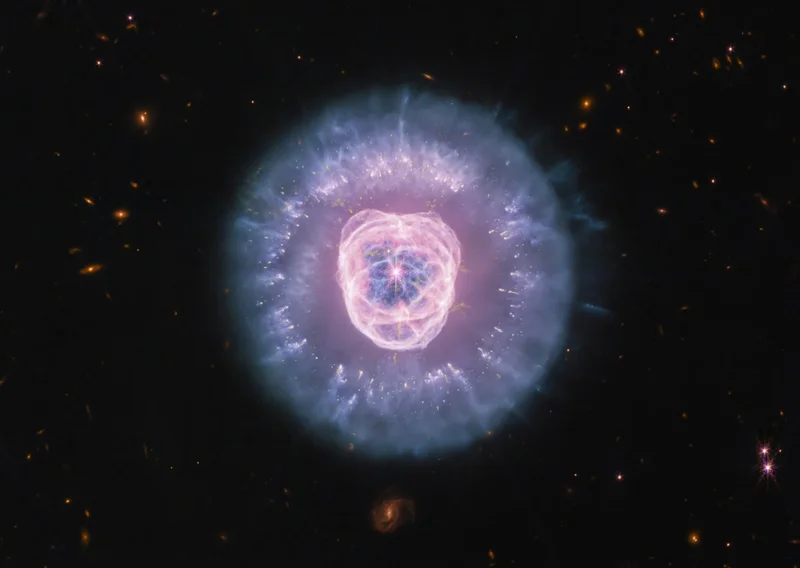
The NASA/ESA/CSA James Webb Space Telescope recently imaged NGC 2392 (aka. the Lion Nebula), so-named because of its distinctive appearance, which resembles a lion's face seen head-on. The venerable Hubble Space Telescope (HST) also viewed this nebula in 2000, showcasing its population of hazy, comet-shaped objects. By combining data from its Near-Infrared (NIRI) and Mid-Infrared (MIRI) instruments, Webb has provided the clearest, most detailed view yet of the Lion Nebula.
The image reveals the nebula's complex structure and the white dwarf at its center that continues to shape it. This stellar remnant created the nebula when it reached the end of its life cycle and shed its outer layers. This star looks like the nose of the lion, whereas the extended gaseous envelope and shells of dust and tendrils resemble the lion's "mane." The central star is so hot that it illuminates everything inside the bubble, ionizing hydrogen as it does and causing it to expand and destroy much of the dust it encounters.
Whereas more massive stars undergo collapse at the end of their lives and shed their outer layers in an explosive event (a supernova), lower-mass stars like NGC 2392 are different. When these stars exhaust their hydrogen and helium fuel, they become unstable and begin to pulsate, blowing off their outer layers in the process. The powerful radiation from the stellar remnant drives the ejected material away, leaving behind a white dwarf surrounded by a shell of gas and dust. This is how most of the observable dust in the Universe is produced.
In the case of the Lion Nebula, the progenitor star was oxygen-rich, leaving behind a white dwarf that heats everything inside the bubble and ionizes the hydrogen gas. The gas bubble is expanding, clearing most of the dust in its path and creating the complex structure of rings and shells visible in the image. Understanding these structures, common in planetary nebulae, remains an active area of astronomical research.
While Webb's images appear similar to Hubble's optical images at first glance, Webb's infrared instruments highlighted certain features. These include compact clumps of dust that appear red, orange, and yellow in the image, as well as haze caused by ionized gas. These clumps are those that survived the expanding gas cloud, which are also protecting material that lies beyond them. The powerful forces that cause the nebula to appear this way are ongoing and will continue to alter its shape as its gas and dust migrate away from the stellar core.
Astronomers estimate that the lionesque appearance of this nebula will disperse in about 10,000 years.