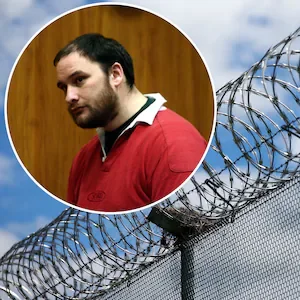
It has been 20 years since Peter Steven Waihape was jailed for life for the murder of a young Christchurch sex worker and mother - tying her up and laughing as he repeatedly ran her over while she pleaded for her life, before dumping her body
Senior journalist Anna Leask reports.
On August 17 2006, Waihape was sentenced to preventive detention - one of New Zealand’s toughest sentences - for the murder of the 24-year-old.
That was on top of a life sentence with a minimum non-parole period of 18 years, alongside 10 years for the abduction and sexual violation of the 17-year-old girl three days before the killing.
Waihape’s crimes shook Christchurch.
In December 2005, he was released from prison, and within days he chanced upon the teenager as she walked home.
Three days later he picked up the young sex worker - who has permanent name suppression - and drove her to an inner city carpark, where a dispute broke out about him not using a condom.
He partially strangled her, removed her clothing, bound her hands and raped her. He then pushed her out of the car and ran over her.
She became trapped under the car and was pleading for her life. Witnesses reported hearing him laugh as he did so.
“Rather than listen to her pleas, you ran over her again,” said Justice Lester Chisholm told Waihape at his sentencing in the High Court at Christchurch.
“You were then seen to get out of your car and kick her at least twice. She managed to free herself and sat up. She pleaded for her life.
“Then you drove at her a number of times, smashing through a concrete wall.”
Waihape later drove her to the river and threw her half-naked body into the water.
“The ultimate indignity was that you used her as a stepping platform to get out of the river,” said Justice Chisholm.
“It couldn’t get much worse, Mr Waihape.”
The court heard that the victim had a young daughter and had battled to beat drug addiction.
Her mother said Waihape was a “calculated, cold-blooded murderer, who does not deserve to live”.
“We are left with the responsibility of raising our granddaughter the best we possibly can,” she said.
“In caring for her needs, we can never replace a mother’s love for a child.”
The slain woman’s father described becoming deeply upset at watching his granddaughter stand next to her coffin, rubbing her stomach.
“When I left [she] wanted to come home with me to see her mum,” he said at sentencing.
Waihape has been refused parole a number of times since he became eligible.
His most recent hearing was last month, and the board’s decision can now be published.
Parole Board panel convenor Kathryn Snook said at the last hearing in July 2025, a psychiatric report stated Waihape had “significant work ahead”, that he had “limited insight into his risk” as well as “trauma-based issues and chronic mistrust”.
Last month the board heard Waihape was “in the rehabilitative phase of his sentence” and “working slowly towards release”.
A fresh psychological report advised Waihape had “demonstrated consistent motivation and engagement in treatment”.
“The psychologist considers that he has made progress across multiple domains including the development of some insight into his offending,” said Snook.
“A number of areas for ongoing treatment remain, including Mr Waihape’s own self-hatred for what he did.
“Mr Waihape is assessed as at above average risk of sexual offending and at moderate risk of violence. The psychologist notes, however, that further offending may involve use of weapons and rapidly escalate to callous and fatal violence.”
Snook said the psychologist considered Waihape would require “a very gradual and externally supported reintegration” into the community “at an appropriate point”.
“Mr Waihape talked well to the Board today. He said that he is working with the
psychologist to understand why he offended as he did and the excuses he made to justify the offending,” she said.
“He said that the trigger for his offending was that he grew tired of his situation and wanted to change it. He was lonely, bitter and did not deal with his emotions. He found it easier to blame other people.
“He said he has a tendency to suppress his emotions but is learning how to deal with them in a healthier way. He is working on his communication style and social etiquette.”
Waihape told the board he continued seeing the psychologist because he wants “to be and feel better” and is “tired of feeling ashamed and guilty”.
“Mr Waihape said that he has worked on changing his view of women, which he previously viewed as simply sexual objects. He has been working well with a female psychologist as well as a female case manager,” said Snook.
“Mr Waihape confirmed that he has the belief that he does not deserve to be happy or be released from prison. He knows he needs to forgive himself and that is a goal which he wants to achieve at some stage.
“He also confirmed that one of the drivers of his offending was his desire to return to prison.”
The board heard about Waihape’s time in prison.
He got a job in the servery and said he got on well with the other inmates, but chose to leave the job as he decided it “was not healthy for him”.
“He did not like the job itself as it was too challenging,” said Snook.
A Corrections officer gave Waihape’s behaviour “a good report” but noted he had been charged with two misconducts since his last parole hearing.
He was only found guilty of one - giving a TV to another prisoner in July 2025.
Snook said despite any improvements Waihape, his lawyer and psychologist reported, he was still too dangerous to be released on parole.
In fact, he did not seek release at the hearing.
“Mr Waihape is doing well and did speak well to the board today about his progress and the treatment with the psychologist. There is, however, a long path ahead for Mr Waihape in terms of the treatment and then potential progress into the reintegration phase,” Snook said.
“At some point he will need to develop a strong release proposal.”
Snook said given the work that was required, the board would not see Waihape again until January 2028.
While experts say 20 years on, Waihape’s insight into his offending is limited, at sentencing his lawyer claimed he was “remorseful”.
He said Waihape even tried - unsuccessfully - to seek psychiatric help prior to the killing.
Waihape had claimed he had felt like he was killing his mother, rather than the young mother.
Justice Chisholm said Waihape clearly had come from a dysfunctional family and suffered from depression and mood disorders.
But he had had “numerous opportunities” to deal with issues he had been facing.
“It is dangerous to speculate you will not offend again in the future,” the judge warned.
Anna Leask is a senior journalist who covers Christchurch issues and national crime and justice. She joined the Herald in 2008 and has worked as a journalist for more than 20 years with a particular focus on family and gender-based violence, child abuse, sexual violence and homicides. She writes, hosts and produces the award-winning podcast A Moment In Crime, released monthly on nzherald.co.nz.