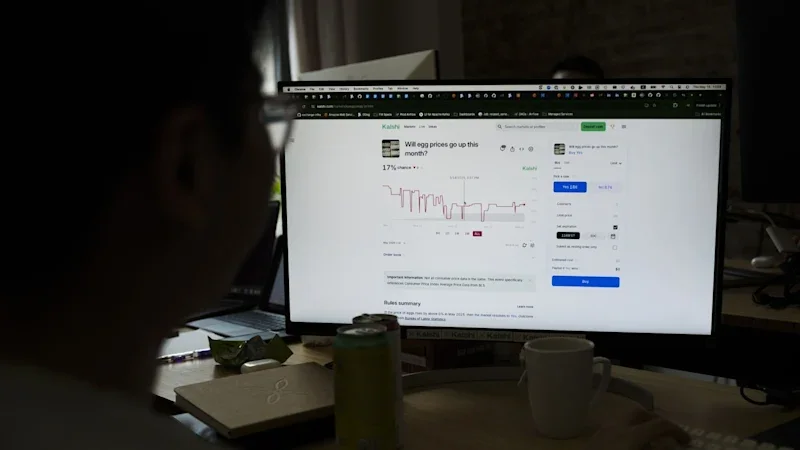
Last month it came out that a man named Gabriel Perez made more than $143,000 by predicting what Donald Trump would say in his speeches.
The rise of US-based prediction markets, Polymarket and Kalshi among them, allowed Perez to gamble on future events through “binary option” bets on whether something will (or will not) happen.
There was a problem: Perez was Trump’s teleprompter operator. He is no longer in the job, although he does not appear to have been charged at this stage.
Having grown more than 380 per cent globally in less than a year, these prediction markets can pay high returns if you bet on unlikely events. For example, at current prices, you could 233x your money by betting on Australia to win the 2030 FIFA World Cup.
It is illegal for these prediction market providers to operate in Australia; however, it takes as little as a $10 VPN to join them. Even worse, the Australian Communications and Media Authority (ACMA) – the regulator that ordered the ban – admits that using a VPN to circumvent geo-blockers is completely legal.
They aren’t all bad news. According to Australian-American economist Professor Justin Wolfers, “prediction markets produce better forecasts than the alternative, whether that’s polls, pundits, models, or other approaches”.
Prediction markets are comprised of a few sophisticated bettors against masses of small gamblers who guess based on little more than vibes.
In the 2024 US presidential election, for example, opinion polls narrowly favoured Kamala Harris, while prediction markets had Donald Trump as the clear favourite. Trump went on to win every swing state. But why does this matter?
Better predictions allow people, businesses and governments to make better decisions about the future. Wolfers argues that having “high-quality forecasts of the likelihood of the Strait of Hormuz opening”, for example, would be of great value to businesses.
These markets are so good at predicting future events, he says, because they excel at aggregating disperse information – instead of asking 10 experts, or polling a few thousand people, markets collect all this information and reflect it automatically in the live price.
When traders think the market has got the probability wrong, they can put their money behind that view, pushing the price up or down. Those willing to bet more have a greater influence on how much prices move from each bet.
The result is that many prediction markets are comprised of a few sophisticated large bettors – armed with expertise and fancy models – who bet against masses of small gamblers who guess outcomes based on little more than “vibes”.
A recent Wall Street Journal analysis found that two-thirds of all profits went to only 0.1 per cent of accounts and more than 70 per cent of users lost money. the Australian Securities and Investments Commission estimates the true number is closer to 75 per cent.
So, while the predictive benefits of these markets are real, they appear to come at the expense of the roughly 75 per cent of users who lose money.
Among other reasons, this is why anti-gambling advocates are worried about the sudden emergence of prediction markets. The recent senate inquiry on gambling is one of the many proof points highlighting the immense financial and emotional cost of gambling addictions.
Another major criticism of these markets is that some of the “smart” big bettors are operating on inside information, as Perez did. There have been more than $US1 billion in perfectly timed bets on the Iran War, raising suspicions of mass insider trading.
Even worse are cases where people have direct control over the event that’s being gambled on. Unlike most sports betting where outcomes are often determined by numerous players and coaches, some markets are as simple as predicting whether a politician or celebrity says a particular word in a speech. This makes it incredibly easy for the subject of a prediction market to influence its outcome.
And, even when people don’t have complete control, they can seek to influence it. There is evidence of individuals tampering with weather stations to influence weather-related prediction market outcomes.
Is the benefit of more accurate predictions outweighed by the risks of insider trading and gambling addiction?
Wolfers concedes it’s a hard question, adding that “current under-regulated prediction markets could easily be doing a lot more harm than good because we haven’t even thought about sensible forms of regulation”.
I concur – the benefits are real, but the risk of serious social costs to vulnerable Australians cannot be ignored.
When I talk to international colleagues at Harvard, I am ashamed to admit that Australia has the highest rates of gambling losses per person in the world. And nearly all Australians know first-hand the social costs of poker machines in pubs and casinos.
A tightly regulated model may be possible in theory, but the current US experience hardly inspires confidence that regulators have solved the problems of gambling harm, manipulation and insider information. For now, an outright ban is probably the best approach.
Australia can continue to free-ride on the informational benefits of overseas prediction markets without exposing Australians to the risks of gambling on them.
The government’s new gambling reforms do not seem to directly address prediction markets, and Minister Anika Wells’ office declined to comment on the matter.
If Australia is serious about keeping prediction markets out, the existing ACMA ban needs teeth. This means addressing the VPN loophole and other obvious ways Australians can circumvent the rules.
I suspect this may be a lower priority on the government’s gambling agenda. Perhaps I should check the prediction markets for the odds of that changing.
Max Yong is a Teaching Fellow in economics and finance at Harvard University. He previously taught at Melbourne University.
- Advice given in this article is general in nature and is not intended to influence readers’ decisions about investing or financial products. They should always seek their own professional advice that takes into account their own personal circumstances before making any financial decisions.