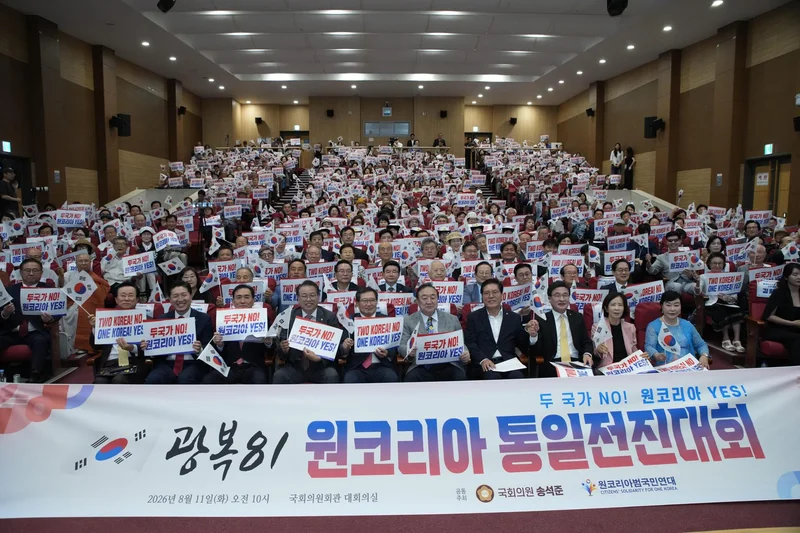
Lawmakers and civic groups gathered Tuesday to call for a unified Korea based on democracy, freedom and human rights, warning against growing discussions of a "two Koreas" approach to inter-Korean relations.
The "One Korea Unification Rally" was held at the National Assembly ahead of the National Liberation Day holiday on Aug. 15. The event was organized by Citizens Solidarity for One Korea, a civic group advocating for Korean unification.
The organizers said Liberation Day not only commemorates the end of Japanese colonial rule of Korea, but also serves as a reminder of the unfinished task of overcoming the country's division.
Participants included lawmakers, civic activists, North Korean defectors and academics. They argued that discussions of establishing the two Koreas as separate states could lead to the permanent division of the Korean Peninsula and called for reunification based on constitutional principles.
Song Seok-jun, chairman of the National Assembly’s Foreign Affairs and Unification Committee and a member of the conservative People Power Party (PPP), stressed that the Constitution clearly calls for peaceful reunification based on a free and democratic order.
"The spirit of reunification envisioned by the Constitution must not be shaken. We must not turn away from or misunderstand the reality of the division, especially as North Korea’s nuclear threats are becoming increasingly serious," Song said in his welcoming remarks.
The debate over a "two Koreas" approach comes as North Korean leader Kim Jong-un has abandoned his regime’s longstanding reunification policy and described South Korea as its "No. 1 enemy" in late 2023. The Lee Jae Myung government has emphasized peaceful coexistence with Pyongyang, which critics say could further entrench a two-state framework.
Jang Man-soon, chairman of the civic organization Committee for the Ten Million Separated Families, said Pyongyang's recent moves to define South Korea as a hostile state and abandon unification have been accompanied by discussions in South Korea about a two-state framework.
"Recognizing North Korea as a separate state would not only directly conflict with the Constitution, but could also affect the identity and rights of separated families and North Korean defectors," Jang said.
"True peace begins with restoring freedom and human rights for the people of North Korea," he said.
Thae Yong-ho, a former PPP lawmaker, also warned against the "two-state approach."
"North Korea has removed unification from its policies and officially adopted a hostile two-state approach, and South Korea is also discussing a peaceful two-state approach," Thae said. "This could lead to the permanent division of the Korean Peninsula."
Seo In-taek, chairman of the coalition organization Action for Korea United, proposed a nationwide movement centered on the "Korean Dream," envisioning unification as the creation of a new country based on freedom, human rights and freedom of religion.
"As a concrete step toward preparing for an 'endgame' of Korean reunfication, we need a nationwide movement centered on the 'Korean Dream' that expands public understanding and participation," he said.