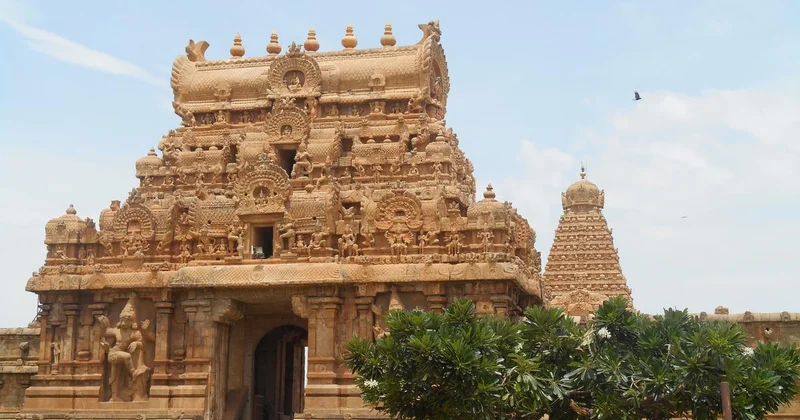
The relationship between temples and the sovereign evolved over hundreds of years and has been one of great interest to scholars. Academics Arjun Appadurai and Carol A Breckenridge studied temples in Chennai and Madurai to show how the deity in a temple was considered to be the “paradigmatic sovereign”. The daily rituals followed in South Indian temples of Shiva and Vishnu are generally described as rājōpachāra, which refers to the paying of royal honours. With royal paraphernalia including palanquins, troupes of dancers and musicians and decoration of flowers, crowns and other jewellery, the deity was given the treatment typically reserved for royalty.
During processions and temple car (ther) festivals, the chief deity is still taken out into the streets around the temple, where worshippers gather to catch a glimpse, seek blessing and provide offerings. It is not unlike how royalty would engage with subjects. Beyond the realm of the temple, the deity is used to commanding resources “which are necessary and appropriate for the support and materialisation of the ritual process”. These resources, which include lands, jewellery and other forms of patronage, were usually received in the form of donations to the temple.
With the deity treated as sovereign, the relationship between the two is a fascinating study in itself. Between the 9th and 11th centuries AD, early Cholas provided lavish donations to temples. Their Queen Sembiyan Mahadevi pioneered the patronage of temples as part of her larger strategic plan to “make herself memorable to Tamil Shiva-worshippers”. She reasoned that “nobody at court could dare move against her” if she became popular among the devout and the influential.
Thousands of temples mushroomed across the kingdom during the Chola reign. Sembiyan donated figures of Nataraja to nearly 3000 of them. Such large-scale endowments moved her devout subjects and made her a revered figure. It also forged a link between the sovereign and her subjects. This helped King Uttama Chola – Sembiyan’s son – be seen by the faithful as the “foremost devotee and champion of the great god Shiva”. The patronage of temples by the rulers brought the two closer and often rendered them indistinguishable before the subjects. The Cholas continued to patronise temples through various means, from founding endowments and instituting deities to ensuring long-term maintenance of the temple activities.
The Chola Kingdom extended all the way from the Kaveri Delta region to present-day Kanchipuram, an urban area which was (and is) known for its textile weaves. At Kanchipuram, Uttama Chola came up with an innovative system to ensure continuous revenue to the temples. He permitted temples to extend loans to the weavers. Uttama declared that the interest paid by the weavers would pay for the annual temple festival. Additionally, in lieu of the tax payable to the sovereign, immigrants to the city were ordered to supply oil and rice to the temple. To offset recurring expenses, the accounting of funds received by temples was entrusted to local merchants. Through these arrangements, the Cholas ensured that temples continued to receive ongoing contributions and contained sufficient funds to maintain religious affairs.
Under the Cholas, the first formal temple economy was borne and sustained under the patronage and purview of the sovereign. Through tax exemptions and contractual obligations coupled with royal oversight, temples were able to fund their own affairs. However, this was no guarantee against disputes and mismanagement. So, the rulers had to step in through oversight to ensure that disputes between temples and others or within the temples themselves were resolved efficiently. In the post-Chola period, especially during the rule of the Vijayanagara kings, temple management partially devolved to the hands of local notables who were considered close to the rulers. Kings continued to play the role of administrators as temples became more influential in the flourishing Vijayanagara economy; so, they never ceded complete control. Temples also served the strategic purpose of bringing together people and building the concept of a “nation state”. The growing popularity of temples could be seen as their spaces often served as educational institutions in the form of residential colleges for the study of religion. They also boarded pilgrims and travellers. They grew in sociocultural importance for the rulers and their subjects.
The relationship between the sovereign and the temples – through a complex and evolving system of donation, protection and administration – would be a defining characteristic of the pre-colonial period. There is sufficient evidence to show that the Chola and Pallava dynasties, realising the importance of temples for cementing the authority of the sovereign, promoted temples and protected their management in disputes. Later, the rulers of the kingdoms of Travancore, Mysore and Pudukkottai would do the same.
The sovereign engagement with temple affairs would continue through the colonial rule. The British East India Company, primarily motivated by the expansion of commerce and trade, set up the Board of Revenue in 1789. The Company recognised the financial potential in large tracts of land and other assets under the possession of temples. Consequently, the collection of revenue from religious institutions, by managing its affairs, was assigned to the Company-appointed board. Collectors were deputed to oversee revenue collection, detect mismanagement and decide disputes. Though it is generally believed that the Company got involved in the affairs of religious institutions because of the scale of the endowments at stake, they also displayed a keen sense of moral duty to see that the vast properties endowed to the temples were put to the purpose intended by the donor.
These concerns led to the Madras Endowments and Escheats Regulation, 1817, the first law enacted by the Company’s administration relating to religious and charitable endowments. The 1817 Regulation allowed for due appropriation of the rents and produce from lands granted for the support of mosques, Hindu temples and colleges or other public purposes. The Regulation was religion-neutral and driven by the sense that temple endowments were made for public purposes and ought not to be misappropriated.
The motivation for the 1817 Regulation is apparent from its text, which notes that it is the “duty of the Government to provide that all such endowments be applied according to the real will of the grantor”. Moreover, the Company made it clear that they did not intend to resume to itself any part of the endowments, but the aim was limited to superintendence of the endowments. To implement this, local agents were appointed in each zilla, who functioned under the authority of the Board of Revenue. The agents, tasked with collecting information from public records, were empowered to undertake inquiries of endowments and to report any mismanagement to the board.
The 1817 Regulation also enabled any individual to file a suit against orders passed by the authorities, thereby introducing public involvement in oversight of the endowments. Soon, the revenue officials of the Company started playing a crucial role in managing temple finances and exercising direct supervisory authority over temple administration. The fiduciary relationship between the Company and temples deepened through the practice of depositing temple finances in the Company’s treasury. A portion of this money was retained by the Company as banking charges as well as for providing oversight of the endowments. Thus, the relationship between the Company – in its capacity as sovereign – and temples started to grow in importance and got intertwined with one another.
Excerpted with permission from The People’s Sanctum: The 100-Year Struggle to Democratize Temples in India, Manuraj Shunmugasundaram, Penguin India.
We welcome your comments at letters@scroll.in.