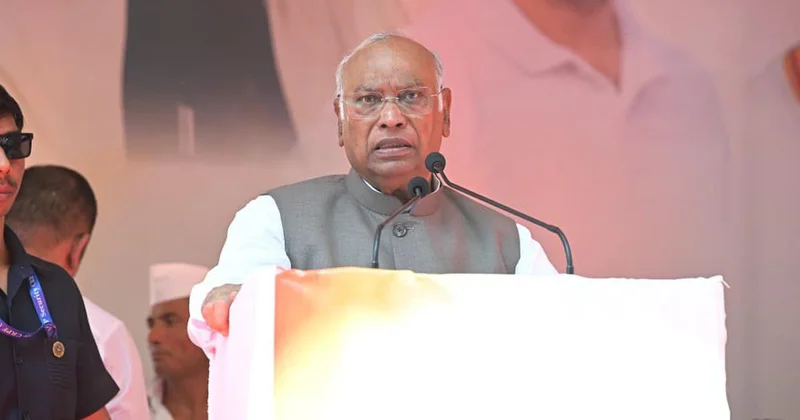
Eighty years into a constitutional order that abolished untouchability with euphoria, a Hindutva outfit carried out a “purification” ritual on a public ground in Haldwani where Congress president and Leader of the Opposition Mallikarjun Kharge had addressed a rally shortly before before Independence Day.
On August 10, two days after Kharge’s rally at the Ramlila Ground, members of the Shri Ram Sena held a “shuddhikaran”, a “purification” havan, on the very stage from which Kharge, a Dalit, had spoken.
Kharge raised the matter in Parliament, visibly shaken, asking with the characteristic parliamentary decency befitting its stature as a senior-most member: “Is this the way in a democracy? How are you protecting the Constitution?” Leader of the House and Union minister JP Nadda, with the same, sterile parliamentary decency, condemned the incident, said the BJP did not support such activities, and assured Kharge the matter would be investigated.
Underneath this theatre of denial and condemnation – the expression of “regret,” the promise of an inquiry, the predictable back-and-forth of blame – is a fact that should stop the republic in its tracks: a man is “purified” out of a public ground for the offence of having stood on it while Dalit. He is no labourer or an ordinary person but the president of India’s oldest political party, a member of Rajya Sabha, a man who has held four decades of high public office.
It is worth sitting with Kharge’s questions.
Kharge is a man of the masses, and hence he should know well that this has been the way Indian democracy has always worked – including through the decades his own party governed.
No survey is really required to establish the lived, daily reality of the country’s roughly 170 million Dalits; a reality that surfaces – after clearing enormous social, economic, and political barriers to registration – in the National Crime Records Bureau’s statistics on caste atrocities.
Those atrocities are themselves nothing but the concentrated expression of untouchability, and they occurred in large numbers through the Congress era as well. What has changed is the political climate around them.
A pattern
Situating the “purification” that followed Kharge’s address Haldwani within a longer record makes clear this is a structural pattern, not a one-off provocation.
On January 24, 1978, Jagjivan Ram, the defence minister at the time and one of the most senior political figures in the country, unveiled a statue of Sampurnanand at a Sanskrit university in Varanasi. After he left, local Brahmins reportedly performed a purification ritual on the statue because it had been touched by a Dalit – accounts describe it being smeared with cow dung and washed with Ganges water.
A 1986 Lok Sabha debate recorded Jagjivan Ram’s account of the incident. The Supreme Court, in a 1992 ruling, and a transcript from a national Judicial Academy seminar cited the episode as an example of untouchability persisting even at the highest levels of public life. What makes it devastating is that the “polluting” touch was that of a sitting Union Cabinet minister and a national leader of decades’ standing.
More recent examples continue the pattern.
In January 2020, Rajiv Saizal, then Himachal Pradesh’s minister for social justice and a Dalit, told the state assembly that he had been denied entry to a temple because of his caste; Governor Bandaru Dattatraya publicly voiced concern and called caste discrimination unconstitutional.
A 2015 Lok Sabha debate on the Scheduled Castes and Scheduled Tribes (Prevention of Atrocities) Act recorded that a Dalit MLA had allegedly been prevented from eating with colleagues at an official meeting in July 2011. It also recorded that in June 2011, the Chairperson of the National Commission for Scheduled Castes – a Dalit – was denied entry into a Hindu Temple.
Two presidential episodes belong in this record. There were allegations that temple servitors treated President Ram Nath Kovind, a Dalit, disrespectfully during a visit, which former BJP MP Savitri Bai Phule cited as an instance of disrespect toward a Dalit head of state – though this may equally be read as a protocol lapse rather than untouchability as such, even if the question of why it happened to a Dalit President in particular remains legitimate.
There were also claims that Kovind was deliberately excluded from the 2020 foundation-laying ceremony of the new Parliament building and then the unveiling of the national emblem in July 2022 at the new building. There were similar claims that President Droupadi Murmu was excluded from the inauguration of the new parliament building in 2023.
Controversy also erupted in June 2023 over whether Murmu had been denied entry to the sanctum sanctorum of the Jagannath Temple in New Delhi. Temple authorities denied any discrimination and said Murmu had chosen not to enter. Murmu is an Adivasi and is not technically subject to untouchability in its typical form – but Adivasis, too, remain outside the fold for much of caste Hindu society, which is its own separate and serious question.
Incidents of untouchability against elected Dalit representatives and sarpanch leaders in rural India are, in fact, legion – far more numerous than the handful that reach national media. The everyday reality of rural India is one of separate wells and cremation grounds, restrictions on temple entry, social boycotts for inter-caste marriage, and violent retaliation for something as minor as a Dalit groom riding a horse through a village.
The “purification” in Haldwani did not introduce a new form of caste assertion into Indian public life. It simply performed, in front of national television cameras and in Parliament records, the same logic that governs thousands of unrecorded village-level humiliations every year – except this time the victim had the platform that made it impossible to ignore.
Symptom, not the disease
If untouchability has persisted this visibly, and at this level of public life, for eight decades, the question worth asking is why the constitutional abolition of untouchability failed to touch the thing that produces it.
Article 17 of the Constitution states: “Untouchability is abolished and its practice in any form is forbidden. The enforcement of any disability arising out of Untouchability shall be an offence punishable in accordance with law.” The provision – draft Article 11, which became Article 17 – was moved by BR Ambedkar, the foremost votary of the annihilation of caste, and was adopted unanimously by the Constituent Assembly on November 29, 1948, framed partly as a tribute to MK Gandhi. Members rose in applause, congratulating themselves as though a revolution had been accomplished.
Only three voices in the Assembly registered scepticism, and they deserve to be named. Pramatha Ranjan Thakur – great-grandson of Harichand Thakur, founder of the Matua sect, one of the earliest Dalit reform movements, and the first barrister from the Namasudra community in Bengal – argued: “I do not understand how you can abolish untouchability without abolishing the very caste system. Untouchability is nothing but the symptom of the disease, namely, the caste system... Unless we can do away with the caste system altogether there is no use tinkering with the problem of untouchability superficially.”
Thakur was the lone Scheduled Caste member to raise this critique. He found support from two upper-caste Bengali members. Suresh Chandra Banerjee, a Brahmin and a distinguished scholar of ancient Indian history and literature, endorsed the same view: “Untouchability is merely a symptom, the root cause is caste distinction and unless and until the root cause is removed, untouchability in some form or other is bound to exist.”
Dhirendra Nath Datta, from an aristocratic Kayastha family, who would go on to serve in Pakistan’s Constituent Assembly after Partition, put it even more starkly: “the root cause of untouchability, namely, the caste system, in Hindu society should be abolished altogether. Unless the caste system is abolished, untouchability will persist in some form or other... unless Hindu society is drastically reformed by abolishing the caste system, it is bound to perish. Caste system should be abolished.”
These were consequential interventions. They were also completely ignored. The euphoria in the Assembly was such that the dissenters did not even press for a formal amendment, and – tellingly – not a single other Scheduled Caste member rose to support them, perhaps out of concern that questioning caste itself might jeopardise the reservations based on caste.
The deeper reasons for this silence go beyond parliamentary inertia. All upper-caste reformers, best represented by Gandhi, had built their entire public campaign around opposing untouchability, not caste as such – Gandhi, for most of his life, actively defended the varnashram system and caste itself as a form of social organisation, even as he condemned the treatment of “Harijans.” The Constituent Assembly, dominated overwhelmingly by the Congress, was in this sense simply fulfilling one of the party’s own long-standing freedom-struggle promises, framed within limits Gandhi himself had set.
But there was a more consequential reason still. The new rulers, having inherited the colonial state apparatus, had no wish to relinquish caste and religion as instruments of governance – the very levers that had proven so useful to colonial administration in stratifying and managing the population.
The Constitution, despite an elaborate drafting process spanning nearly three years, ended up adopting much of the structure of the last colonial constitution (The Government of India, 1935), effectively continuing the colonial state apparatus under republican garb.
Caste was thus skilfully preserved even as untouchability – the two conflated in most people’s minds – was abolished. Caste was, if anything, integrated into the constitutional order as the very basis of the social-justice superstructure built around reservations. Religion, meanwhile, was preserved through a particular conception of secularism in which the state professes no religion of its own and treats all religions as equal – a formulation that never satisfactorily answers how a state constituted through majoritarian institutions can, in practice, actually treat all religions equally.
The result is a republic that declared itself sovereign, and declared the people the source of that sovereignty, while retaining nearly the entire coercive infrastructure through which a colonial power had once ruled a subject population. This is the real meaning behind the observation that what changed after 1947 was rhetoric, not apparatus. The new rulers spoke the language of national liberation and popular sovereignty but administered the country through the same police structures, the same bureaucratic hierarchies, the same emergency and preventive-detention powers, the same fundamentally executive-heavy design the British had built to manage a colony, not to answer to its people.
Eighty years later, the ordinary citizen’s actual experience of the state – as something to be feared, placated, and survived, rather than as an instrument they command – is the direct legacy of that continuity. Sovereignty exercised only once every five years, over a machinery of governance the people cannot actually direct in between, is sovereignty in name only.
Politics of impunity
As the record above makes clear, untouchability was never going to be abolished while caste itself continued to live and thrive – and the original sin here can be traced to the Congress, with its own particular political logic of opposing untouchability while leaving caste, and the colonial state form, undisturbed.
But the story takes a different turn with the BJP, the political arm of the Sangh Parivar, which openly swears by “sanatan dharma”, the source of the caste system and whose leaders have, at moments, proclaimed the life of a cow matters more to them than the lives of Dalits. Since power has settled into its hands, the practice of caste and untouchability has been pursued not merely as inherited social inertia – as it largely was under Congress rule – but with something closer to ideological conviction, restrained mainly by electoral calculation. When that restraint slips, as in Haldwani, what surfaces looks less like an isolated lapse and more like conviction meeting impunity.
What has genuinely changed with the ascendancy of a party rooted in Hindutva and organisationally intertwined with the Rashtriya Swayamsevak Sangh and its affiliate outfits, then, is not the existence of caste prejudice – which long predates it – but its degree of impunity.
When an organisation like the Shri Ram Sena can perform a purification ritual at a public ground used for a rally by the country’s principal opposition leader, and the ruling establishment’s response is a carefully worded expression of “regret” alongside an inquiry that predictably produces no visible consequence, the message transmitted – not to elites in Delhi, but to caste Hindu vigilante formations across the country – is unambiguous: such acts carry no real cost.
The numbers bear this out. Despite the current regime’s documented tendency to obscure inconvenient data, the latest NCRB report for 2024 still records crimes against Dalits well above the 55,000 mark for the year – an average of roughly three Dalits murdered and twelve Dalit women raped every single day.
These figures have largely ceased to generate sustained public interest. This is what makes the rising incidence of atrocities against Dalits over the past decade legible as something other than a statistical anomaly or a law-and-order failure. It is the visible manifestation of an untouchability that was never dismantled, now operating within a political climate that treats its assertions with, at best, performative disapproval.
Reading Haldwani correctly
Seen this way, Haldwani is not an isolated embarrassment for one party or one region. It is a single, sharply-lit instance of two much larger and interlocking failures: the failure to recognise, at the republic’s very founding, that untouchability could never be abolished while caste itself survived, and the failure to build a genuinely new state apparatus in place of the colonial one whose coercive core the republic simply inherited and re-badged.
The first failure explains why a Dalit leader, eight decades after Article 17, can still be ritually purified out of the ground he has spoken from. The second explains why, when this happens, the citizen’s only recourse is to ask a rhetorical question in Parliament and hope that a machinery of state – structurally the same machinery colonial subjects once petitioned in vain – chooses this time to act.
It would be a mistake to read the anger this incident has generated as a partisan skirmish to be resolved by an inquiry report. The root lies much deeper, and reaching it will take the courage to dig up foundational wrongs rather than dealing superficially with symptoms – a task that can only be accomplished through persistent, uncomfortable questioning. The reflexive worship of “holy cows,” in both the literal and figurative sense, has been part of what now threatens, existentially, to erase even the modest gains Dalits have made since 1950.
The Constituent Assembly’s three dissenting voices on Article 17 were right, and they were ignored. Eighty years on, the ordinary Dalit citizen – without Kharge’s office, his security, or his visibility – continues to pay the price of that convenient ignorance, largely outside the range of any camera. The incident in Haldwani simply made an old and continuing wound, for one afternoon, impossible to look away from.
Writer and civil rights activist Anand Teltumbde is a former CEO, Petronet India Limited and a professor at IIT Kharagpur and the Goa Institute of Management. His most recent book is The Cell and the Soul: A Prison Memoir.
We welcome your comments at letters@scroll.in.