Dear young friends,
Greetings!
As our nation celebrated its 80th Independence Day, I am happy to share a few thoughts with you, the teenagers and young people who are the pillars of our nation.
Veni, vidi, vici — “I came, I saw, I conquered.”
This famous Latin phrase is attributed to Julius Caesar, who reportedly used it after his swift victory at the Battle of Zela in 47 B.C., more than 2000 years ago. Three short words captured the confidence of a conqueror who faced an obstacle and overcame it. More than two millennia later, I think your generation has found its own version of veni, vidi, vici.
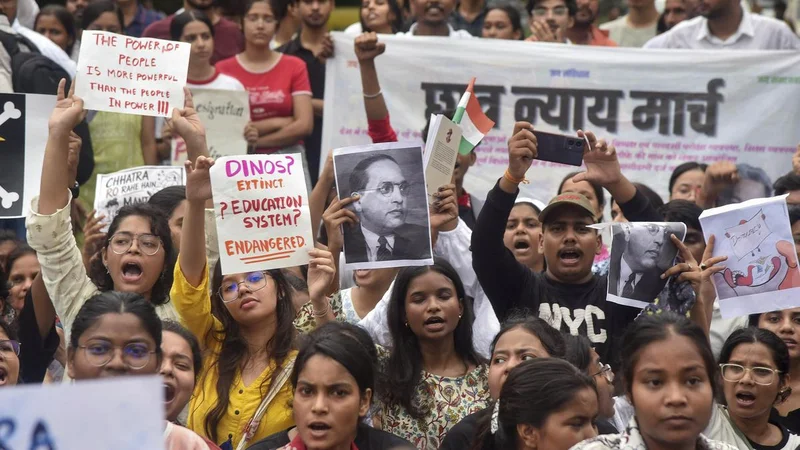
In June, thousands of Gen Z protesters gathered at Jantar Mantar in Delhi and demanded the resignation of Union Education Minister Dharmendra Pradhan over examination-related irregularities. The Cockroach Janta Party (CJP) organised the protest, which grew into a 49-day agitation. On July 25, Mr Pradhan resigned, and the CJP called off its protest after the government gave assurances on some of its other demands. The protesters brought with them something incredibly important: the freedom to express their views, the courage to question, and the determination to be heard.
They came. They saw. And they conquered. The Gen Z protest makes us think about what freedom really means to young Indians today. Is it merely the right to vote once every five years or the freedom to express an opinion? Or does it also mean having the courage to question those in power, demand accountability, and call for reforms when institutions fail us? Independence Day is a good occasion to reflect on these questions. We celebrate the freedom India won in 1947, but every generation must discover what freedom means in its own time. For your generation, freedom may increasingly mean the confidence to speak up, question authority, and demand a better education system and a better society.
Perhaps the most important lesson from the Gen Z protest is this: freedom is something we exercise.
But the freedom to think and express yourself should not begin only when you become an adult. It must be nurtured from childhood.
Freedom begins at home
Many parents, relatives, elders, teachers and even the education system unintentionally impose their views on children and young people. When you are not allowed to think for yourself or make decisions about your studies and career, you may gradually lose your individuality and simply learn to follow instructions. You do not necessarily have to share your parents’ political beliefs, career choices or opinions. You have a mind of your own and the right to form your own opinions.
Lebanese American poet Kahlil Gibran expressed this beautifully: “Your children are not your children. They are the sons and daughters of Life’s longing for itself. They come through you but not from you.”
These words remind us that children are individuals in their own right. Parents can guide and advise you, but they should not impose their dreams and choices on you. Think about a familiar situation. Suppose your parents are doctors and want you to become a doctor too. There is nothing wrong with their desire. They may simply want you to follow a path they believe will give you a successful future. But what if you have no aptitude for medicine? What if your passion lies in engineering, literature, journalism, the arts, technology or something completely different?
Should you be forced to live someone else’s dream? I don’t think so.
You should have the freedom to discover your interests, recognise your strengths, choose what you want to study, and eventually decide what you want to do with your life. Education is not about programming you to follow instructions; it is about helping you think independently, ask questions, make informed choices and become the author of your own life.
Never be afraid to ask questions
The freedom to think naturally leads to curiosity, and curiosity leads to questions. And questions are powerful. History gives us many examples of the importance of questioning accepted beliefs. Consider the story of Galileo Galilei. For centuries, people widely believed that the Earth was stationary and at the centre of the universe. In the 3rd Century B.C., however, Greek astronomer Aristarchus of Samos proposed the radical idea that the Sun, rather than the Earth, was at the centre. His idea was not widely accepted because the Earth-centred view was deeply rooted in popular belief.
More than 1800 years later, Galileo used a telescope to observe the night sky and found evidence supporting the Sun-centred model. He did not simply accept what he had been taught; he observed, questioned, and drew his own conclusions. His ideas challenged prevailing beliefs and eventually brought him into conflict with the Roman Catholic Church.
The stories of Aristarchus and Galileo teach us an important lesson: accepted beliefs are not necessarily correct. Progress often begins when someone has the courage to ask a simple question: “What if we are wrong?”
So, never be afraid to ask questions. Questioning does not mean that you are disrespectful or rebellious. It means that you are curious and willing to learn.
Learn how to think, not just what to think
This is why your classroom should not merely be a place where you are taught what to think. It should be a place where you learn how to think.
When you encounter an unusual idea, don’t accept or reject it immediately. Examine it. Look for evidence. Listen to different perspectives. Discuss it with others. Then form your own conclusion.
Being an independent thinker does not mean thinking alone. You can disagree with someone while respecting them, and you can change your opinion when you encounter better evidence. In fact, the willingness to change one’s mind may be one of the signs of a truly open mind.
A free society needs citizens who can think freely. If we want to nurture such citizens, we must begin in our homes and classrooms.
The freedom India won in 1947 gave us the right to live as free citizens. Your generation has another responsibility: to make sure that freedom continues to live in our minds and institutions.
Seven habits of a free mind
- Be curious.
- Ask questions.
- Think independently.
- Listen to others.
- Challenge ideas respectfully.
- Choose wisely.
- And have the courage to speak up when something is wrong.
After all, a nation is truly free not merely when its people are free from foreign rule, but when its young people are free to think for themselves.
With warm wishes,
Albert P’Rayan
(Dr Albert P’Rayan is an ELT resource person, trainer and education columnist. Send your feedback to rayanal@yahoo.co.uk)
“Confidence is knowing who you are and not changing it a bit because of someone’s version of reality is not your reality.””Author, Shannon L. Alder
Published - August 18, 2026 10:12 am IST