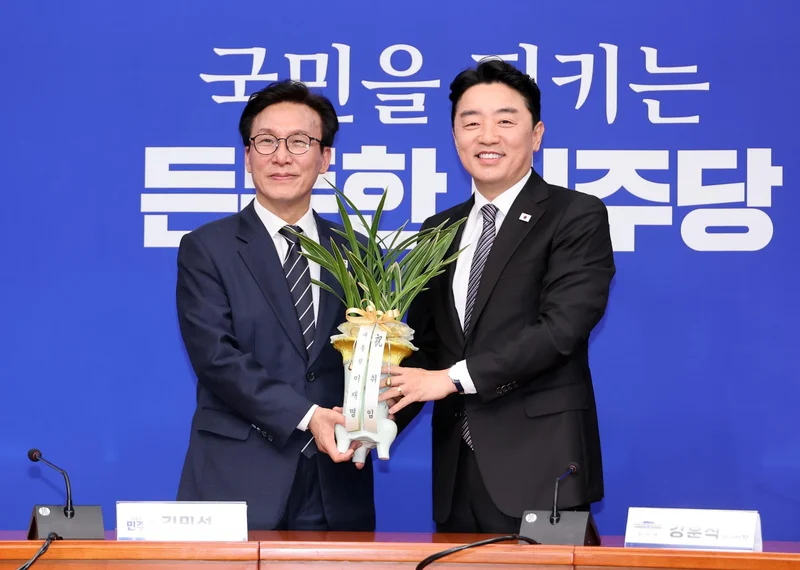
Former Prime Minister Kim Min-seok has been elected leader of the ruling Democratic Party of Korea. His victory at the party convention on Monday, when he won 54.08 percent of the final vote against former leader Jung Chung-rae’s 45.92 percent, marks a consequential moment for both the party and the Lee Jae Myung administration.
Kim’s victory, achieved after a runoff, was relatively narrow. It suggests that party members want a stable working relationship between the presidential office and the ruling party, but it also underscores the divisions exposed during the leadership contest. The new leadership faces an urgent task: healing a party fractured between Kim’s pro-Lee camp and Jung’s supporters, and replacing factional warfare with constructive debate over policy.
The contest was widely seen as a showdown between Lee and Jung's political factions within the party. Yet the real differences between the two sides were less about policy than about influence and the distribution of power ahead of the next general elections. Such a contest risks turning the ruling party into an arena for internal patronage rather than a vehicle for governing the country. Kim must ensure that disagreement within the party becomes productive rather than destructive.
Equally important is the need to redefine relations between the ruling party and the presidential office. Kim has pledged to establish what he calls a “creative horizontal relationship,” in which the party fully cooperates with the president and government. Cooperation is essential for a governing party, but must not become subservience. A responsible ruling party should support the administration’s legitimate agenda while also telling the president when policies are out of step with public sentiment.
Kim therefore needs to serve as a check on the government. That role is particularly important as the Lee administration faces growing public skepticism. Controversies over property-tax reform, the abolition of prosecutors’ supplementary investigative powers, proposals concerning the withdrawal of criminal charges against the president and calls for constitutional reform have all raised questions about whether the government is sufficiently attentive to public opinion.
The proposed withdrawal of charges involving Lee deserves especially careful scrutiny. Even if supporters believe it is politically or legally justified, pushing such a measure through the ruling party could deepen public distrust and fuel accusations that the governing camp is changing the rules for its own benefit. With the next general elections roughly two years away, the ruling bloc should not manufacture a political crisis through actions that could alienate voters and intensify internal divisions.
The same principle applies to property tax reform. Kim has said he broadly supports the government’s direction while acknowledging the need for detailed adjustments. But the issue requires more than cosmetic revisions. When policies directly affect household finances and housing security, the ruling party must convey voters’ concerns frankly to the administration and ensure that ideology does not override practical realities.
Kim has promised “people-centered,” “everyday,” “inclusive,” “expansive” and “competent” politics. Those commitments should now be tested in practice. What voters need is not a more powerful or more combative ruling party, but a more democratic and inclusive one. That means resisting excessive polarization, listening beyond the party’s most fervent supporters and treating the opposition as a legitimate partner in governing the country.
Kim’s political career gives him both advantages and disadvantages. He has enjoyed a long and prominent career, but he has also endured criticism and a lengthy period away from frontline politics. Now, as the leader of the ruling party with significant influence over nominations for the next election, he faces perhaps the most consequential test of his career.
His central responsibility is clear: He must put public sentiment ahead of factional loyalty. Even if Kim won the leadership with the backing of the president, he must now govern the party with the trust of the broader public. He should support the president when support is warranted, speak frankly when it is not, reconcile competing factions within the party and pursue reforms at a pace the public can accept.
The strength of any governing coalition ultimately comes from public consent. Kim should remember that principle above all else. His challenge is not to build a stronger ruling party, but a wiser, more democratic and more inclusive one.