When British band Massive Attack covered Seo Taiji and Boys’ “Regret of the Times” during their set at the Incheon Pentaport Rock Festival, it was clearly meant to provoke. Their social media posts and onstage performance made the message evidently clear: K-pop, which once stood as a form of resistance against state censorship, has now become subjugated to capitalism and mass commodification.
The possibility of it being a mere fan service for their Korean audience can be dismissed, with the band delivering the same message during its performances in Japan and Sweden. It was crystal clear that their intent was to raise questions about K-pop, which has become globally influential.
Some took issue with the band including a footage of the 1980 Gwangju Uprising during its “Regret of the Times” performance, complaining that it amounted to a “political message.” The resulting controversy feels almost reminiscent of the censorship battle Seo Taiji and Boys faced when Korea's Public Performance Ethics Committee objected to the song's lyrics 30 years ago. More importantly, it entirely misses the message the band was trying to convey.
The message the band conveyed had little to do with resisting against oppressive political regimes, but with problems inherent in the K-pop industry. The performance appears to reflect criticisms that the industry is producing idols who are bound to live a music career managed by companies like stock prices.
One may dismiss the criticism as a bunch of older musicians who debuted 40 years ago complaining about music nowadays. K-pop, after all, was not unfamiliar with age-old attacks over its musicians being devoid of autonomy and creative agency.
But being an age-old problem means it has persisted after all these years, and eventually there will come a moment when it needs to be addressed. That moment may now be inching closer. Following BTS' global success, the format of the K-pop industry is starting to be met with more understanding and tolerance — and, by some, even encouragement.
However, K-pop is becoming increasingly contradictory. The discrepancy between commercialization and artists’ creative agency grows bigger as agencies become larger and producer credit lists gets longer.
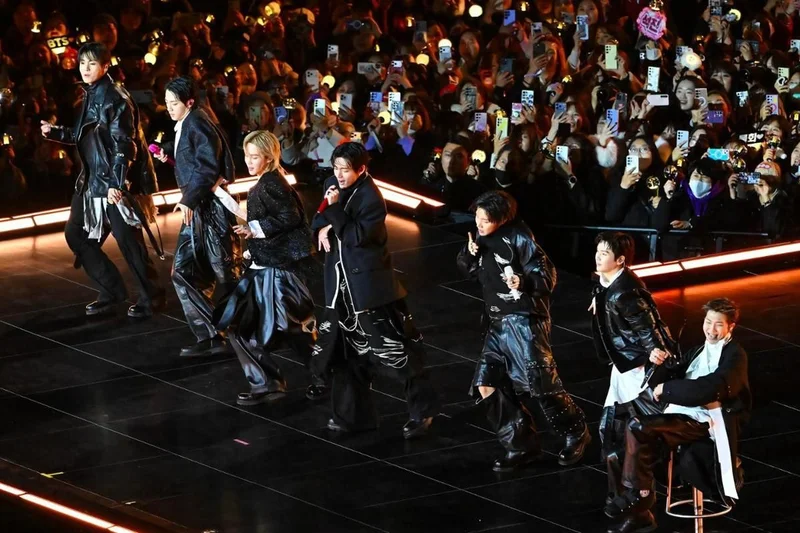
Even BTS offered a glimpse of this tension in their documentary about the group's return to the spotlight after a nearly four-year hiatus due to mandatory military service. In the documentary, the members disagreed with the company’s directive to incorporate an Arirang theme into their songs. Judging by how the documentary and the actual comeback stage played out, it seems that BTS gave in and accepted the role of being the “K-pop icon” that HYBE chairman Bang Si-hyuk pushed so strongly. The decision must have come after long deliberation, but the gloomy thought remains that even BTS is unable to break free from the system.
At the new heights K-pop has reached, the industry no longer pretends its idols are not products, but instead explicitly emphasizes that they are. Fans demand that their idols be the glowing products they were intended to be, and the idols faithfully fulfill those expectations. Agencies continue to release ever more expensive products that reinforce this structure. When aespa's Karina was caught dating, it was in this context that she wrote a handwritten letter of apology. Ironically, aespa covered “Regret of the Times” just before the Karina fiasco blew up.
What kind of incisive and subversive music, if any, will these idols produce, when they are forced to live up to the expectations of their companies and fans, and have to date in secret so their group’s stock price does not go south? Their situation embodies the question the British band asked: Has culture lost its political power?
K-pop can no longer dodge away from these questions, for it has grown too big to brush them aside with the meek excuse that this is simply how K-pop has always been. If anything, companies and the Korean government are joining hands to actively promote K-pop and its fandom culture to the world under the name “fanomenon.” Instead of coming up with palatable notions such as “a culture driven and shaped by proactive fans,” they need to clearly explain why the project matters and what they want to achieve.
It would be absurd to tell them to give up a business model that works so well. But using such a commercially successful mechanism, for once, to channel positive change into the world is certainly an idea worth considering. Although musician Jung Tae-chun was the central figure in the fight against prior censorship in the 1990s, it was Seo Taiji and Boys, the biggest stars of their time, and their fans who turned the tide of that uphill battle almost overnight.
A brief glance beyond K-pop shows that a surprising number of musicians are writing and singing resistance music. There is no reason to rule out the possibility of a pop star emerging to lend strength to such a movement. The first step would be to think over what those older musicians were trying to say with “Regret of the Times.”
This article from the Hankook Ilbo, the sister publication of The Korea Times, is translated by a generative AI system and edited by The Korea Times.