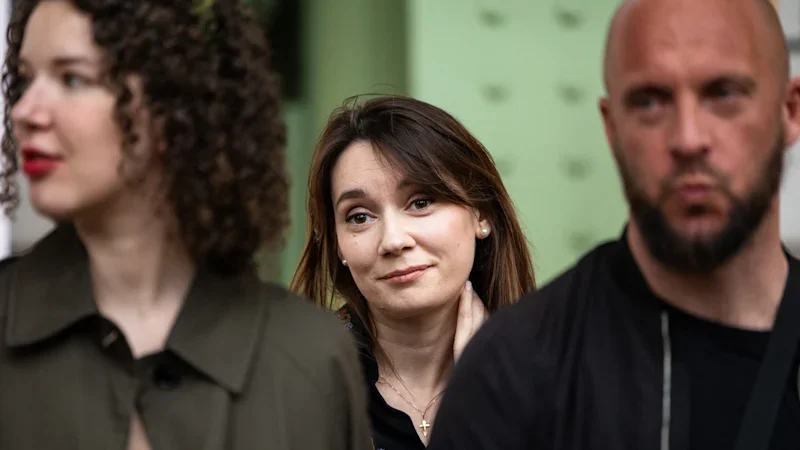
London: When French authorities ordered Xenia Fedorova to leave the country three weeks ago, the Russian television host gained swift support from some senior figures on the political right.
Fedorova, an ardent supporter of Russian President Vladimir Putin during years of broadcasts from Paris, railed against the expulsion and sought to overturn the decision in court.
Her defenders included Philippe de Villiers, a former cabinet minister and presidential candidate, who declared the move an illegal act by a paranoid government.
“We are witnessing the radicalisation of a cornered regime that can no longer tolerate dissenting voices,” de Villiers said.
“As it weakens, it develops a paranoia toward any form of criticism. This is the shift to authoritarianism and the climate of state suspicion.”
Now the nation’s foreign minister, Jean-Noël Barrot, has denounced her as a threat to France and linked her case to a pattern of Russian interference and sabotage in Europe.
“This professional in subversion, trained in Russia, carried out destabilisation operations directed by the Kremlin,” Barrot declared on Monday (Paris time).
“Her case illustrates the threat of interference we are confronted with. The enemies of democracy are observing us. They scrutinise our debates, exploit our anger and our fears.”
That makes her case a key test of government action against Russian influence. Kremlin agents have been found guilty of sabotage in the United Kingdom, France and Poland. Concerns grew last week when a drone carrying explosives was discovered near a Ukrainian cargo plane at an airport in Leipzig, in Germany’s east.
This means the attention on Russian influence is stronger than ever, especially after The Wall Street Journal reported on August 6 that US intelligence officials believed Putin might try to test NATO with a “limited incursion” into Western territory.
For her supporters, however, Fedorova is merely a journalist with strong opinions.
Said to have been born Ksenia Borchik in the Russian city of Kazan in 1980, Fedorova emerged with a new name as a producer for the Russia Today network in France in the early 2000s.
She found a home at the media networks owned by right-wing billionaire Vincent Bolloré when France and other countries shut down Russia Today (also called RT) after the full-scale invasion of Ukraine in February 2022.
French President Emmanuel Macron dismissed her as a propagandist, yet she continued her rise on the right-wing channel CNews, likened by some to Fox News because of its conservative bent. Among his critics, Bolloré is sometimes described as a French Rupert Murdoch.
His support for the Russian host appears undimmed. Two media companies within the Bolloré empire, Canal+ and Lagardère, condemned the government’s move to expel her.
“Freedom of expression is not defended only when the opinions expressed are consensual,” they said.
“It is defended precisely when they disturb or provoke disagreement, provided they form part of democratic debate, as is the case across all of our media.”
When Fedorova challenged the expulsion order in the Paris administrative court, she lost her request for an emergency injunction. She has not disclosed her location but appears to be planning other legal challenges.
“Already being out of France, I will not return there until these measures have been suspended or annulled,” she said on August 4.
The latest move by the French government shows that Macron and his allies will step up their warnings about Russian influence in the lead-up to April’s presidential election.
That presents a challenge for National Rally leader Marine Le Pen, who has expressed admiration for Putin in the past.
Le Pen’s senior party colleague, Jordan Bardella, has been more critical of Putin and the Russian invasion of Ukraine. Even so, the National Rally leaders have been silent on the expulsion of Fedorova – as if the issue is too hot to handle.
In his latest missive, Barrot raised the stakes by citing Fedorova as part of a wider Russian threat to the West.
Barrot said the Russian goal was to influence decisions in France and other countries without being held accountable – and he warned that the lines between influence and subversion were now blurred.
“From Moldova to Germany, via Romania and Poland, we have seen the same pattern emerge,” he wrote in Le Monde.
“Propaganda, information manipulation, opaque funding, along with sabotage and drone attacks, such as those witnessed during the week of August 3 in Leipzig, Germany.
“The aim is always the same: to sway elections, delegitimise political leaders and set citizens against one another.”
On one point, there is no doubt. Fedorova has certainly set French leaders against each other. We have yet to see how this plays out in the presidential campaign.