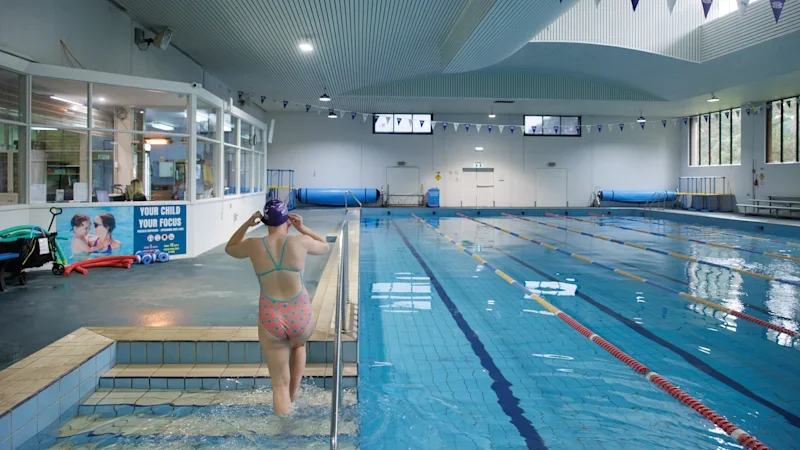
In its day, the Wonthaggi pool was ahead of its time. When it opened in 1980, there were few indoor pools in regional Victoria.
But the pool’s heyday ended long ago. The 25-metre pool, about 140 kilometres south-east of Melbourne, is primitive by modern standards.
The separate children’s pool is a cramped and brutalist concrete square. Last week, the heat pump failed, forcing the cancellation of popular classes such as water aerobics.
Bass Coast Shire mayor, Brett Tessari said without a major upgrade the pool faced certain closure.
“We’ve got bits of material falling off the walls all the time,” he said. “It’s the only pool we have. So when this does finally die, our community has no pool.”
From Port Fairy in the state’s south-west, to Bendigo and Bairnsdale, regional communities have long fought to save their pools when they fall into disrepair.
Now, the Bass Coast Shire is hoping to leverage Wonthaggi’s location in one of the state’s most marginal state seats, Bass, to secure funding pledges before the November state election.
In the 2022 state election, Labor won Bass by just over 200 votes on a two-party-preferred basis. Pool advocates want the upgrade to become a local election issue.
“We have been advocating to all sides of the political spectrum, asking for an election promise,” Tessari said.
The council has committed $15 million to the upgrade, but wants $15 million each from the state and federal governments.
Tessari said the council was told about 11 years ago that the pool had a 10-year lifespan.
“It’s evaporating, losing water at an incredible rate. So, it’s costing a fortune to keep the doors open.”
Despite the pool’s dilapidated state, it remains immensely popular. Figures supplied by the pool’s management show the facility had 15,000 visits a month and about 610 members. It provides lessons for about 380 students a week.
The council wants to widen the existing 25-metre pool and build a spa, sauna, cafe and new changing rooms. It also wants a new children’s pool and another heated pool geared towards older swimmers.
The council also hopes to upgrade the centre’s existing indoor sports facilities, including a gym and multipurpose rooms.
The council expects demands for the aquatic centre will continue to rise. The Bass Coast Shire’s population has already surpassed 41,600, but is set to exceed 47,400 by 2036.
That population growth could also influence the outcome in the Bass electorate in November.
Monash University political scientist Zareh Ghazarian said winning Bass could prove crucial for whichever side wins the election.
He said Labor faced an uphill battle to form majority government without seats like Bass. Likewise, Ghazarian said, the Coalition would struggle to win without taking Bass from Labor.
“There’s a lot riding on Bass,” he said. “It could be one of those handful of seats that determines who wins government.”
Ghazarian said candidates in Bass would have to balance the interests of diverse communities, from growth areas on Melbourne’s outskirts to more established rural areas, including Phillip Island, Inverloch and Wonthaggi.
That means election promises have to be finely tuned to local communities within Bass to be successful. “They will have to be tailor-made for Bass.”
Bass Labor MP Jordan Crugnale announced last year that she would not contest the November election, robbing Labor of the advantage of incumbency.
Labor has preselected former Latrobe Valley Authority chief executive Chris Buckingham to contest the state election. The Liberals preselected former Bass Coast Shire mayor Rochelle Halstead.
A spokesperson for the Victorian government said the Bass Coast deserved world-class sport and aquatic facilities, and the government was working with the council to explore how it could support a redeveloped Wonthaggi pool.
The spokesperson said Labor had spent $106 million on regional aquatic facilities since 2014 because people in communities like Bass should not have to travel for essential services.
The opposition did not respond to a request for comment.
Inverloch resident Marilyn Crump uses the pool three times a week for water aerobics and socialising. She loves the classes and cups of tea and coffee afterwards.
“If anybody’s got a problem, everybody chats about it,” she said. “It helps mentally to get past it.”
Amy Hodson, 14, trains five times a week in the pool with the South Gippsland Bass Swimming Club. But the swimmers cannot compete there because it is not suitable for competition. Nor can they practise diving because the pool has no starting blocks.
“It’s very wavy because the water bounces off the walls,” she says.
Amy has a vision impairment, so when lights fail she struggles to see the pool edge, which can be a tripping hazard, or the backstroke flags.
Despite its shortcomings, the pool has been crucial for Amy’s physical and mental wellbeing.
“Swimming’s probably the biggest thing in my life at the moment. I do it all the time. I love it.”
Amy’s mother, Robyn Hodson, said people in her community may decide who they’ll vote for based on the pool’s future.
“It really is central to the community to have everyone, regardless of race, colour, disability, or age, able to come to the one place,” she said.
Hodson is among the pool advocates who want to make waves for the asset they love while they have the momentum and spotlight of the state election campaign.