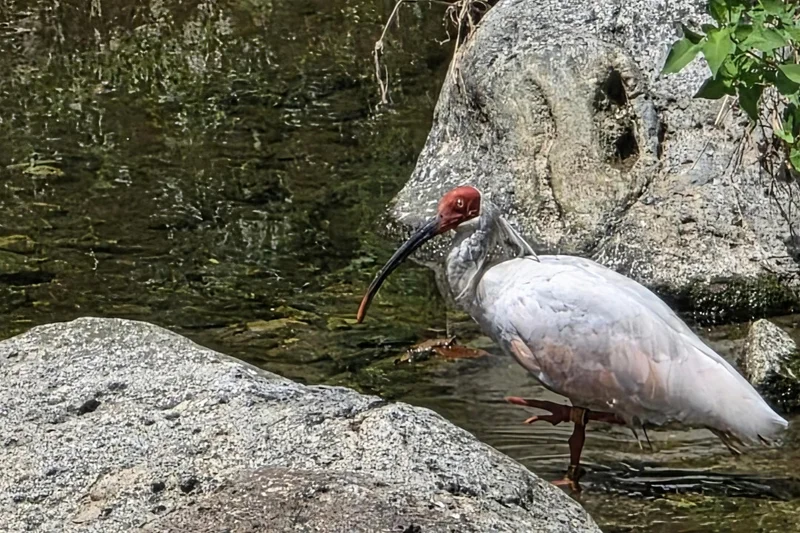
In an encouraging milestone for Korea’s long-term wildlife restoration efforts, a crested ibis was observed resting among the ancient canopy of the Korea National Arboretum, marking the first time the endangered bird has been sighted in the historic Gwangneung Forest in Pocheon, northeast of Seoul.
The national arboretum said that the bird was first spotted on camera within the sanctuary grounds. Photographs and video footage revealed a distinct yellow identification ring attached to the bird's leg, indicating it originated from a captive-breeding and reintroduction initiative. Officials from the arboretum have partnered with the Upo Ibis Restoration Center in Changnyeong, South Gyeongsang Province, to trace the specimen’s exact release date, flight paths and movement history, with specialists from the center conducting on-site investigations.
The sighting represents a significant ecological triumph for the region. The crested ibis (Nipponia nippon) once faced near-total extinction across the Korean Peninsula due to severe habitat loss, agricultural pesticides and deforestation over the past century. To revive the species, environmental authorities launched an intensive conservation project centered around the Upo Wetland, a vast inland marsh ecosystem in the south. Released back into the wild in carefully managed waves, individual birds have gradually expanded their range, roaming across various provinces.
However, the bird's appearance in the Gwangneung Forest — a UNESCO Biosphere Reserve renowned for its centuries-old primeval trees and rich biodiversity — suggests that released populations are successfully identifying viable habitat corridors far beyond their primary southern release points.
Forestry researchers said they plan to integrate this historic observation into the official biodiversity inventory of the Gwangneung Forest. As joint tracking efforts with the restoration center continue, conservationists hope the rare visitor signals a broader recovery for native species reclaiming their historic domains.
This article was published with the assistance of generative AI and edited by The Korea Times.