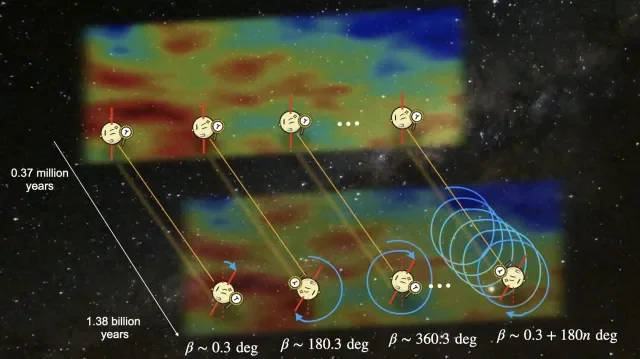
One of the most enduring principles in the entire Universe is the cosmological principle: an outgrowth of the Copernican revolution. Copernicus, nearly 500 years ago now, hypothesized that the Earth occupied no special place in the Universe when he put forth the heliocentric picture, instead recognizing that Earth might be just an ordinary planet like all the others: revolving around the Sun. We’ve since expanded our view of the Universe substantially, and with it, our view of the cosmological principle. In every way fathomable, there’s nothing special or preferred about our location in space and time — in there here and now — relative to the vast, expanding Universe that we ourselves are a part of. But any number of possible signals, coming from the Universe itself, could call that very principle into question. Such signals could include: a bulk “flow” to the Universe, where everything appears to move uniformly in the same direction, an overall directional field to the Universe, such as an electric field, that causes a uniform acceleration of certain particles, a preferred direction to the sky, where the Universe is anisotropic (or not the same in all directions), an overall rotation to the Universe, or a preference for galaxies rotating either clockwise or counterclockwise from our perspective, rather than random orientations, or an overall net polarization to the cosmic background of light remaining from the Big Bang: the cosmic microwave background (CMB) radiation. While extremely large studies show excellent agreement with the longstanding assumptions of isotropy and homogeneity for the Universe, recent studies of the CMB — first from WMAP, then from Planck, and now from ACT as well — indicate a small but positive, real, and nonzero effect for cosmic birefringence of that light. Behind the Hubble tension, it’s probably the second most exciting tension we’re seeing in observational cosmology today, and the three leading explanations all give us something to look forward to with new, superior observations on their way. Light is nothing more than an electromagnetic wave, with in-phase oscillating electric and magnetic fields perpendicular to the direction of light’s propagation. The shorter the wavelength, the more energetic the photon, but the more susceptible it is to changes in the speed of light through a medium. Credit: And1mu/Wikimedia Commons One of the most foundational aspects of our Universe is the principle of relativity itself: that uniform motion itself is indistinguishable from being at rest. Dating all the way back to the time of Galileo, it’s the oldest physical principle that’s still thought to be 100% correct. Einstein built upon this to conclude that the speed of light in a vacuum was indeed invariant for all observers, and that was the key insight that led to special relativity. All observers, everywhere, no matter where or when they were or how they were moving, measured the same speed for all forms of light. That principle was later extended by Einstein to include acceleration and gravitation as well, leading to general relativity. However, since light itself is an electromagnetic wave in nature — with oscillating, in-phase, mutually perpendicular electric and magnetic fields — different observers in relative motion to one another will observe the same light wave to have different wavelengths: the light will be redshifted or blueshifted depending on the relative motion of the observer to the direction of propagation of the light wave itself. The light’s speed is invariant (the speed of light in a vacuum), but the observed wavelength changes. This is thought to be absolutely true in a vacuum. However, it isn’t always true when light passes through a material, as materials can slow down light in a wavelength-dependent fashion. This, quite famously, is why white light gets broken up into its individual wavelengths when you pass it through a dispersive prism. Through the vacuum of space, all light, regardless of wavelength or energy, travels at the same speed: the speed of light in a vacuum. However, when that light passes through a medium, the speed doesn’t just drop to the speed of light in that medium, but rather it drops in a wavelength-dependent fashion, with shorter-wavelength light typically slowing down by more, leading to the phenomenon of refraction illustrated here. Credit: Lucas Vieira/Wikimedia Commons For some materials, refraction goes a step further: to what we initially called “double refraction,” and now know as birefringence. The first birefringent material was identified way back in 1669: a calcite crystal, which literally splits the light that passes through it into multiple paths. The reason some materials are birefringent are because they’re both: anisotropic, which means that the effects of the material on light propagating through it are dependent on the direction of propagation through the material, and also polarization-dependent, where light that’s polarized parallel or perpendicular through the material behaves differently, and moves at different speeds and/or refracts at different angles. We have excellent observational constraints against the vacuum of space being birefringent. The light we see of different wavelengths traveling from even tens of billions of light-years away exhibits no birefringent properties, even if the original light itself is heavily polarized. That rules out a birefringent vacuum, and rules out birefringence for a variety of light emitted from distant galaxies: optical, X-ray, ultraviolet, infrared, and radio light. But if the leftover light from the Big Bang, the CMB, were found to exhibit birefringence, that would truly have profound implications. This three-panel animation shows: (1) what the actual CMB looks like, including in both E-mode and B-mode polarizations, (2) the expected modification from an anisotropic or rotating Universe, and (3) the CMB as it would appear if it contained such a modification. The data is most consistent with no rotation and no anisotropy at all: the null hypothesis. However, other physical effects could still have measurable effects on the polarization data. Credit: D. Saadeh et al., Phys. Rev. Lett., 2016 You see, the light that we observe from the Universe’s earliest stages really is polarized, and is polarized in two fundamentally different ways. There are E-mode polarizations, where the polarization pattern can occur either along the line-of-sight or perpendicular to it, in a fashion that either points radially outward (like stars shooting out from a firework) or radially inward (like spokes from a bicycle tire connecting to the axel). And there are B-mode polarizations, where the polarization pattern occurs in a fashion that curls around the line-of-sight direction: either clockwise or counterclockwise, like a planet orbiting a star. The radiation in the Universe, according to standard theory, should be born with both E-mode and B-mode polarizations (both seeded by cosmic inflation), where the E-modes arise from density imperfections and the B-modes arise from gravitational wave imperfections. According to our standard cosmological model — the inflationary Big Bang with dark matter and dark energy, also known as ΛCDM — these types of polarizations should arise and imprint themselves in the CMB’s light, but shouldn’t lead to an observation of cosmic birefringence in the CMB’s light on its own. The fluctuations in the E-mode polarization data seen in the cosmic microwave background, particularly on small angular scales, encode a tremendous amount of information about the contents and history of the Universe. Combined with B-mode data, and explicitly by cross-correlating E-modes and B-modes, we can search for all sorts of effects that don’t appear in the raw temperature fluctuation data alone. Here, fluctuations from a large region of sky are shown, constructed from data taken with the Atacama Cosmology Telescope. Credit: ACT Collaboration DR4 However, it’s important to check the CMB’s light for those effects, because there are three main explanations for cosmic birefringence if we do, indeed, observe it. The standard model of cosmology is wrong, and something that we presently think is fundamental about the Universe is wrong or violated. This could include a violation of Lorentz invariance (basically violating the principle of relativity), or the introduction of a parity-violating field: basically some type of new physics that means all directions don’t equally obey the same rules, violating our concept of isotropy. There’s some new type of exotic particle that couples to the photon, such as variants of the axion, a theorized dark matter candidate, that’s inducing this cosmic birefringence as the light travels though the space where those particles are present. Or that there’s some sort of systematic effect that’s causing these observations, rather than a true cosmic signal. Such effects could include polarized dust within our own galaxy (a galactic foreground effect) or an imperfect calibration of the instruments used to measure the CMB and its polarization. This is the trickiest one, and must be robustly ruled out before we draw any wild conclusions. The way you look for cosmic birefringence is to measure the polarization of the light from the CMB, and to see if it exhibits a non-zero rotation angle, indicating that the CMB light’s polarization is actually being affected by something — one of these three effects, most likely — happening during its journey from 46 billion light-years away until it reaches our instruments. This map shows the CMB’s polarization signal, as measured by the Planck satellite in 2015. The top and bottom insets show the difference between filtering the data on particular angular scales of 5 degrees and 1/3 of a degree, respectively. While temperature data, alone, can demonstrate that the CMB is of cosmic nature, the polarization signal gives us key pieces of information about inflation’s nature, and can also help us see if the polarization rotates: evidence for cosmic birefringence. Credit: ESA and the Planck Collaboration, 2015 There are, to date, three main CMB experiments that have measured the polarization of the CMB’s light exquisitely. First was WMAP: NASA’s successor to COBE and the first observatory, more than 20 years ago now, to measure the CMB’s polarization. It placed strong constraints on the effects of cosmic birefringence, to the less-than-1° level in terms of rotation, but preferred a slightly positive, non-zero value over the no-birefringence option of 0°. Next was Planck in the 2010s: a more sensitive ESA space mission that was the successor to WMAP. Planck had two polarization-sensitive instruments: HFI and LFI. The strongest signal for birefringence came from HFI, but HFI is also most easily polluted by dust, so many were skeptical. Overall, Planck favored a value for β, the polarization rotation angle, of around 0.3°. However, because of the large errors and uncertainties, the statistical significance was very weak, not even rising to the 2σ (95% confidence level) threshold. Planck ended in 2018, and subsequent reanalyses of Planck and WMAP data combined — along with a new model for galactic foregrounds — led to similar values for the rotation angle β: between 0.2° and 0.3°, but with a more suggestive significance of around 3σ. However, with the latest data release from the Atacama Cosmology Telescope (ACT) collaboration here in the 2020s, a new set of analyses has arrived. From ACT alone, the significance rules out zero rotation angle (β = 0°) at 2.9σ, and by jointly combining together WMAP, Planck, and ACT data together, a brand new preprint of a paper out in August of 2026 claims to see β = 0.277° ± 0.057°, which is non-zero at 4.8σ significance. The latest data from ACT, despite not having all-sky coverage, is superior to anything Planck or WMAP has done in terms of smaller angular size and superior polarization measurements, which is primarily responsible for the recent spike in interest in cosmic birefringence. This analysis shows the correlation between EE-mode and EB-mode measurements of the CMB over the same region of sky. The “zero cosmic birefringence” case corresponds to the horizontal line (in red) that is disfavored by the data. Importantly, ACT-ACT (lower left), ACT-Planck (lower middle), and Planck-Planck (lower right) correlations all show the same non-zero effect. Credit: J. Eskilt, arXiv:2608.06480, 2026 One of the most interesting things you can do, as cosmologist Johannes Eskilt showed recently, is to try to correlate E-modes and B-modes in the CMB together. You can do this by comparing what are known as “EE” modes (where only the electric-type polarization patterns are considered) with “EB” modes (which links together E-modes and B-modes), and which should be zero unless either there’s some type of real cosmic birefringence or an instrumental alignment/calibration error. If you only had one data set, you would worry very strongly about whether your instrument was aligned and calibrated properly, as everything would hinge on you having an exquisite understanding of that instrument and all of its potential systematics. However, with two independent instruments — such as ACT and Planck — you can correlate the “EE” modes with the “EB” modes in three different ways: of ACT “EE” modes with ACT “EB” modes, of ACT/Planck “EE” modes with Planck/ACT “EB” modes (mixing the two), and of Planck “EE” modes with Planck “EB” modes. If you get consistent, non-zero EB modes in all three cases, then it’s unlikely that the alignment and calibration was the sole culprit. The independent confirmation of the signal, including of the same magnitude and with the same effect, serves as a sanity check that this may indeed be something real. When the entire sky is viewed in a variety of wavelengths, certain sources corresponding to distant objects beyond our galaxy are revealed. This first all-sky map from Planck includes not only the cosmic microwave background, but also extragalactic contributions and the foreground contributions from matter within the Milky Way itself. There is a great concern that polarized dust emission from the galaxy, even far from the galactic plane (where ACT observes), could be biasing our measurements of polarized light and its rotation. Credit: ESA, HFI and LFI consortia, 2010; CO map from T. Dame et al., 2001 The reason for this is that there are two effects that can “appear” to cause the rotation of the polarization angle: α, which represents the effect of instrument calibration and the polarized foreground emissions (e.g., of the galaxy), and β, which is the actual primordial cosmic birefringence angle. The actual signal that we measure is the combination of “α + β,” and so we have to make sure that α isn’t responsible for the entirety of what we’re inferring the rotational angle of polarized light is. The fact that we see a strong, positive signal for all three cases strongly suggests that either at least some of the effect is due to a real, non-zero (i.e., cosmic birefringence), or that some combination of miscalibration and galactic foregrounds are conspiring in both data sets, consistently, to mimic a birefringence signal. Of course, the ACT data is better than the Planck data for these purposes: it’s more granular and it extends to smaller scales, or higher multipoles in the data. (Planck has more complete sky coverage, however, making it superior for all-sky studies.) The joint analysis is able to rule out the possibility that dust is causing the non-zero EB signal, and furthermore shows that if you want to recover a value where there’s no cosmic birefringence at all (β = 0), then both the dust modeling and the instrumental calibration must both be failing together across multiple data sets. This graph shows the progression of measurements, techniques, and confidences of a measured signal of cosmic birefringence in the CMB, using data primarily from WMAP, Planck’s LFI instrument, Planck’s HFI instrument, and, most recently, ACT: the Atacama Cosmology Telescope. In 2026, for the first time, the combined confidence of the various data sets now approaches the vaunted 5-sigma threshold: the threshold to confidently announce a discovery. However, substantial systematic uncertainties persist. Credit: J. Eskilt, arXiv:2608.06480, 2026 The latest ACT data is particularly exciting because of how revolutionary it would truly be if cosmic birefringence were real. In astrophysics as well as particle physics the “gold standard” for announcing a new discovery is the vaunted 5σ threshold for statistical significance. With ACT, WMAP, Planck LFI and Planck HFI data combined, we’re anywhere between 4.6σ and 4.8σ sigma in terms of significance, at maximum, depending on how you’re treating the data. That’s tantalizingly close to achieving the necessary threshold for announcing an actual discovery of cosmic birefringence. But before you get too excited about that particular line of thought, it’s worth remembering the adage that “extraordinary claims require extraordinary evidence.” We have fooled ourselves many times in the past with claims that have achieved the necessary statistical significance to announce a discovery, but were instead plagued by a systematic error that went unidentified. The fiasco of faster-than-light neutrinos was due to a hardware error. The DAMA/Libra collaboration’s alleged detection of dark matter was most likely the result of poor conduct among the experimenters, and was ruled out by a reproduction test. And violations of lepton universality, which nearly reached the 5σ threshold at the Large Hadron Collider, were instead indeed identified to be a calibration error: one that was corrected. In all cases, once the experiment or observation was correctly calibrated, the effect disappeared. It will take strong, robust, independent confirmation of the presence of cosmic birefringence before the community is ready to accept something so exotic. The small aperture and large aperture telescopes that make up the Simons Observatory will measure temperature fluctuations in the CMB down to the smallest, most precise scales ever, and also will include polarization data for those scales atop it. In the search for cosmic birefringence, the Simons Observatory should provide the best- ever measurements of the effects that it would imprint onto the leftover glow from the Big Bang. Credit: Simons Observatory Thankfully, that’s exactly what a brand new CMB experiment is going to do, when the new measurements from BICEP3 and then, likely definitively, from the Simons Observatory. These independent measurements, from two independent facilities, can help us gain control over the instrumental systematics that could be responsible for our current best measurements indicating that β, the polarization rotation angle of the CMB light, is non-zero. They can teach us whether we’ve calibrated our instruments correctly, and whether we truly understand the foreground dust emissions as well as we claim to. If it turns out that this polarization rotation term is indeed non-zero and frequency-independent for the CMB, then that would hint at an axion-like field that couples to the photon, which could truly lead to a revolution in cosmology: either by shedding light on the nature of dark matter or by showing us that the Universe does exhibit a fundamental parity (mirror-symmetry) violation. In this Universe, it’s our observed reality — to the limits of our measurement capabilities — that’s the ultimate arbiter for how physical reality actually is. The suggestive evidence pointing towards cosmic birefringence, although it isn’t overwhelming just yet, could be the crack in our current cosmic picture that takes us to the next level in our understanding of the Universe. This article Cosmic birefringence: the signal that could upend cosmology is featured on Big Think.
Cosmic birefringence: the signal that could upend cosmology