President Lee Jae Myung is repeatedly calling for South Korea to regain wartime operational control (OPCON) from the United States within his term, with analysts saying the push reflects a sense of urgency to accomplish a long-standing liberal goal that has remained unfulfilled.
The analysts added that Lee’s push could gain momentum from U.S. President Donald Trump’s desire to scale back Washington’s military and financial burdens in South Korea, presenting Seoul with a rare opportunity to complete the transfer after years of delays.
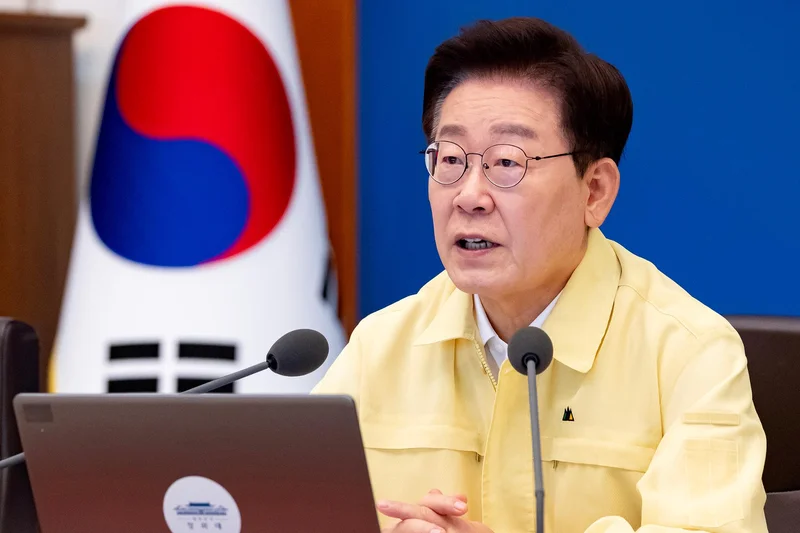
Lee renewed his call for the transfer during a Cabinet meeting at Cheong Wa Dae on Tuesday.
“We must proceed smoothly with the transfer of wartime operational control within [my] term, in accordance with the government’s original plan,” Lee said.
Regaining OPCON within Lee's five-year term, which ends in 2030, has been the administration's goal. It has been pushing recently to set the target year for 2028, or as early as 2027, to be discussed during a Security Consultative Meeting (SCM) with the U.S. this October.
In particular, Lee's renewed instruction came as uncertainty over the scale of South Korea-U.S. military exercises raised questions about whether changes to the drills could disrupt the transfer timetable, after Trump said on social media on Sunday (local time) that he ordered a reduction in the allies’ ongoing Ulchi Freedom Shield exercises.
Such training is essential for assessing Seoul’s readiness to lead the combined forces. Seoul had planned to use the joint military drills as an opportunity to assess Full Operational Capability, the second stage of the three-phase verification process. A reduction of drills could affect the assessment and other required verification procedures, potentially delaying the transfer.
Following Trump's comments, there were reports about the U.S. moving to reduce the drills, including U.S. forces not participating in South Korean-led exercises, U.S.-led exercises becoming U.S.-only drills and the Combined Forces Command relocating from the CP Tango wartime command post in Seongnam, Gyeonggi Province, to U.S. Army Garrison Humphreys in Pyeongtaek, Gyeonggi Province.
Seoul’s Joint Chiefs of Staff was unavailable to confirm the reports as of 5 p.m. Tuesday.
“Taking back wartime operational control has long been a security objective of liberal administrations,” said Ahn Chan-il, president of the World Institute for North Korea Studies, referring to the past administrations of Roh Moo-hyun (2003 to 2008) and Moon Jae-in (2017 to 2022).
“Now that they are back in power, they are determined to complete the transfer under their road map and secure greater autonomy in national defense,” Ahn said.
A researcher at a private think tank, speaking on condition of anonymity, expressed a similar view.
“If another liberal president fails to complete the transfer, there is no guarantee that a future administration will pursue it with the same level of commitment."
The OPCON transfer was initially scheduled for 2012 but was postponed, first to 2015 and later until specific military and security conditions were met.
Cha Du-hyeogn, vice president of Asan Institute for Policy Studies, said the transfer of wartime OPCON could be “a welcome development” from the Trump administration’s perspective because it would reduce Washington’s responsibilities and leave South Korea primarily in charge of security on the Korean Peninsula.
“Trump has sought to ease Washington’s financial and military commitments while pressing allies to take greater responsibility for their own defense,” he said. “Under the circumstances, his transactional approach could make him more receptive than previous U.S. leaders to transferring OPCON.”
Cha, however, cautioned against interpreting Trump’s demands for greater burden-sharing as support for an accelerated OPCON transfer.
“The Trump administration has never explicitly said it wants to transfer OPCON itself as quickly as possible,” Cha said, explaining that Washington primarily wants its allies to contribute more to regional and global security.
While calling for the transfer, Lee appeared mindful that his emphasis on military autonomy could fuel speculation about strains in the alliance.
“A solid Korea-U.S. alliance and stronger independent defense capabilities are necessary and sufficient conditions for each other,” Lee said. “A solid alliance strengthens the foundation of our security, while building our own strength increases our value and importance as an ally.”