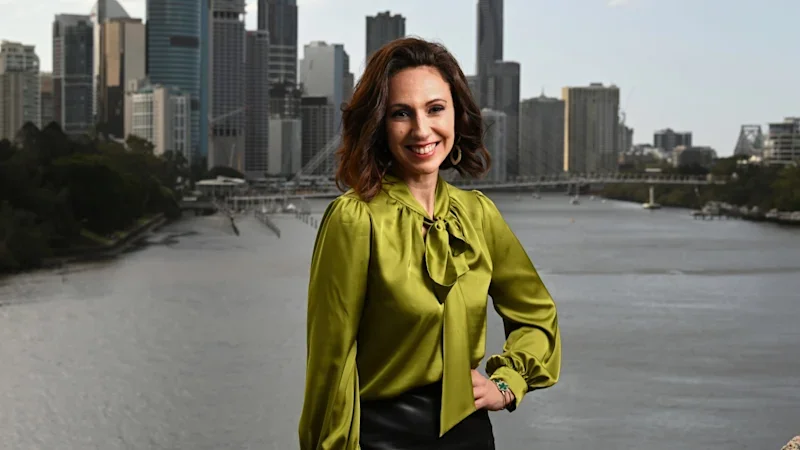
Welcome to CityChats, where Brisbane Times meets our city’s most interesting characters on our most iconic form of transport. This week, the Brisbane Powerhouse’s artistic director and chief executive, Louise Bezzina, tells us about the historic building’s inspiring but quirky nature, the city’s confidence problem, and her optimism for Brisbane 2032.
Bezzina is so personable and chatty when she arrives at the terminal that we all forget to get on the ferry when it arrives. Luckily, there’s another one along soon – and plenty to talk about.
What do you love about working at the Brisbane Powerhouse?
It’s such an incredibly iconic institution in our city. I remember going to the official opening as a theatre student [in 2000], and I was so inspired. It really instilled something in me as a young creative to feel like I could be part of something, and now to think all those years later I’m at the helm as the custodian of this incredible institution is a great privilege.
It really is quite remarkable. And any time you’re feeling a little bit down, you just go out onto the deck, look out to the Brisbane River, and you’re reminded how beautiful it is and the location and the absolute abundance of opportunity that exists. It’s a very inspiring place to be.
- social video
How does it compare to your old job as artistic director of the Brisbane Festival, which you were for six years?
It compares in the sense that I’m contributing still to the Brisbane arts ecology and that I have this wonderful, privileged opportunity to be instrumental in bringing the dreams of artists to life, helping to create a fabric for the city that really does transcend the everyday, that allows people to be inspired by arts and culture and feel like there’s a connection point.
I guess what I’ve got now is a 12-month home to do that, and that comes with the quirks and nuances of a cultural precinct that is heritage listed. So I’m learning a lot about things that I hadn’t really encountered before.
I guess I feel like I’m the mother of the house now and it’s my job to care for it and make sure that it’s really well looked after so it continues to be a beating heart for arts and culture in our city and broader.
What do you love about Brisbane?
The Brisbane River is something that I love very much about the city. I think it gives you this wonderful kind of grounding and a unique landscape in which to work. The other things I love about Brisbane is that it doesn’t take itself too seriously. There’s a real sense of generosity, collaboration. People genuinely want to support each other, do great work, get behind a great idea.
What is Brisbane’s problem?
There was a period where we almost were a little bit like, “Oh, we’re not Sydney and we’re not Melbourne”. I don’t think we use that any more. I think we’ve shaken that off. So I guess there’s a confidence that we have embraced and embodied, and I’m very happy about that.
I suppose if there was a problem, I think we’re overcoming it with confidence by continuing to do good work. And I’m saying this purely from an artistic lens because that’s probably the way I see the world and how I can contribute to the world. But it really irritates me when we second-guess ourselves, that “Oh, it’s Brisbane”. That’s just unacceptable to me. I think: we’re Brisbane. Like, be proud! Don’t try and be anything that we’re not because that’s the whole point.
Can you tell me a bit about the River Pride Parade that the Brisbane Powerhouse organises?
One of the great things that I’m very excited about is being able to contribute to the growth of the River Pride Parade, which is a signature part of the annual Melt Festival. River Pride Parade, I think, has the opportunity and the potential to be one of the most incredible and exciting parades in the world. Leaning into that with a whole flotilla of absolute spectacle creations is something that I’m really excited to create.
What is your controversial Brisbane opinion?
I’m incredibly optimistic and incredibly excited about Brisbane 2032!
I am incredibly passionate about what this opportunity means from an arts and cultural point of view and that ongoing legacy, and there’s been numerous conversations about that in the sector and I think that’s great.
But I think it’s now time to just get on with it and actually start doing things.
And that doesn’t mean that we need suddenly a big permission tick. We are leaders in our various roles across the city. I am one.
How do we make the most of what we have and start to show how we leverage that for greater outcomes? I’m very much an action-oriented person. So, lots of talk and consultation is great, but then that’s enough for me. Let’s just do it.