Could an explosive drone at a German airport signal a growing Russian threat to NATO?
A drone attack at an airport in central Germany has raised the alarm for NATO partners
As German authorities investigate a drone laden with explosives and a detonator found at Leipzig airport, Russian Foreign Minister Sergey Lavrov has signalled Moscow's intent to step up retaliation against countries helping Ukraine.
"We will adopt much harsher methods to destroy everything that enables the West to fuel Kyiv's war machine," Lavrov said in an interview with VGTRK, Russia's state media. "We are already doing this."
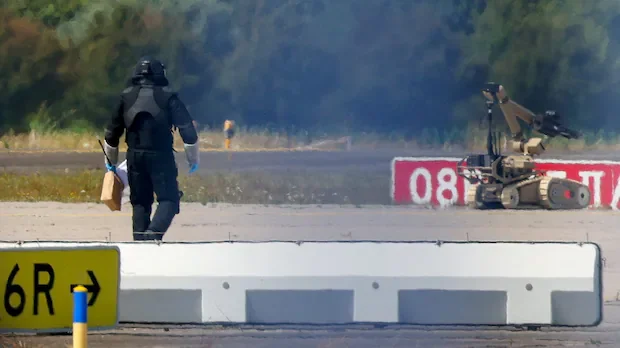
German investigators said an airport employee found a drone carrying an unknown explosive device in the security area of the cargo operations zone near the south runway of Leipzig airport, a facility classified as "critical infrastructure."
Leipzig is a strategic NATO airport used to deliver armaments, ammunition, weapons and other military equipment to Ukraine on flights operated by Ukrainian cargo companies.
The discovery of the drone, which was spotted beside one of those Ukrainian cargo planes, marks "a new level of danger" for Germany, according to Germany's interior minister.
Alexander Dobrindt said the incident did not appear to be the work of amateurs and that investigators were treating it as part of a "professional hybrid threat scenario."
German authorities are investigating the incident and have not said where they believe the drone came from. Late last week, U.S. intelligence officials told the Wall Street Journal that intelligence reports indicated the drone likely belonged to the Russian government.
Berlin is responding cautiously, strengthening anti-drone capabilities while avoiding premature attribution.
"We are right in the middle of establishing the facts," Dobrindt said. "We are at the investigation stage and it would not be appropriate for a federal minister to prematurely comment on this."* *
But officials warn that Russia is already using drones, espionage, sabotage and influence operations across Europe — including ahead of upcoming regional elections in Germany.
"We are facing new threats," Dobrindt said in the days following the drone incident. "We are facing a serious threat situation we are confronted with every day."
Escalations in hybrid warfare
Dobrindt says Germany is the "daily target" of hybrid warfare, including "espionage, sabotage, cyber attacks and covert actions by foreign powers aimed at destabilizing Germany, causing harm to our country and bringing about political and social change as well."
In 2024, U.S. and western intelligence uncovered a Russian plot to assassinate Armin Papperger, CEO of German defence contractor Rheinmetall. The company is responsible for heavy military production and is a major supplier of armaments to Ukraine.
In March, German federal prosecutors arrested a man suspected of spying for Russia and scouting sabotage targets. The intelligence he gathered reportedly included details about Berlin's military support for Ukraine and information about the country's defence industry, particularly companies developing drones and robotics.
The Institute for Strategic Dialogue (ISD), a London-based think-tank specializing in counter-extremism and digital policy, has been tracking the ways it says Russia is interfering in Germany online, through a campaign known as Operation Overload.
- AnalysisPutin is poking NATO with drones and jets. The military alliance is still sorting out its response
- German politicians praise bus driver's risky move with explosive drone at airport
The ISD says the campaign aims to exploit "emerging controversies within NATO member countries and Ukraine," with a focus on Germany, France and Ukraine. The group said its messaging centres on undermining Ukraine's war effort and destabilizing democracies.
The latest phase of the campaign, according to the ISD, included videos impersonating news organizations, law enforcement agencies and academics.
"It is apparent that there are attempts to influence German politics and society," Dobrindt said. "I'd say we all have a pretty good sense that such disinformation attempts take place especially in such upcoming regional elections. Thus we must assume they too are a target of our adversaries."
Hans-Jakob Schindler, senior director of the Counter Extremism Project, said Russia is testing how much Germany is willing tolerate, calling the drone incident in Leipzig an "aggressive escalation" of such interference.
"Very clearly, Russia is trying to test how far Germany is willing to accept [these attacks], going from hacks and lower level sabotage to something that has turned into quite serious plots to kill CEOs of German companies, disruption of critical infrastructure and now this very aggressive attack in Leipzig."
For Schindler, these increasingly physical tactics raise urgent questions about where defence ends and direct conflict begins.
"There has to be a point that its made very clear to Russia that there is a limit.... Where does it stop being hybrid and where does it start to be a conventional attack?" Schindler said. "In this case, it looked like they were willing to exert a lot of damage. People could have been killed or hurt on German soil if it worked."
Schindler said Lavrov's comments mark a shift from the Kremlin's past denials about Russia's interference in Western countries.
"In addition to being as close as it will ever get to an admission of guilt by Russia in any hybrid warfare operation, the statement by Russian Minister Lavrov is also a threat and a warning that the campaign against Europe, against the west and against NATO is going to be more aggressive," he said.