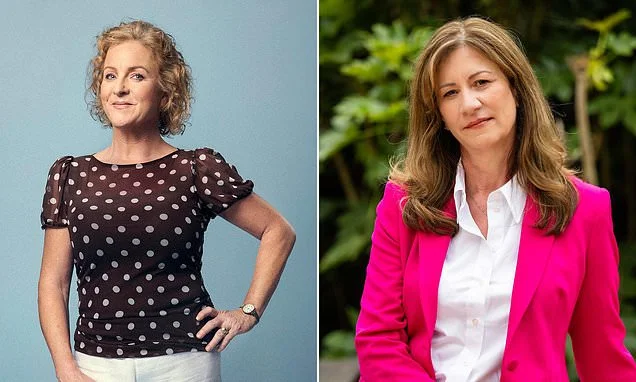
Every morning, Nicola Palfreyman washes her hair in volumising shampoo, spritzes it with thickening spray and carefully blow-dries the wispy strands around her shoulders, all in a desperate attempt to make it look thicker.
If she’s in a rush, she will scoop what little hair she has into a scrunchie and hope that no one notices how thin it has become.
Her once blonde mane used to be so lush and full her hairdresser would bemoan the hours it took to highlight it, and she would regularly snap hairbands in her attempts to wrestle it all into a ponytail.
Now, it is too thin and sparse to endure the bleaching process and she has been forced to come to terms with being a brunette – at least for the time being.
Nicola, 41, from Oxfordshire, lost 8st last year on Mounjaro, slimming from over 21st to 13st, swapping size 24 clothes for size 14. The mother of four, a special needs advocate for children and teenagers, is delighted with her weight loss and general improved health but, like an increasing number of women taking GLP-1 medication, it has absolutely wrecked her hair.
Hair loss is listed as a possible side-effect on the leaflet you get with Wegovy and Mounjaro pens, as well as the new Wegovy pills, but most users are too desperate to get their hands on this clever drug which promises to end all their years of failed dieting to notice – until their hair starts falling out.
The official line from obesity experts has always been that hair loss happens when you lose weight too fast and your diet lacks key nutrients. So if you are careful to eat a nutritious diet and to lose weight slowly, the implication is that you’ll be OK.
But then, last month, a shocking study appeared from US researchers setting out the risks of using weight-loss drugs in stark terms. GLP-1s, it said, can increase the risk of hair loss by 37 to 68 per cent. That means you’ve probably got a greater than one in two chance of ruining your hair if you decide to use a skinny jab or pill.
Nicola Palfreyman, 41, lost 8st last year on Mounjaro – but she also began to lose her hair
Nicola estimates it will take another year before her hair fully recovers – however, she does not regret taking the weight-loss jabs
I know exactly what that’s like. This time last year I had thick, bouncy, shoulder-length curls which, in part, helped compensate for a chubby body that defied all my attempts to slim.
I started taking Mounjaro in January last year. By August, my hair had started to fall out. I’m not talking about a bit of thinning – this was great fistfuls at a time.
Over a nightmarish six weeks, each time I washed my hair the shower tray would fill with tangled clumps. It was terrifying and I genuinely thought I would lose the lot.
After dropping 2st, instead of relishing my slim new figure, all I could focus on when I looked in the mirror was my receding hairline and the shiny pink skin of my scalp showing through on top.
The GLP-1 Facebook support groups were peppered with posts from women fretting about hair loss. They were met with helpful suggestions to try vitamin B7 supplement biotin, pumpkin seed oil, collagen or expensive shampoos.
‘I spent a fortune on supplements, head massagers, special shampoos, oils and gels, but nothing seemed to make a difference,’ says Nicola. ‘My hairline was receding so badly I looked bald if I scraped my hair back, and my hairdresser told me she could see big patches of scalp at my crown. It was devastating.’
For a while, Nicola stopped going out. ‘I’m usually such a sociable person, but I became very self-conscious about my hair – it was so embarrassing!’ she says. ‘At one point it was so bad I seriously considered shaving the whole lot off and wearing a wig instead.’
I felt the same. When my hair loss was at its most dramatic I paid £345 for a consultation with a medically trained scalp expert at Philip Kingsley in London. After checking my scalp and asking questions about my diet and lifestyle, trichologist Susie Aikin-Sneath told me my hair problem was a temporary one. I hugged her in relief.
This time last year I had thick, bouncy, shoulder-length curls which, in part, helped compensate for a chubby body that defied all my attempts to slim, says Louise Atkinson
After dropping 2st, instead of relishing my slim new figure, all I could focus on when I looked in the mirror was my receding hairline, says Louise
She explained that ‘telogen effluvium’ is the condition responsible for a vast majority of GLP-1 cases – where an ‘interruption’ in the hair’s growing phase stalls the natural growing/shedding cycle, causing a whole load of hair to shed all at once. Beneath every fallen strand of hair, she said, a new baby hair would already be pushing through in its place. Sure enough, closer inspection revealed a fringe of tiny new hairs sprouting along my hairline.
Nicola’s hairdresser also reassured her that there were loads of baby hairs emerging all over her scalp. She kept in regular contact with Shameela Adam, the lead pharmacist at online pharmacy medicinemarketplace.com, who coached her through optimising her diet and lifestyle and tailoring her Mounjaro journey to reduce the risk of more shedding.
Even when her hair was at its worst state, Nicola refused to stop her jabs.
‘I was confident enough that my hair would recover once I came off the high doses, but I was absolutely determined to get down to a healthy weight first and I knew I needed the jabs to get there,’ she says.
Nicola had worked her way up the weekly Mounjaro doses from 2.5mg to 5mg, then 7.5mg and 10mg, before her hair started to fall out. She only took a break last September when the prices suddenly trebled and has since been maintaining – on and off – on 2.5mg. This, she says, seems low enough to control her appetite and sustain good hair re-growth.
So why do so many women lose their hair when they lose weight?
Previous studies into weight loss have noted hair loss as a common complication after metabolic and bariatric surgery, and it is also recorded in people who go on crash diets. The assumption has always been that rapid weight loss shocks the body, putting the hair follicles into ‘disaster mode’ and shutting down growth.
Yet with an estimated 2.5 million people in the UK now using weight loss drugs, the numbers reporting excessive shedding after steady, slow weight loss, even after eating a balanced diet, is escalating.
Helen Bligh, 60, says: ‘Every time I showered I’d find myself pulling increasing amounts out of the shower tray. It was scary, and I worried that all my hair would fall out'
Helen lost 3.5st in seven months on Mounjaro, and says she will continue to use the drug despite her hair troubles
Susie Aikin-Sneath told me: ‘When you’re eating fewer calories and smaller portions it’s hard to get all the nutrients your hair needs. Hair cells are greedy – they are high energy, but they sit at the back of the queue – the body siphons off nutrients to essential functions first.’
Stress or illness, she says, can further drain nutritional resources. ‘It is also possible that the jab medication could be viewed by the body as an extra stressor in some way,’ she adds.
The US researchers behind the latest study speculate that reduced caloric intake contributes to physiological stress and micronutrient deficiencies to disrupt the hair growth cycle.
However, they add that ‘other factors’ including the way the drugs change the body’s metabolism (reducing appetite), hormone levels (such as insulin, leptin and in some people sex hormones including oestrogen), plus its impact on the immune system, could be altering delicate processes in ways that might affect how hair grows, rests and sheds.
Adrian Heald, professor of medicine and consultant endocrinologist at Salford Royal Hospital, says: ‘There’s no clear biological pathway to explain this, but it is possible that there could be something going on that we don’t yet know about.’
Helen Bligh has a wealth of personal and professional experience of dealing with GLP-1s. After training as a registered dietitian with the NHS, she moved into life sciences, training pharmaceutical companies in aspects of disease and medicine, including weight-loss drugs. She now works as a GLP-1 coach.
In February last year she began her own Mounjaro journey, losing 3.5st in seven months. Helen, 60, who is divorced with two grown-up children and lives in Buckinghamshire, says: ‘I was very impressed by the emerging research about the health benefits and I knew I had to do something about my high blood pressure and cholesterol levels.’
After building up to a 7.5mg dose of Mounjaro, she settled on 5mg. By August her hair was thinning and by September she had lost a great deal. ‘Every time I showered I’d find myself pulling increasing amounts out of the shower tray,’ she says. ‘It was scary, and I worried that all my hair would fall out.
‘I knew it was time to cut back my Mounjaro and focus on my diet – the suppression initially had been so strong that I was getting to 4pm without eating anything. Although I was eating good food, I wasn’t eating enough, and I think my body went into some kind of shock. My hair is so much more important to me than my clothes – it is my pride and joy and a big part of my identity.’
At first, Helen used dry shampoo and regular blow-dries to try to create lost volume. ‘Every time I went to the hairdresser I’d beg her to check for new hair growth, asking if new hairs were still coming through,’ she says.
After investing nearly £300 on supplements, hair drops, masks and oils, she threw herself into investigating GLP-1 hair loss and nutrition and has written a book – It Was Never About Willpower, available on Amazon – which helps guide users through a healthy weight-loss journey.
‘Whatever mechanisms are at play when you experience GLP-1 hair loss, good nutrition is fundamental,’ she says. ‘This means keeping your dose low enough to allow you to eat healthily. You just need to eat fewer calories than you were previously eating without your body fighting back to protect its energy reserves, and each of those calories needs to be as nourishing as possible.’
She recommends eating regularly (three to five small meals a day might be easier than two large ones), adding a daily vitamin and mineral. If hair is shedding, you need to focus on protein (1.2-1.6g of protein per kilogram of target body weight per day), iron, zinc, vitamin B12 and vitamin D. She also advocates eating probiotic foods (yoghurt, kefir, sauerkraut, miso) and prebiotic fibrous foods (garlic, onions, leeks, asparagus).
Experts agree if your hair is shedding it is probably a good idea to keep your GLP-1 dose as low as possible until things calm down.
Talk to your prescriber about slowly reducing your dose or having a break from the medication to allow your hair to recover. One option, if hair shedding is distressing or prolonged, is to discuss blood tests for iron stores (ferritin) B12 and vitamin D with your GP and supplement accordingly.
Susie Aikin-Sneath suggests that, when you get your blood test results back, even if your GP says they look ‘fine’, check where your levels fall within the ‘normal’ ranges. ‘When it comes to hair health, it’s best to punch for “optimal levels”, which can be quite a bit higher than “normal levels” that put you safe from deficiency,’ she says. ‘Aim for the middle of the reference range as a minimum.’
Despite her hair worries, Helen has decided not to come off Mounjaro. ‘The health benefits are just too great,’ she says. She continues to take a low-maintenance dose to keep her weight and blood pressure stable.
I don’t plan to come off GLP-1s either. When my own shedding phase stopped, all those baby hairs grew into a crazy curly fringe, and last month I had my hair cut short – four or five inches of thick, healthy regrowth. It’s quite a style adjustment after decades having long hair, but it’s a sacrifice worth making. I’m slim and healthy, it’s just that my hair is shorter than it used to be.
Nicola’s GLP-1 regrowth is about six inches long. ‘I reckon it will be another year before my hair fully recovers,’ she says. But despite all the stress and anguish of losing her hair, she has no regrets.
‘When I was at my heaviest my life was on hold, I was really struggling with my health, my eating was out of control, and I was terrified I would die young or become an awful burden to my children.’
Even if it meant losing all her hair, she says she would do it again in a heartbeat.