Offshore the fictional town of Portorosso in the Italian Riviera, a young sea monster named Luca herds goatfish on his family’s aquatic farm. In the surf above, fishers threaten to fatally spear any sea monster that comes within range. The youth’s mother sternly warns him: “We do not talk, think, discuss, contemplate or go anywhere near the surface!”
But Luca defies her, goaded by a beach-dwelling sea monster kid, Alberto, and the two dream of exploring the world on a Vespa. When Luca’s parents find out about his trespasses, they announce he must live with his uncle deep in the ocean. Horrified, Luca flees to Alberto’s, and the two decide to hide in the human town, where fear and hatred of sea monsters is rampant.
So begins the Academy Award–nominated Pixar movie Luca. Viewers are transported to this fantastical world, invited to suspend disbelief as the ocean creatures shed their scales and assume a human form as soon as they are dry. They root for Pixar’s improbable protagonists as they dodge detection and train for a triathlon in hopes of winning the prize money they need to buy a Vespa.
On supporting science journalism
If you're enjoying this article, consider supporting our award-winning journalism by subscribing. By purchasing a subscription you are helping to ensure the future of impactful stories about the discoveries and ideas shaping our world today.
The brain follows this story seamlessly—tracking characters from one scene to the next and tracing the interwoven threads of its plot to make sense of the unfolding action. It’s a talent so ingrained that screenwriters can count on it. “Stories are this fundamental way in which people see the world and respond to the world,” says Ben Rogers, an organizational behavior researcher at Boston College.
No story, whether “real” or imagined, is a true replica of events. Luca is a deliberately streamlined version of reality in which cause and effect is evident and take-home lessons are fully wrought. People’s real-world experiences are similarly edited by the brain into Pixar-like narratives so we can make sense of them, the edited scripts living in memory. “When we say ‘narrative,’ all we are really saying is ‘simplification,’” says Pixar’s Jesse Andrews, who co-wrote the screenplay for Luca. “It’s a simplification in the name of understanding.”
The early origins of storytelling suggest that stories powerfully connect to the human psyche.
The brain simplifies all experience in this way. But the workings of the brain’s narrative wiring were largely mysterious until about a decade ago, when scientists began to deploy sophisticated mathematical tools to decode the brain’s response to movies, which they screened for subjects inside brain scanners. In the ensuing years, they found biological real estate dedicated to intuiting a story’s cinematic divisions, editing the footage, tracking its characters and extracting its meaning. They’ve also revealed neural scaffolds for familiar scenarios that the brain relies on when people encounter new but similar situations.
The work has helped explain why stories have played such an integral role in nearly every human society since ancient times. It shows the power of narrative to convey lessons from other people’s experiences, to bring people together or push them apart, and to make sense of romantic comedies and cozy mysteries alike. Related psychological studies, meanwhile, show how culture shapes storytelling in ways that can subtly but profoundly affect our well-being and sense of self. Family and society are co-authors even in the stories we tell ourselves.
People have been telling stories for millennia. Scientists glimpsed the ancestors of picture books in scenes sketched in caves in France dating back some 30,000 years. Oral storytelling is thought to have originated around 10,000 years ago. Epic poems such as the Iliad and the Epic of Gilgamesh, which date to around 3,000 years ago, were first spoken tales that traveling poets or court entertainers performed, and scholars have been dissecting what makes a good story at least since Aristotle wrote his Poetics around 330 B.C.E.
The early origins of storytelling and all its modern incarnations suggest that stories powerfully connect to the human psyche. But it wasn’t until the 20th century that psychologists began to gather experimental support for that connection. In 1944 Austrian American psychologist Fritz Heider and his then research assistant Marianne Simmel were investigating how people interpret others’ behavior. They asked 114 subjects to watch a crude animated film in which a small triangle, a big triangle and a small circle ricochet off one another and scoot in and out of a rectangle with a doorlike flap.
When asked to describe what they saw, hardly any of the participants reported on the physical movement of shapes. The vast majority instead “interpreted the picture in terms of actions of animated beings, chiefly of persons,” the authors wrote. To some, those “beings” were engaged in a love triangle; to others, they were embroiled in a family drama or an episode of bullying. At the time, the researchers interpreted the results in terms of the human tendency to anthropomorphize. But decades later many scientists saw them as support for another default for the human brain: storytelling. Viewers instinctively constructed a sequence of events to make sense of an otherwise nonsensical stimulus.
It would be decades before people found the brain circuitry that underlies this construction. Doing so required both new technology and the courage to use it in a novel way. Developed in 1991, functional magnetic resonance imaging (fMRI), which measures blood flow as a proxy for neural activity, was conceived as a window to the workings of the human brain. But as of the early 2000s, Uri Hasson, then a graduate student at the Weizmann Institute of Science in Israel, didn’t think it was being put to good use.
In typical fMRI experiments, researchers exposed subjects to very simple stimuli such as line drawings, word lists and auditory tones because they believed that doing so was necessary for the results to be tractable. The problem, according to Hasson, was that the results were not meaningful because the stimuli were unrealistic. “There was a crisis in science,” Hasson recalled. “We had these nice experiments in the lab, but they didn’t explain how people behave in real life.” Explaining real-life behavior, he posited, required exposure to something that better represented life experience—such as movies.
Most experts believed that analyzing the brain’s responses to something as complex and dynamic as a movie would be impossible. But to Hasson, this complexity was the point. Along with his adviser, Rafael Malach, Hasson and three colleagues placed five people in brain scanners to watch half an hour of the 1966 western The Good, the Bad and the Ugly. To the surprise of many, the researchers were able to make some sense of the resulting storm of neural activity. The brains of all five viewers responded synchronously to shifts in scenery, dialogue and even plot, as if operated by the same neural story-watching program. The results, reported in a 2004 paper in Science, offered the first solid support for the idea that such a universal program existed.
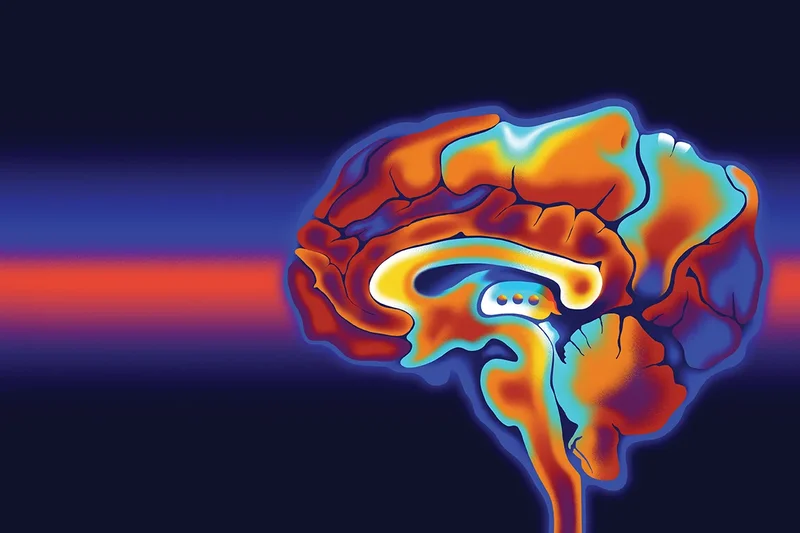
The movie engaged large swaths of the brain—including not just sensory regions but areas of the brain’s ridged surface, the cerebral cortex, that are charged with complex tasks such as language. In the ensuing years, Hasson and others homed in on a set of interconnected cortical areas called the default mode network as the main switchboard for narrative. Also known as the daydreaming network, the default mode regions were thought to come online when the mind was wandering “at rest,” contemplating the future or the past. Activity in this network has been linked to rumination, the sense of self, social cognition and autobiographical memory. But the fact that exposure to stories in real time also recruited this network suggested that it handles more than internal deliberations.
Movies were the entry point for these discoveries. In acting on his wish to mimic real life in a scanner, Hasson had inadvertently put a spotlight, albeit a dim one at first, on brain circuitry dedicated to narrative. He had also kicked off a line of research that would unveil how the brain decodes elements of plot, identifies scenes, traces character arcs and decodes a story’s overall meaning.
In 2008 Hasson moved to Princeton University, and his laboratory attracted scientists who wanted to screen movies in brain scanners to study memory. In 2012 Janice Chen joined the lab as a graduate student. Chen, now a cognitive neuroscientist at Johns Hopkins University, got the first glimpse of the brain’s stored rendition of a story.
Chen, Hasson and their colleagues scanned people’s brains while they watched and then recalled the first episode from 2010 of the television show Sherlock. The researchers found synchrony in brain activity among people in the group as they watched the show, as well as when they recalled it. Yet the pattern seen during recall was not the same as the one seen during the viewing of the show. The differences between these patterns, the investigators concluded, most likely reflected edits to the material as the brain socked it away. The edits appeared to be systematic because they were similar across viewers.
Such editing helps us not only to interpret stories we watch, read or listen to but also to shape a meaningful narrative from the raw, chaotic footage of daily life—a love story from the arbitrary movement of shapes. “We are inundated with a lot of very confusing information all the time,” Rogers says. “Narratives boil that all down to ‘this leads to this, and it means this.’” The brain does automatically what a screenwriter does deliberately. “When you create narrative, you sweep almost everything off the table, and you focus on a few things. You say, ‘Well, this caused this, or this would have caused this, but this other thing happened,’” Pixar’s Andrews says.
The primary glue for what remains is cause and effect. As soon as Alberto drags Luca to the beach, the dominoes begin to fall: Luca’s parents threaten to send him away; Luca escapes to Portorosso, where he meets Giulia and becomes entranced by the idea of school; his new goal infuriates Alberto, igniting a fight, and so on. In outlining his script, Andrews checked his sentences for glue words: “therefore” for a causal connection and “however” for a reversal.
The brain tracks the “therefores.” In a 2022 study, Chen and her colleagues screened a series of movies for people as they lay in an MRI machine. When people watched or recalled scenes that were causally connected to many other scenes, activity spiked in parts of the default mode network. That higher activity was associated with a higher likelihood of recall of those scenes. “Events are not isolated. They are connected to other events in the story,” says Chen, the study’s senior author. “That’s one of the types of information that is being tracked or encoded in these brain regions that care about narrative.”
The adhesive of causality binds scenes even more strongly than that of proximity. In the 2000 thriller Memento, one storyline is told backward, and another (past) storyline is told forward; the two meet in the final scene (which is the chronological middle of the story). In a 2024 study, people watched the movie and then were asked to describe what they had seen. They were told to relate the events either as they had been presented in the movie or as they supposedly happened. Participants overwhelmingly told the story the way it happened, rearranging the movie’s presentation to what made sense in terms of cause and effect. “The purpose of a story for the human being is to make sense of disparate things that have happened to you,” says Chen, an author on the paper. “You need to bring [them] together into a coherent causal structure in order to understand what happened.”
As it builds that causal structure, the brain is also paradoxically breaking it down into parts. “The building block of the movie is the scene,” Andrews says. These cinematic divisions jibe with a known phenomenon in psychology called event segmentation. People naturally draw boundaries within stories or experiences where they perceive shifts in place, time or situation. And these segments, it now turns out, are a natural product of the brain.
Christopher Baldassano, now a cognitive neuroscientist at Columbia University, joined Hasson’s lab in 2015. His first move was to reanalyze Chen’s Sherlock data using new mathematical tools. His analysis revealed that the brain was carving up the episode into scenes: striking shifts in neural activity in a default mode hub called the prefrontal cortex lined up with what people perceived as scene changes. “At a scene change, you recognize, okay, now a new thing is starting,” Baldassano says. “This is something that we could see in the raw data.”
The brain doesn’t create or comprehend stories from scratch. When people watch Luca or Sherlock or go to the grocery store, they filter these experiences through previous ones. Based on other shopping trips, shoppers expect, for example, to pick up a cart, walk the aisles, put items in the cart, enter a checkout line, and so on. Back in the 1970s psychologists hypothesized that people have basic scripts for what happens in familiar situations or events. These scripts inform future trips to those places—say, a store, airport, library or restaurant.
In crafting the story for Luca, Andrews assumed viewers had a script for races or competitions when he created a quirky triathlon with a pasta-eating portion. He banked on them having a script for a farm that herds sheep when he envisioned a clever variant: a sea monster herding fish. “There are all these familiar cues that go, ‘Okay, I haven’t seen this, but I also have. This is familiar to me,’” he says.
Several years ago Baldassano and his colleagues found these scripts in the brain. They screened clips from eight movies or TV shows, including Due Date, Derek and Pulp Fiction, and eight audio narratives adapted from movies or TV shows. Four of the clips of each type depicted airport sequences, and the other four showed restaurant scenes. The researchers identified patterns of brain activity that corresponded to each part of an airport or restaurant script. Four distinct patterns accompanied arriving at the airport, entering security, going to the gate and boarding the flight. A separate sequence of activity patterns denoted people entering a restaurant, sitting down, ordering food and receiving food.
Remarkably, the patterns were consistent across people; however, there were some differences that affected memory for the narratives. The closer a person’s pattern was to a mathematically determined standard, the more details that person remembered from the clip. “When you are going through the airport, there’s a sequence of patterns that should show up,” Baldassano says. As Baldassano explained in a 2024 webinar, if these patterns appear with high fidelity, “that’s actually a predictor you’re going to have detailed memory” of that experience.
The patterns show up largely in the medial prefrontal cortex, a goal-setting region that marries the most relevant memories with ongoing experience. “Your brain is not built to just record the pixels that are coming in from the screen or from the movie. You are trying to match this into something that you know,” Baldassano says. The work helped neuroscientists reimagine the default mode network’s role. The network was not just for internal musings; it also acted as a broker between ongoing experience and a person’s knowledge and memories.
Baldassano imagines that an adult brain holds hundreds of thousands of scripts for expected scenarios, a huge neuronal library of story outlines crafted from experience. These scripts serve as a foundation for the stories to be written as we live our lives. As we write these stories, we may have a choice of template, and our choice guides the story we write. In one of Baldassano’s studies, subjects were given roles—a restaurant critic or a wedding planner—that dictated what they paid attention to in a plotline about a marriage proposal in a restaurant. That role shaped the story they constructed in their minds—and therefore what they recalled when asked to report back. If we enter a situation with a purpose, we filter our experience of that situation through the lens of our goal. People with different goals, or frames, for an experience show differences in brain activity that reflect variations in their narratives.
A protagonist who undergoes change lies at the heart of many good stories. Luca starts out as a shy, obedient kid. He is pulled out of the water and out of his shell by his daring new friend, Alberto. “By the end of the movie, he’s someone who bursts out from under this awning into the rain, exposing himself, risking it all to help his friend,” Andrews says. “That’s an action that is really hard to imagine him doing at the beginning of the story, which means he must have really changed.”
The brain tracks that change in part through neural templates for characters. In a 2023 fMRI study, researchers identified a pattern of neural activity in part of the default mode network whenever a specific actor appeared in a video clip. When the actor was present, so was the pattern. When the actor was absent, the pattern was gone. Where the actor was—a coffee shop or grocery store—didn’t affect the character code. “There’s a certain network of areas in your brain that represent the person, and they don’t care about where the person is or what the situation is. They just say, ‘Okay, here’s Ingrid,’ ” says Zachariah Reagh, a cognitive neuroscientist at Washington University in St. Louis and one of the study authors.
To understand a character change, a person must not only recognize the character but also grasp a story’s context. Dartmouth College cognitive neuroscientist Emily Finn and her colleagues recently homed in on the brain’s machinery for context in stories. In an fMRI machine, they played audio of an episode called “The Dark End of the Mall” from the podcast The Truth, created by Jonathan Mitchell. It is set in a bridal shop and features a dialogue between an irritable customer (Steve) and a polite but curt shopkeeper (Lucy). Although the exchange is testy, listeners perceive nothing extraordinary until partway through the story, when they learn that Steve is one of the last humans alive after a 2050s apocalypse. He has survived because he knows that some bridal shops store energy bars and water behind the counter. Lucy is a robot whose rigid programming, listeners realize, will cause her to thwart Steve’s plans and hasten his demise.
An adult brain may hold hundreds of thousands of scripts for expected scenarios.
Everyone listened to the script twice. The second time, people were privy to the twist, so they had a different assessment of the story and its characters at the start. But because the audio input was the same both times, any differences between the iterations in a person’s brain activity would relate to their different conceptions of the story. “What that allows us to do is to pinpoint where in the brain these so-called latent interpretation frameworks are,” Finn says.
These frameworks included the default mode network, as well as other brain areas involved in making sense of events and integrating information over long timescales. “It was all over the place in regions that we know are involved in some way in higher-order thought,” Finn says. “I was surprised by how widespread those changes were, given that it’s the exact same person and the exact same sensory information coming in.”
The same machinery also most likely extracts meaning from experiences. Starting in adolescence, people become able to reflect on their experiences to draw conclusions. After winning a student election in high school, a teenager might start to think of herself as a leader. A young adult might see himself as bold if he risked harm to save a friend. In this way, stories establish identity. “If you could see an identity, what would it look like?” asks Dan McAdams, a psychologist at Northwestern University and a pioneer of the subfield “narrative psychology.” “It’s a story in a person’s mind about how they came to be and where their lives are going.”
In Luca, folktales of sea monsters attacking humans spread fear through Portorosso, where men hunt the creatures for sport and self-defense. “Storytelling can be used in great ways, or it can be used for propaganda or fake news,” McAdams says. “It’s a tool. It’s like fire.”
As a tool, storytelling imprints the neural patterns associated with one person’s experience to another individual, expanding the latter’s experiences beyond their own. “Narratives are the typical means by which we can transport experiences from one person to another,” says Fritz Breithaupt, a cognitive scientist at the University of Pennsylvania, who wrote the 2025 book The Narrative Brain.
Storytelling can teach useful lessons when the experiences are new. Not everyone has to touch a hot stove, text and drive, or lie on their résumé to learn the consequences of such actions. “You are learning about the experiences of others in a safe place,” Hasson says. “This is why it’s really useful.”
To be persuasive, however, a story must resonate with listeners. It must elicit in their brains activity similar to that of the storyteller. And whether a tale resonates depends on a listener’s background. In the 1951 short story “Pretty Mouth and Green My Eyes,” by J. D. Salinger, a man named Arthur leaves a party without his wife, whom he couldn’t find. Worried, Arthur calls his friend, Lee, asking if he knows where his wife is. Lee is with “a girl,” her identity unspecified.
Hasson and his colleagues played an adapted version of this story to people in a brain scanner, prefacing it in one of two ways. In one rendering, the girl with Lee is Arthur’s wife—they are having an affair. In the other, the girl with Lee is Lee’s girlfriend, and Arthur’s suspicions are unjustified. The researchers found that the brain activity of people given the same context—affair or misplaced suspicion—was tightly aligned, but the brain activity of people who were given different contexts was different. A person’s memories and beliefs shape their understanding of the story, says Hasson, who led the study. “We are going to be more aligned with people who think like us.”
Stories that appeal to broad audiences are often rooted in shared cultural narratives, which are based on accepted ways of thinking. These templates can range from expected life sequences—attend college, get a job, get married, have children—to popular story arcs such as the redemption narrative. In a 2020 study by Kate McLean, a developmental psychologist at Western Washington University, and her colleagues, people read vignettes involving hurricanes, car accidents, sexual assaults, or other traumatic events. Some of them ended badly; others offered a positive lesson or outcome. People liked the redemptive endings best; they also rated the authors of those stories as more likable than those who relayed purely negative anecdotes. “If something bad happens to you, in America, you know you better tell a story where you learn something or you grow or there is some kind of silver lining at the end,” McLean says.
Framing your life as a story of redemption may have other benefits, according to an intensive analysis of 157 case studies by McAdams and his Northwestern colleague Jen Guo. McAdams defines a redemptive life story as one with a narrator who is special or lucky in some way; who describes the world as dangerous; who has strong moral principles; who suffers but whose suffering leads to a positive outcome; and who envisions personal growth and making a difference in the future.
People whose stories roughly follow that template, McAdams’s research shows, tend to be more productive and more content with their lives than those who don’t. “Nobody’s life story fits that perfectly,” McAdams says. “But people who are highly generative—that is, caring and productive adults—our research shows again and again, at least in the U.S., tend to tell their life narratives in ways that get closer to that kind of pattern.” Rogers, McAdams and their colleagues found similar benefits for a related template, the hero’s journey.
Not only do cultural narratives shape individuals’ stories, but each act of storytelling either fortifies or weakens the template. “When we tell our personal stories, we are contributing to master narratives or resisting them,” McLean says. “We are all players in this dynamic cultural system.” Luca contributes to a broader narrative about friendship and its power to change people. But it also speaks to what it means to be an outsider, to have a life story that conflicts with the accepted lore. “There’s this larger question of, ‘What does it mean to be a sea monster in a world of humans?’ That is about prejudice and othering and when to hide yourself and when to show people who you are,” Andrews says.
That unveiling presupposes knowing who you are, knowledge that comes from a story. “The world in its entirety and people in their entirety actually cannot be understood,” Andrews says. “But with the skillful editing that we do spontaneously, that we do without thinking about it, we can understand the world in part and understand each other in part.” Far from just an entertaining ritual, creating stories may guide much of human thought.