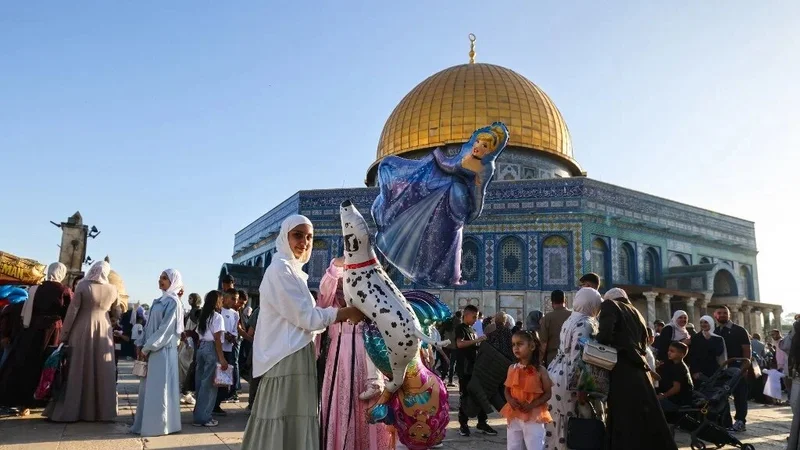
Saudi Arabia deletes 'the Muslims will never give up Jerusalem' from its textbooks
An Israel-based organisation has praised Saudi Arabia for removing the phrase “the Muslims will never give up Jerusalem” from its school textbooks, as it seeks to reshape how the kingdom teaches Islam, Palestine and Israel.
Israeli research group Impact-se published its review of the Saudi curriculum at the end of July.
“The statement implied that Muslim control over or presence in Jerusalem was under threat,” the report said, adding that the reference “could be interpreted as framing Jerusalem as a site of ongoing struggle between Muslims and other groups, particularly Israel.”
The criticism comes as Israeli politicians regularly call for the destruction of Al-Aqsa Mosque, Islam’s third-holiest site, and the construction of a Jewish temple in its place.
On Monday, Israeli authorities formally allowed Israeli settlers to conduct Jewish prayers inside Al-Aqsa Mosque in occupied East Jerusalem for the first time, an act of provocation that further violated and dismantled the site’s decades-old status quo.
With government support, Israeli settlers also continue building settlements on Palestinian land to alter Jerusalem’s demographic character.
The report also said that "all instances of antisemitism" as defined by Impact-se had been removed from the curriculum.
Passages from the Quran removed
The report celebrated as a “positive development” the removal of passages from the Quran and Hadith, the recorded sayings and teachings of the Prophet Muhammad.
Saudi textbooks notably dropped a well-known hadith about Muhammad visiting a sick Jewish boy who later accepted Islam.
“The removal of this example in the 2025 edition marks an improvement in the acceptance of religious minorities, as students are no longer taught that unbelief in Islam leads to damnation,” Impact-se said.
'While the change of terminology reduces hostility toward Israel, the use of the term 'the Israeli Occupation' [...] continues to reflect a position of non-recognition of Israel'
- Impact-se report
The organisation also welcomed the truncating of Quranic verses addressing disbelief and sin. It however criticised Saudi schools for continuing to teach Muslim pupils that Islam represents humanity’s natural religion, despite similar teachings appearing across major faiths.
The report also turned its attention to maps and terminology.
Impact-se said several maps had previously “omitted Israel” and labelled the entire territory Palestine. In the 2024-25 textbooks, Saudi authorities removed the Palestine label.
“[W]hile Israel is still not identified on these maps, the revision removes the explicit designation of the entire territory as Palestine.”
A Grade 11 history textbook also replaced “the Zionist Enemy” with the “Israeli Occupation”. Impact-se still deemed the change insufficient.
“While the change of terminology reduces hostility toward Israel, the use of the term 'the Israeli Occupation,' especially as it appears to refer to Israel as a whole rather than specific territories, continues to reflect a position of non-recognition of Israel,” it said.
The complaint is issued in the context of the Israeli government’s declared rejection of Palestinian statehood.
“There will not be a Palestinian state. It's very simple: it will not be established,” Israeli Prime Minister Benjamin Netanyahu said in November.
'Cunning and devious'
Impact-se also objected to Saudi textbooks describing Zionists as “cunning and devious”.
One textbook recounts how Chaim Weizmann, a Zionist leader who later became Israel’s first president, tried to bribe Saudi founder King Abdulaziz to “abandon the issue of Palestine” and not be “a major obstacle to the Zionist movement’s ambitions”.
The textbook describes Ibn Saud’s response, who regarded Weizmann’s “criminal audacity” as despicable.
Impact-se said the account “presents Zionists in a conspiratorial way, encouraging a negative view of the movement as a whole”.
However, the historical record supports the central facts.
A US State Department memorandum dated 6 February 1940 records Weizmann saying that “the only thing the Jews had to offer was money”.
Weizmann said he was prepared to raise three to four million pounds Sterling in exchange for Ibn Saud’s support for a plan under which Palestinians would be “voluntarily transferred” to Transjordan and Iraq.
That language echoes the “voluntary migration” promoted by Israeli ministers seeking to ethnically cleanse Palestinians from Gaza and the occupied West Bank.
Founded by figures closely connected to the Israeli state and Zionist institutions, Impact-se campaigns to change textbooks across the Middle East and promotes an Israeli version of regional history.
It demands that Palestinian and Arab textbooks recognise Israel explicitly. Neither the organisation nor its founders appears to have offered equivalent recognition of the State of Palestine.
Washington has reinforced this campaign through diplomatic pressure, including work led by the Israeli-born US special envoy to monitor and combat antisemitism, Ambassador Rabbi Yehuda Kaploun.
Following the report, Impact-se wrote on X: “We appreciate Saudi Arabia’s continued efforts to improve school curricula, including work to address concerning themes in textbooks.
“The portrayal of Israel and Zionism continues the gradual moderation documented in previous IMPACT-se reports,” the report said.