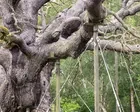
England’s ancient oak trees are dying in the summer’s extreme heat and dry weather, according to the Woodland Trust, with trees and ecosystems unable to adapt fast enough to the changing climate.
The heatwaves across much of Europe this summer have had a notable impact on crop growth and plant health. To cope with the extreme conditions, many trees are undergoing “early autumn”, wilting and losing their leaves early.
John Parker, the chief executive of the Arboricultural Association, said: “The signs of heat stress and dry weather is visible.”
Ed Pyne, a senior conservation adviser at the Woodland Trust, said it was helpful to think of trees like a large pipe constantly transporting water, minerals and nutrients from the soil, through its roots, up its trunk and out to its branches and leaves.
“When the trees are losing too much water, it stops this process and that’s when we start seeing the leaves wilting and dying, which can give rise to this early autumn phenomenon where the trees are losing their leaves early,” he said.
While the impact of the extreme weather is widespread across different species, Pyne said England’s ancient and veteran trees were being disproportionately affected. “These really old trees, they’re survivors, but, like us, when they get old they get a bit less resilient.”
This was made particularly visible by the death in June of the Major oak, one of Europe’s oldest, largest and most celebrated ancient trees. “One of the main reasons that tree died is because of these extreme weather conditions,” Pyne said.
Oak trees are classed as chronologically ancient from 400 years old onwards, although many will have ancient characteristics from around 300 years. There are about 3,300 oak trees greater than 6 metres in circumference in England, and about 114 over 9 metres. The rest of Europe combined, including Scotland and Wales, has about 98 recorded oaks over 9 metres.
Sherwood Forest lost eight ancient oak trees in 2024 and 2025, and Pyne has identified seven in England and Wales that are now in a critical condition:
- Crow Leasow oak, Shropshire.
- Tea Party oak, Suffolk.
- King John oak, Devon.
- Enmore oak, Somerset.
- Lydham Manor oak, Shropshire.
- Old Knobbley, Essex.
- Pwllpriddog oak, Carmarthenshire.
He said: “When you get these incessant droughts year after year, it’s a cumulative effect which compounds across time and gets worse. Almost all of our ancient trees are struggling under these conditions. They’re dying of this drought stress.”
Pyne’s analysis of mortality rates of ancient oaks found that half could be lost over the next 60 years. This analysis did not consider the changing climate, so Pyne believes the figure is likely to be a significant underestimate.
It is not just oak trees that are affected. Parker said beech trees in particular were also struggling with the heat. “They are possibly going into decline and may die, which would be disastrous for us,” he said.
Alexander Held, a senior expert at the European Forest Institute, said in Europe even drought-tolerant trees such as pine trees were dying. “Our trees can’t cope,” he said. The impact is varied, with some trees affected by the heat and others sunburnt from the sunlight.
Angelo Morgan, a director of urban tree management at the company Trees UK of Bromley, said historically their busy period had been the winter, when high winds and rain could cause a whole root system to come up. But now they were receiving an increasing number of calls to deal with “limb failure” in periods of hot and dry weather.
“The tree’s vascular system isn’t taking up as much moisture as it would normally do and so a lot of the limbs become very brittle and a lot of larger limbs are failing,” he said.
While forests are in a state of permanent adaptation, Held said the problem was the speed of change. “Our trees and ecosystems aren’t fast enough to cope with the speed of change. These changes will likely be a big disruption to our ecosystems,” he said.