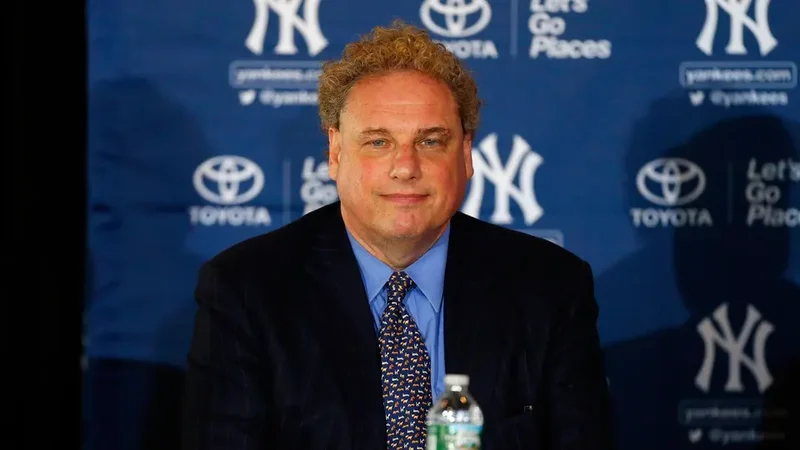
New York Yankees president Randy Levine has spent decades operating at the intersection of professional sports, politics and business. His latest role has put him in the middle of another contentious debate, this time over the future of college athletics and the increasingly complicated relationship between sports and public policy.
Levine was tapped by President Donald Trump to help lead the administration's effort to reshape college sports earlier this year, as the landscape undergoes dramatic change amid the surge in Name, Image and Likeliness (NIL) payments, sports betting and more.
“New York Yankees president Randy Levine will serve as vice chair of Trump’s new Saving College Sports Roundtable, a group of some two dozen executives and athletes from the college and professional levels, to fix the financial side of college sports, including the insane money grab known by its acronym, NIL,” Charles Gasparino reported for the New York Post. “A longtime college sports fan, Trump sees what has happened to a system where athletes used to spend four years playing for one school, receiving an athletic scholarship for free tuition.”
While Levine had been tapped to help carry out Trump’s ideas for reform among college sports, he has now offered his most detailed public call for change to the landscape, taking particular issue with the stances taken by the National Association for the Advancement of Colored People (NAACP) as well as the Congressional Black Caucus.
New York Yankees President Disputes NAACP, Black Caucus Calls For Sports Reform
In a recent Sports Business Journal article outlining his calls for changes to college sports, Levine argued that federal action is necessary to bring greater stability to an increasingly fractured system.
“The current system is unsustainable,” Levine wrote. “Universities are spending themselves into financial distress. Non-revenue, women’s and Olympic sports are disappearing. Smaller institutions are struggling to compete. Student athletes are caught in a system of constantly changing rules, litigation, transfers, NIL uncertainty, and inconsistent standards.”
While many groups seem to agree that college sports is in need of reform and government intervention as student-athlete compensation changes rapidly, Levine also used the article to call out the arguments against the Trump-endorsed “Protect College Sports Act.”
The NAACP has argued that this piece of legislation would reward academic institutions that should be doing more to champion Black voting representation, a stance that Levine refuted directly in his article.
“Equally unpersuasive is the argument advanced by the NAACP and the Congressional Black Caucus that a boycott of college sports will force universities — particularly Southern universities — to pressure their elected representatives to overturn the Supreme Court’s recent decision concerning redistricting and voting rights,” Levine wrote. “The time has come to move beyond the politics, the litigation, and the competing special interests.”
New York Yankees President Takes On Broad Sports Debate With Political Ramifications
The dispute between Levine and other proponents of the proposal and representatives of the African-American community illustrates how the college-sports debate has expanded well beyond NIL compensation and conference realignment. Questions involving athletes, universities, federal legislation, voting rights and civil-rights organizations are increasingly overlapping.
And ultimately, given Levine’s role with the Yankees organization, some fans of the team will take notice of who supports the proposed legislation and who opposes it. Though Levine might feel like his involvement in the issue is non-partisan, there are surely some fans of his team who would disagree.