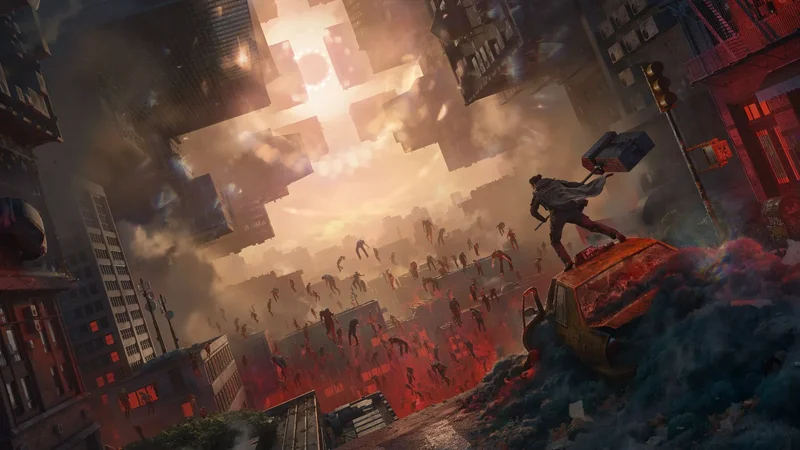
They say New York City can be a main character. Portrayed right, that’s as true for a Nora Ephron film as it is for a video game, like The Division or Marvel’s Spider-Man. We’re expecting a similar characterization when Control Resonant brings its bold vision in 2026, but that’s far from the first time developer Remedy Entertainment has delivered on a memorable New York.
First released for Windows PC 25 years ago (and following shortly thereafter on PlayStation 2 and Xbox), Max Payne is a memorable shooter that opens in a frigid version of New York City. There’s no ignoring the harsh elements and the accompanying sense of dread as police cruisers and a helicopter converge on a skyscraper that towers over the icy streets. No one feels the weight of the moment more completely than the titular Max Payne, who is still mourning a tragic loss from three years earlier that led to the night’s events.
Players remember Max Payne fondly because it tells its dark story with a lot of flair, so much so that it even inspired a 2008 movie starring Mark Wahlberg. Players first witness Max as he stands near the edge of the roof, looking down at the police response to “shots fired.” A horrifying backstory follows, presented as panels in a graphic novel with gruff narration provided by James McCaffrey.
Three years earlier, Max Payne worked on the police force and went home each night to his wife and daughter in New Jersey. But one evening, he stepped through his front door and into an unfolding tragedy. Three thugs flying high on a designer drug ransacked his house. Max shot them all, but not before they murdered his loved ones. Those events prompted him to step away from his close friends on the force to join the DEA. In his new undercover role, he then infiltrated a local mafia family linked to the distribution of the drug that made everything go wrong in his life.
You can unwrap the story yourself, and you’ll want to. The noir presentation is compelling despite its simplicity, because the developers at Remedy weren’t afraid to go for the throat as the genre requires. Happily, they backed that ambition up with enjoyable gameplay that featured an unexpected twist: bullet time.
First relevant during early events in Roscoe Street Station (note: not a real street in Manhattan), bullet time sees Max lunge or leap forward as events around him grind to a halt. The maneuver temporarily stuns his opponents, who suddenly respond as if they have become trapped in a vat of molasses. The delay isn’t indefinite. But while it lasts, Max can carefully aim and blast with near-impunity. Shotguns all but eliminate the necessity to even aim.
The plot in Max Payne may lack nuance, but it keeps things barreling along at a pleasing pace and bookends satisfying gunplay. Most of the worst blemishes are easy enough to accept while accounting for the game’s age. Environmental textures and architecture tend toward the bland. Max’s permanent smirk begins to feel comical rather than edgy. Those are examples of elements that a person would expect to fare poorly after multiple decades.
The game’s bigger problems are most noticeable when it is experienced on consoles. For starters, there is the inverted Y-axis. It leaves some players battling the camera as much as the various thugs who are so determined to make Max’s life difficult. Newer titles make it easy to switch up settings, and so does the original PC version, but Max Payne kept things lean for the PlayStation 2.
Another issue that hits hard on consoles is the scarcity of healing items and checkpoints. It’s not a lot of fun to wander several corridors, clearing out goons along the way, only for one shootout to go spectacularly wrong and force a retread. Restorative items sometimes are available, but less practiced players will quickly exhaust their supply with no way to replenish it. The checkpoint system then leaves Max stuck ahead of long set pieces packed with surprise attacks from enemies located off-screen, which feels punishing even on the lower difficulty settings. At least on PC, there’s the option to save freely.
Despite the rough edges, and sometimes even because of them, Max Payne remains a mostly satisfying shooter a full quarter-century after its debut. The game offers lots of style backed up by compelling action, especially when you play with fixes on PC. It will be interesting to see how Remedy adjusts the experience for the modern player with Max Payne 1 & 2 Remake, and what it continues to do with its interpretation of Manhattan in Control Resonant later this year.