In November 2018, 29-year-old Representative-elect Alexandria Ocasio-Cortez joined a group of 200 youth activists associated with the Sunrise Movement as they staged a protest at the office of then-House Minority Leader Nancy Pelosi. They were there to urge Democratic leadership to act more quickly on issues of climate change. The period between the election and swearing-in is normally when a newly elected legislator would be getting to know their future colleagues and angling for a good committee assignment. But there was Ocasio-Cortez, the improbable candidate, the member of Democratic Socialists of America who took no corporate donor money and had no major endorsements but still managed to unseat the 10-term incumbent Joe Crowley, shaking the table before taking her oath of office, aligning herself more with the activists than the politicians.
Ocasio-Cortez's win—along with those of Rashida Tlaib in Michigan, Ilhan Omar in Minnesota, and Ayanna Pressley in Massachusetts—served as a warning shot to establishment Democrats about the growing discontent with the party, especially among younger voters who yearned to see the party grow more progressive as the threats of climate disaster, student loan and healthcare debt, billionaire wealth hoarding, police violence, and MAGA Republicans loomed ever larger and put into question what kind of future they would be inheriting.
Earlier this month during an interview on ABC’s This Week, 36-year-old Rep. Alexandria Ocasio-Cortez, now one of the country's most popular Democrats, who seems to be eyeing either a presidential or Senate run, was presented with a headline from The Hill which read: “Today's cautious AOC would not have endorsed the AOC of 2018.”
“I mean, that's probably correct, right?” ABC host Jonathan Karl asked. “What's your thinking there?” Having served for four terms, on the way to be elected to her fifth consecutive one, Ocasio-Cortez is a more seasoned politician, and responded as such by not directly answering the question. But this all came about because she had declined to endorse fellow DSA member Francesca Hong in her race to secure the Democratic nomination for governor in Wisconsin. Hong had come under fire for old tweets expressing support for abolishing police and prisons, as well as a disdain for the genocidal history attached to Thanksgiving, positions which she had backed away from. While Ocasio-Cortez said she believed candidates should be judged for what they say in the present, the thing she said that made headlines was her dismissal of an entire period of radical political movement.
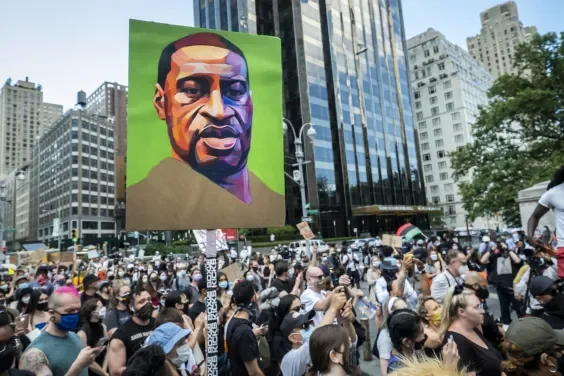
“I have a local city councilman that has this saying, ‘Woke 1 was crazy,’” Ocasio-Cortez told Karl. The councilman in question is Chi Ossé, who represents New York’s 36th district (Bedford-Stuyvesant and parts of Crown Heights, historically black neighborhoods, dating back to the 1930s and 1960s, respectively) and was elected in 2021, having been inspired to run for office through his participation in the protests that sprang up around the murder of George Floyd in 2020—in other words, because of “Woke 1.” In their assessment, Ossé and Ocasio-Cortez offer a view of the largest protest movement against police violence and for racial justice as the product of inflamed passions that presented ideas so far outside the bounds of serious discussion as to be deemed “crazy.” Later in the interview, Ocasio-Cortez said:
“I think that the doors were really open in trying to entertain any and every policy that was going to get us to a better place. And I actually think that the discussions that had—that were had in that time were quite fruitful. I think that when we talk about crime today, it’s fundamentally different than the way that we talked about crime in bringing crime down, right? And I think that we all share in the goals of having as low a crime rate as possible. I think that, you know, during lockdown, of course, rhetoric in that time is not rhetoric that we would use today.”
But the only “we” she could be referring to here is her fellow politicians; for a number of people, myself included, the politics of abolition is not just “rhetoric.” These are deeply held beliefs informed by an intellectual and activist history that views violence and punishment as the least effective ways to address our social and economic inequality. To dismiss it as a moment of “crazy” is spitting in the face of those who have sacrificed and laid their lives on the line to work toward these goals.
It’s not unexpected. Any politician who seeks higher office must do the work of distancing themselves from ideas deemed too radical. Bill Clinton had to attack Sister Souljah; Barack Obama had to throw Jeremiah Wright under the bus. This is the way American politics works. What’s disappointing is seeing the very politicians who benefited from this movement they now call “crazy” putting themselves at odds with the people who brought them to where they are. For them, it's a natural evolution in the pursuit of higher power: The AOC of 2018, protesting for decisive action on climate change at Nancy Pelosi’s office, gave way to the AOC of 2024, standing on stage at the DNC and lying about Kamala Harris working tirelessly for a ceasefire in Gaza, but that's the only path forward for her advancement. What some might call evolution, others will recognize as abandonment.
Credit where it's due: To say “Woke 1 was crazy” is an ingenious bit of political maneuvering. “Woke” has become the enemy of many—to conservatives predisposed to believing any progressive ideas are tantamount to societal decay, to liberals who fear “cancellation,” and even to leftists who have determined that “wokeness” is associated with issues of race and gender identity that they deem distractions from the more salient and unifying economic issues facing the working class. “Woke 1 was crazy” has mass appeal.
“Woke” has been transformed to fit whatever—whoever—you dislike. It can be deployed as a means of branding one's political opponents as unserious because they exist only on the fringes.
The actual roots of “woke” are far simpler. The first recorded usage of the word with its black vernacular meaning intact comes from the folk and blues singer Huddie “Lead Belly” Ledbetter, speaking about his 1938 protest song “Scottsboro Boys”: “So I advise everybody, be a little careful when they go along through Alabama—stay woke, keep their eyes open.” For modern ears, their first exposure may have been Erykah Badu’s 2008 song “Master Teacher,” written by Georgia Anne Muldrow: “What if it was no niggas, only master teachers?/I stay woke.”
In each instance, the plea is a basic one: Pay attention. That’s it. That’s all being “woke” was ever supposed to mean.
But as it began proliferating online during the mid-2010s, it became synonymous with particular expressions of progressive and radical ideologies, and for some with what they deemed as the excesses of those ideologies: land acknowledgements, pronouns in email signatures, critical race theory, intersectionality. Basically any challenge to entrenched racial and gender hierarchies became “wokeness,” and anyone who believed these to be important interventions in how we consider race and gender was an adherent to “woke ideology.”
But “woke” was never meant to be an ideology unto itself. It was only ever meant to encourage awareness of the world around you. If being “woke” led you toward more radical political ideas, that isn’t the fault of “woke,” but of the fact that the world is full of so many injustices.
By 2018, though, “woke” was losing most of its punch. I say that because it was the year that Ross Douthat, former New York Times columnist and incoming 60 Minutes contributor, wrote a piece titled “The Rise of Woke Capital.” Aside from there not being such a thing, as Gaby Del Valle would later write in Lux Magazine, it was a clear instance where the veil was dropped. Resistance to “wokeness” had little do with whether or not it was radical, but with it placing previously marginalized people at the center of our political imagination, and in particular the community from which the word sprang. People hate “woke” because they hate “black.”
I don’t believe either Ossé or Ocasio-Cortez hate black people, but I do think they make a grave mistake in not recognizing the ways in which “woke” has been weaponized against black people and black political movements, and that in saying “Woke 1 was crazy,” they hand over more ammunition to a right-wing agenda seeking to delegitimize black political expression. For them, “Woke 1” seems to be specifically about the summer of 2020, when calls for police and prison abolition broke through to the mainstream, and though they joined the chorus to “defund the police” at the time, they have since “evolved” past such “rhetoric.” That's fine for them—everyone is entitled to change their mind—but abolition is deeply rooted in an anti-capitalist, anti-carceral, black liberation politic that extends beyond that summer.
What was truly crazy about “Woke 1” was the way in which it was exploited. As Natasha Lennard wrote in her column for The Intercept, “Law-and-order Democrats genuflecting in kente stoles was laughable and lambasted at the time. Or, remember when Pelosi thanked George Floyd for ‘sacrificing’ his life ‘for justice’? Shameful.” A multi-racial, multi-gender coalition of mostly young people took to the streets demanding protection and investment in black life, and the best the country could do was to retire Aunt Jemima.
So what, then, is “Woke 2”? After all, we're in the age of endless sequels; of course a major blockbuster like “Woke 1” would require a follow-up. Erin Vanderhoof of Vanity Fair reported on this back in January, under the headline “Can Woke 2 Go IRL? Even Thomas Chatterton Williams Thinks It’s Possible.” Yes, the same Thomas Chatterton Williams who has made his crusade against “wokeness” his sole intellectual pursuit, to the point of publishing an awful book about it last year (his third and worst, a considerable feat given how terrible the other two are), thinks there’s something agreeable about “Woke 2.” The gist of it, as explained by Williams to Vanderhoof: “If Woke 2.0 is just being progressive without the nonsense identity stuff, for its own sake, then I think it would be a real improvement.”
As far as I can tell, that’s what “Woke 2” has to offer: capitulation to the right-wing distortion of “wokeness” by de-emphasizing anything that has to do with so-called “identity politics,” another term that has been divorced from its original meaning. It’s about returning the Democratic Party to New Deal-style political ambitions of government investment in the economic welfare of the public. Good. I’m glad that’s on the agenda. I hope Ocasio-Cortez becomes president and Ossé becomes a congressman, because right now they are the best of what is possible in electoral politics.
But it’s sad that the best of what is possible is to appeal to the Thomas Chatterton Williamses of the world. It’s sad that they feel the need to say things like “Woke 1 was crazy,” which doesn’t feel too far off from Elon Musk decrying the “woke mind virus.” It’s sad to think they can’t see how hurtful such language might be to the people who put their lives on the line to shift the political landscape, and made it possible for them to be elected in the first place.
Sad, but not unexpected. Not if you’re paying attention.