Sign in. It’s quick, free and it’s up to you.
An account is an optional way to support the work we do. Find out more.
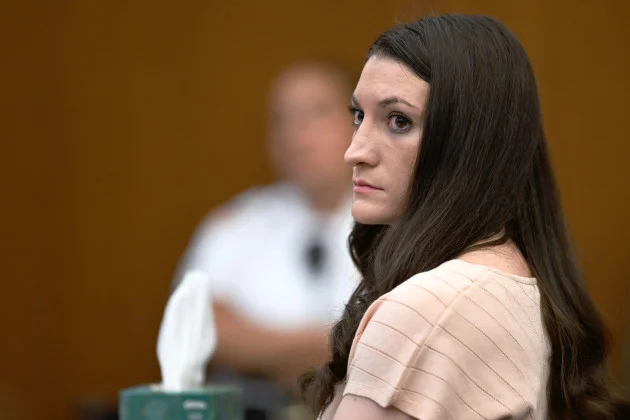
THE TRIAL OF Lindsey Clancy, a 36-year-old woman who admitted to killing her three young children in the basement of her Massachusetts family home in January 2023, has become the latest criminal trial to find a huge audience in the US and abroad.
This is in no small part due to the trial being broadcast live and the countless social media accounts that have been posting commentary about it.
Clancy does not deny that she fatally strangled 5-year-old Cora, 3-year-old Dawson, and 8-month-old Callan with exercise bands.
After the killings, Clancy jumped from the window of her second-floor bedroom, an action that has left her paralysed from the waist-down, her defence said. She was found by her husband “with deep cuts on her wrists.”
But her defence has argued that the killings were committed in the throes of postpartum psychosis, a rare mental health condition that affects between one and two of 1,000 women after childbirth.
Her defence is working to prove that Clancy was suffering from this condition and therefore cannot be found guilty of murder.
The prosecution is fighting to prove its opposing hypothesis: that Clancy was of sound mind and intentionally and rationally carried out the killing of her three children. The prosecution has also alleged that Clancy’s suicide attempt was insincere.
The prosecution rested its case on Monday after weeks of testimony from over 70 witnesses, including Clancy’s former husband Patrick Clancy.
Patrick Clancy testified that his wife was suffering from mental illness and he believes she was failed by medical practitioners that treated her in the months preceding the deaths of their children.
The trial also heard from first responders to the scene and medical professionals that treated Clancy in the months preceding the killings.
Medical professionals testified that they did not diagnose Clancy with psychosis and she showed no signs of being psychotic or manic, although they acknowledged that she was treated by a variety of doctors and this meant her treatment was disjointed.
The defence began to outline its case on Monday. Clancy’s mother and sister were called to the stand to testify on Clancy’s deteriorating mental health in the lead up to 24 January 2023.
Clancy’s mother Paula Musgrove described her as a “loving mother” and testified that her daughter was suffering from mental health problems.
Clancy was prescribed up to a dozen different medications to treat a myriad of symptoms of various mental illnesses, including postpartum depression, anxiety, paranoia and insomnia. Her defence attorney, Kevin Reddington, told the court that Clancy has bipolar disorder.
Musgrove said her daughter had reached out to her with fears that some of the medications she was taking were “destroying her mind”, and she was scared of sleeping alone.
Text exchanges between the two in October 2022 were displayed to the jury. One such message showed Clancy asking her mother to come and stay at her home in Duxbury, with her writing, “I’m really sick. Something is wrong”.
Allison Ozga, Clancy’s sister, also testified that she witnessed her sister’s mental health deteriorate around November, and she appeared to have low energy.
Clancy appeared to believe that her medication was causing her further difficulty, and she changed between different medications, different dosages, and sought out opinions from various providers.
In December 2022, she began to take a new antipsychotic medication, her former husband Patrick Clancy testified, saying he believes this is when her “big spiral” occurred.
That month, Clancy had confided in Musgrove and Patrick Clancy that she had thoughts of harming her children and was experiencing intrusive thoughts and suicidal ideation.
“She said she had thoughts of harming the children,” Musgrove testified.
Like Patrick Clancy, Musgrove said she had no fear that her daughter would act on these thoughts. But by January, Clancy had checked herself into an inpatient facility. She spent almost five days here.
Upon leaving this facility, she seemed to have improved, her former husband said, and she didn’t mention having any suicidal thoughts or thoughts of harming their children.
Nineteen days later, she carried out the killings.
If you have been affected by any of the issues mentioned in this article, you can reach out for support through the following helplines. These organisations also put people in touch with long-term supports:
To embed this post, copy the code below on your site