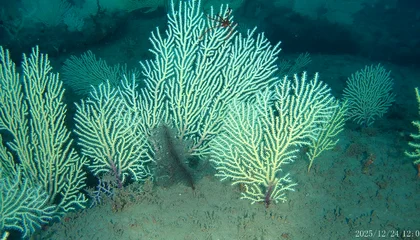
In the 1960s, government-requested fish surveys detected a coral reef barrier off the coast of Benin in West Africa, but it was presumed to be dead.
Now, however, researchers have taken a second look and found a flourishing coral ecosystem, they report in a study published on July 19 in the journal Frontiers in Marine Science. Their observations provide the first documented evidence of living low-light coral communities on the Gulf of Guinea’s continental shelf. What’s more, the reefs’ rediscovery is a testament to scientific endurance and sheds light on an understudied marine region.
“I was guided by the hope that sometimes nature can surprise us, and what you don’t intend to see is what can actually happen—it surprised me as well,” study co-author Gérard Zinzindohoué, an oceanographer at the Benin Fisheries and Oceanological Research Institute, tells Scientific American’s Sanidhya Sharma.
The project began in January 2025, thanks to a National Geographic Explorers grant, reports Inside Climate News’ Johnny Sturgeon. However, the team hit roadblocks when trying to purchase sonar equipment from a supplier in Europe. Additionally, since Benin doesn’t own a permanent research vessel, the scientists had to make do with small fishing boats to travel roughly 14 miles offshore.
“The fishermen’s boats are not used to going that far offshore, so it was risky for everyone,” Zinzindohoué tells the outlet.
Nevertheless, they persisted. Between April and December 2025, the team conducted sonar mapping, underwater drone surveys and deployed stationary video recorders to see what was going on in a 4.3-mile stretch of the suspected 24-mile-long coral reef barrier mapped in the 60s.
The data revealed a patchwork of corals about 177 feet below the surface at a depth called the mesophotic zone, where little sunlight reaches. Additionally, the video surveys captured eight fish species, including golden African snappers, blackbar soldierfish, West African goatfish and Guinean angelfish, using the corals for shelter and feeding. Although the team did not estimate how many individual fish were living there, the observations hint that the habitat supports a diverse assemblage of animals, the researchers write in the paper.
It was a “really undisturbed environment,” Zinzindohoué tells ABC News’ Julia Jacobo. “Everything was alive. And it was a really big moment for us because it was some things we have never seen.”
They were looking at a mesophotic coral garden, an ecosystem that differs from shallow coral reefs by living in deeper and darker waters and sometimes forming various chunks of coral communities instead of a continuous reef structure. It’s the first verified documentation of a living mesophotic coral ecosystem on the Gulf of Guinea continental shelf, Zinzindohoué says in a statement.
Did you know? Mesophotic coral ecosystems
Because these ecosystems are quite deep, little has been known about them until recently, thanks to technological developments. Scientists suspect that mesophotic corals could help replenish degraded shallow-water coral ecosystems because they share common species.
“However, I think what we found is probably not an exception,” he adds. “It is more likely a reflection of how little we still know about coastal regions in West Africa and elsewhere. If we were able to find this reef again after 60 years, how many others are still undocumented or simply forgotten?”
Luiz Rocha, curator of fishes at the California Academy of Sciences, agrees. “I think the most significant aspect of the study is that it confirms that living mesophotic coral communities occur in a region where we knew almost nothing about [them],” says Rocha, who did not participate in the research, in an email to Smithsonian magazine. “The Gulf of Guinea remains a major gap in our knowledge of deeper (and shallow) coral ecosystems, so discoveries like this highlight how much is still out there to explore.”
Still, many questions remain, including about the corals’ extent and their communities’ diversity, he adds. To understand the true nature of the observed ecosystem, researchers should conduct broader surveys of the continental shelf that incorporate direct observations, mapping and biological collections.
The team also notes that more work is needed. The researchers have yet to directly sample the corals, so the species still need to be verified. Further data could also reveal whether the corals detected in the surveys were indeed dead in the 1960s and rebounded or whether the initial assumption was simply wrong.
Regardless, the new work offers a helpful starting point, Zinzindohoué tells Scientific American. “We hope that, through this result, people will start to look at the ocean differently, and that it might inspire others to do more ocean research and focus on the protection and conservation of marine ecosystems.”