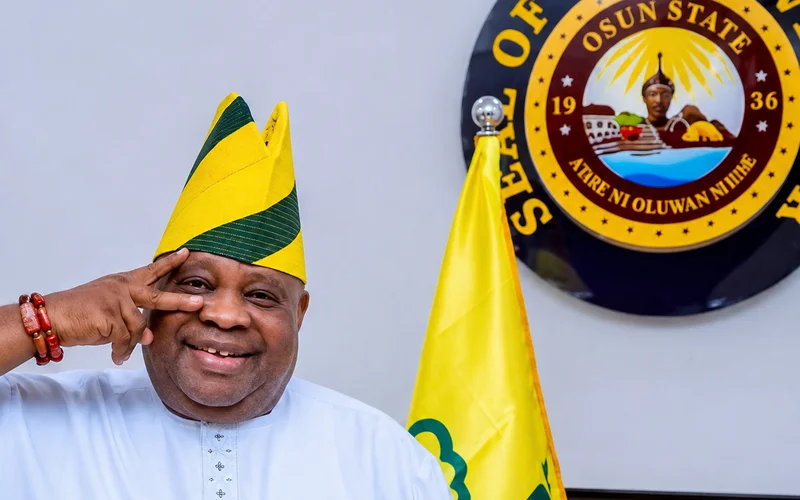
Governor Ademola Adeleke of Osun State secured a second term after defeating his main opponent, Bola Oyebamiji of the All Progressives Congress (APC), in Saturday’s governorship election.
Mr Adeleke, who contested on the platform of the Accord Party, polled 511,067 votes to defeat Mr Oyebamiji, who polled 444,815 votes, according to results declared by the Independent National Electoral Commission (INEC). He won in 19 of the state’s 30 local government areas, while the APC candidate won in 11.
The result extends Mr Adeleke’s time in office beyond his first term, which began after he defeated the then incumbent, Gboyega Oyetola, in the 2022 election on the platform of the Peoples Democratic Party (PDP).
But the 2026 election presented a different political landscape. Mr Adeleke left the PDP, the platform on which he won in 2022, to contest under the Accord Party and faced an APC candidate backed by several prominent political figures.
| | |
|---|
Despite these challenges, Mr Adeleke emerged victorious, winning by 66,252 votes.
PREMIUM TIMES analyses six factors that may have contributed to the governor’s victory.
Adeleke’s performance
One factor that may have worked in Mr Adeleke’s favour was how some residents assessed his first term against previous administrations.
Mr Adeleke came into office in 2022 after years of salary and pension arrears in the state. His administration subsequently made the payment of inherited obligations, workers’ welfare and infrastructure key parts of its record.
Also, the government said it constructed or rehabilitated more than 300 kilometres of roads, rehabilitated over 200 primary healthcare centres and more than 150 public schools, and cleared inherited pension liabilities. It also pointed to the establishment of the University of Ilesa and other completed projects.
On the state’s finances, Osun’s domestic debt reduced by over 43.84 per cent and its external debt also fell from $91.78 million to $75.14 million over the same period. The state’s internally generated revenue also rose from N27.72 billion in 2023 to N54.7 billion in 2024,
Some of these achievements were contested by the opposition. The APC National Publicity Secretary, Felix Morka, described Mr Adeleke’s record as lacklustre and criticised the state of the health and education sectors.
Despite the criticisms, Mr Adeleke went into the election with a record of projects that he could point to in seeking a second term and majority of the voters in the state agreed with him.
Workers’ welfare
Improved workers’ welfare may have given Mr Adeleke an important advantage because his record was being compared with the experience of workers under his two immediate predecessors.
Under Rauf Aregbesola, Osun began paying modulated salaries during the state’s financial crisis. Between June 2015 and December 2017, workers on Grade Level 14 and above received half of their salaries, while those on Levels 8 to 13 received 75 per cent.
When Gboyega Oyetola took over in 2018, the payment of full salaries resumed, but significant salary, pension and other inherited obligations remained outstanding.
Mr Adeleke came into office in November 2022 and began clearing some of those liabilities. His administration said it inherited unpaid salaries, pension obligations and deductions from the previous administrations and subsequently started paying the arrears.
In August 2024, for instance, the government announced the payment of N1.69 billion in inherited cooperative deductions and another seven months of half-salary arrears.
At a 2026 presentation of his record, Mr Adeleke said his administration had paid almost N100 billion in inherited pension debt.
Residents compared the experience of workers under the previous administrations with the payment of salaries, pensions and arrears under Mr Adeleke.
“We used to hear half salary, but he cleared all previous administration debts. Now, Osun State salary scale is far better, and it adopted the minimum wage ahead of any state in Nigeria. This has helped other sectors like education and the economy,” Adeyemi Waheed, a resident, told PREMIUM TIMES.
Labour unions also endorsed the governor. At the 2025 Workers’ Day celebration, Osun NLC chairman Christopher Arapasopo commended Mr Adeleke for paying salary arrears owed by previous administrations, paying promotion arrears and implementing the N75,000 minimum wage.
Mr Adeleke, however, also faced criticism over his workers’ welfare record. Critics argued that the increase in the state’s revenue gave Mr Adeleke greater resources to clear inherited obligations and improve workers’ welfare.
Grassroots appeal
Mr Adeleke’s personal style was a factor that may have strengthened his grassroots appeal.
The governor regularly attended churches, mosques, traditional ceremonies and community events, often dancing and interacting with residents at such gatherings.
His dancing eventually became a defining feature of his public image, earning him the nickname “the dancing governor.”
His opponents have sometimes used that behaviour to portray him as unserious. But the same visibility has helped him maintain a connection with residents and presented him as an accessible governor.
Some Muslim groups also accused him of marginalising Muslims and questioned his religious identity. In June, the Concerned Muslim Stakeholders and League of Alfas endorsed the APC candidate, arguing that the Accord ticket did not adequately reflect the state’s religious balance.
The criticism continued during the campaign. In July, the APC deputy governorship candidate, Benjamin Adereti, described Mr Adeleke as a “religious hypocrite” and questioned whether he was a Christian or Muslim.
Mr Adeleke’s supporters, however, pointed to his engagement with both Muslim and Christian communities. Some Muslim clerics also backed his re-election, while his administration highlighted the appointment of Muslims to senior positions and the construction of an Osun Hajj camp and a mosque at the Government House for Muslim staff.
The governor also maintained a strong presence at traditional and community gatherings.
The election results suggest that his appeal was not confined to his traditional strongholds. He won in 19 of the state’s 30 local government areas.
Federal might
The election also gave Mr Adeleke an opportunity to portray himself as an incumbent confronting federal political pressure.
The APC had significant political figures behind its candidate, including former Osun governor Gboyega Oyetola, who is now minister of Marine and Blue Economy.
The issue became quite obvious in the final days before the election.
On 5 August, the Economic and Financial Crimes Commission (EFCC) obtained a court order freezing an account belonging to the Osun State Government, just 10 days before the poll.
The commission said it had been investigating the state since March over the alleged handling of about N11 billion in Ecology Funds, Intervention Funds and Federal Account Allocation Committee (FAAC) funds, and said it acted after detecting what it described as suspicious transfers from the state’s accounts.
The affected account was reportedly used for the payment of workers’ salaries, making the timing sensitive. Mr Adeleke’s administration condemned the action as politically motivated and capable of disrupting government operations ahead of the election.
President Bola Tinubu intervened and directed the EFCC to return to court to vacate the order. The president’s major reason was that it should not have been done a few days to the election.
There was another incident that fed into the perception of federal pressure.
In July, the police arrested Osun’s Secretary to the State Government, Teslim Igbalaye, and five others after a raid on his residence. Police said they recovered N4.81 million, two voter cards, a voter register and other items.
The state government and Adeleke’s campaign rejected the allegations surrounding the raid. Mr Adeleke’s campaign repeatedly portrayed itself as resisting federal political pressure.
This narrative may have helped turn the strength of the federal government and APC into an electoral argument for the incumbent: that Osun voters should decide who governs the state rather than political forces outside it.
Tinubu’s neutrality
President Bola Tinubu’s approach to the contest was another element.
Ordinarily, the presence of the president would have been expected to strengthen the campaign of the candidate of his party.
Mr Oyebamiji repeatedly described himself as Mr Tinubu’s candidate, and APC leaders campaigned heavily for him. In June, Mr Oyebamiji said he remained the president’s “only anointed candidate.” However, the president’s personal statements and actions suggest otherwise.
Firstly, the president was absent from the party’s major campaign activities in the state, and Vice President Kashim Shettima did not represent him either. In essence, the president did not join the campaign for his party’s candidate in Osun.
The president’s intervention in the EFCC matter was also notable. After the commission obtained the order freezing the Osun government account, Mr Tinubu publicly intervened and ordered the agency to seek the vacation of the order, saying the timing was inappropriate because of the election.
After the election, Mr Tinubu also congratulated Mr Adeleke and described his victory as reflecting the will of the people. He said his re-election “is a fitting assurance that democracy will continue to flourish in our country under the All Progressives Congress administration.”
“The outcome of the election reflects the will of the people and is a fitting assurance that democracy will continue to flourish in our land,” Mr Tinubu noted in his congratulatory message on X.
As an opposition governor, Mr Adeleke endorsed the president’s bid for a second term, describing him as a leader of the South-west.
He maintained that position even after leaving the PDP and moving to Accord. He also reaffirmed his endorsement after he was declared winner of the election, to which aviation minister Festus Keyamo responded by suggesting there was an agreement between Mr Adeleke and Mr Tinubu.
Ahead of the election, Mr Adeleke’s campaign also backed Mr Tinubu’s call for security agencies to remain neutral during the election.
Mr Tinubu’s approach therefore meant that, despite the APC’s strong political presence in Osun, the party’s candidate did not have the direct presidential campaign backing that could have added further weight to the APC’s challenge.
Davido’s influence
Mr Adeleke also had a huge advantage in the form of his nephew, David Adeleke, popularly known as Davido, whose involvement gave the campaign access to a large youth and social media audience.
In May, Davido was appointed chairman of the Imole Youth Campaign Mobilisation Team and announced a two-month break from music to concentrate on the re-election campaign.
He also obtained membership of the Accord Party and used his social media platforms to canvass support for Mr Adeleke.
During one campaign appearance in Ede, Davido urged supporters to mobilise for his uncle and said Mr Adeleke had performed and deserved another term.
His involvement attracted significant attention beyond the traditional political campaign space.
Former South-East spokesman to President Tinubu, Denge Onoh, after the election, described Davido’s participation as significant for youth mobilisation and political engagement.
Overall, Mr Adeleke’s ability to win a second term after changing parties, while retaining his traditional base and making gains across other parts of the state, suggests that his political appeal had grown beyond the platform on which he first won office.