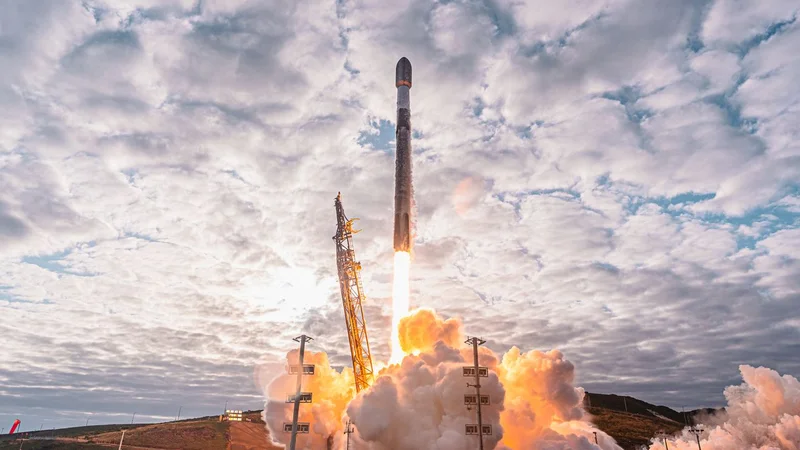
SpaceX is about to hit the century mark for the third year in a row.
A Falcon 9 rocket is scheduled to lift off from California's Vandenberg Space Force Base tonight (Aug. 18), during a four-hour window that opens at 10 p.m. EDT (7 p.m. local time; 0200 GMT on Aug. 19).
It will be the 97th Falcon 9 launch of the year and the 100th mission of 2026 overall for SpaceX. You can watch live via the company's website, beginning about 10 minutes before liftoff.
Tonight's mission will carry 24 of SpaceX's Starlink internet satellites to low Earth orbit. If all goes according to plan, the Falcon 9's upper stage will deploy them there 61.5 minutes after liftoff.
The rocket's first stage, meanwhile, will come back to Earth about 8.5 minutes into flight, landing in the Pacific Ocean on the drone ship "Of Course I Still Love You." It will be the 12th mission for this particular booster, which is designated B1097.
B1097 is no stranger to milestone flights. During a Starlink launch this past April, for example, the booster performed the 600th landing of an orbital rocket in SpaceX's illustrious history.
The vast majority of SpaceX's launches this year — at the moment, 73 of them — have been devoted to building out the Starlink megaconstellation, which currently consists of nearly 11,000 operational satellites.
One of SpaceX's three non-Falcon 9 launches of 2026 was performed by its Falcon Heavy rocket. The other two were suborbital test flights of Starship, the giant, fully reusable vehicle that SpaceX is developing to help humanity settle the moon and Mars, among other tasks.
SpaceX first topped 100 launches in 2024, when it conducted a total of 138 missions (132 by Falcon 9, two by Falcon Heavy and four by Starship). In 2025, the company flew a total of 170 times (165 by Falcon 9 and five by Starship).
Such numbers will jump dramatically in the coming years, if all goes to plan. SpaceX founder and CEO Elon Musk has said the company wants to launch Starship multiple times per day, boosting annual tallies to 1,000 or so. Falcon 9 and Falcon Heavy aren't part of this longer-term picture; SpaceX wants to phase them out and have Starship shoulder the load.