Syria's participation in the 61st Venice Biennale of Art this year was more than simply a return to one of the world's most important artistic platforms. Rather, it appeared to be an attempt to reclaim Syria's place in the narrative of global culture – not merely as a country emerging from war and destruction, but also as a place that, for thousands of years, helped shape the meaning of civilization and human exchange.
For this reason, the choice of Palmyra as the theme of the Syrian national pavilion was neither purely aesthetic nor archaeological. The project presented by Syrian artist Sara Shamma, titled "The Tower Tomb of Palmyra," revisits the model of Palmyra's funerary towers, built between the first and third centuries, and reconstructs their underlying concept within a contemporary space through an immersive installation combining painting, architecture, light, sound and scent.
According to the Biennale's official presentation, these towers were not merely elevated tombs standing in the desert. They represented an architectural form that kept the dead close to the living, creating a bond between generations and making memory part of a shared human realm.
It is here that the deeper significance of Syria's participation begins.
Palmyra's funerary towers were among the ancient city's most distinctive architectural features. During the years of the Syrian war, this architectural heritage was subjected to destruction and looting, while Palmyrene artifacts and funerary sculptures were dispersed beyond the country's borders. Erecting a Palmyrene tower in Venice, therefore, is not an attempt to reproduce an ancient monument exactly as it once stood. It is a symbolic reclamation of something that was meant to disappear.
In this sense, the work does not reconstruct stone. It reconstructs meaning.
This is a fundamental aspect of Shamma's project. Visitors enter a structure that evokes the ancient tower, yet inside they encounter painted faces belonging to the present. The artist has explained that large paintings surround visitors in circular layers inspired by Palmyrene funerary portraits, while contemporary figures look directly at the viewer in an attempt to dissolve the distance between past and present.
Paradoxically, the "tomb" thus becomes a place of life.
The dead whose faces and memories were preserved in these towers 2,000 years ago are confronted by the living of today, as though the work were suggesting that civilization is not simply what remains buried beneath the earth, but rather the uninterrupted chain linking those who once lived, those who are here now and those who will come after them.
The Palmyrene tower in Venice therefore becomes a metaphor for Syria itself: a place subjected to destruction, yet whose physical devastation did not necessarily entail the destruction of memory.
Palmyra is also significant because it enables Syria to present itself to the world beyond the image that has become attached to the country over the past decade and a half.
In recent years, the world has come to know Syria through the vocabulary of war, displacement, destruction, massacres and military maps. Palmyra, by contrast, evokes a span of time far longer than the present political conflict. It restores the country to a historical context in which it stood as a crossroads between East and West, connecting trade routes, cultures, languages and religions.
This is why the Syrian pavilion's official description emphasizes that Palmyra was a city shaped by exchange rather than exclusion, a place where multiple cultures and religions coexisted, and that invoking it today carries an ethical proposition grounded in tolerance and coexistence in a world marked by loss and displacement.
The message acquires even greater significance because it is being articulated in Venice.
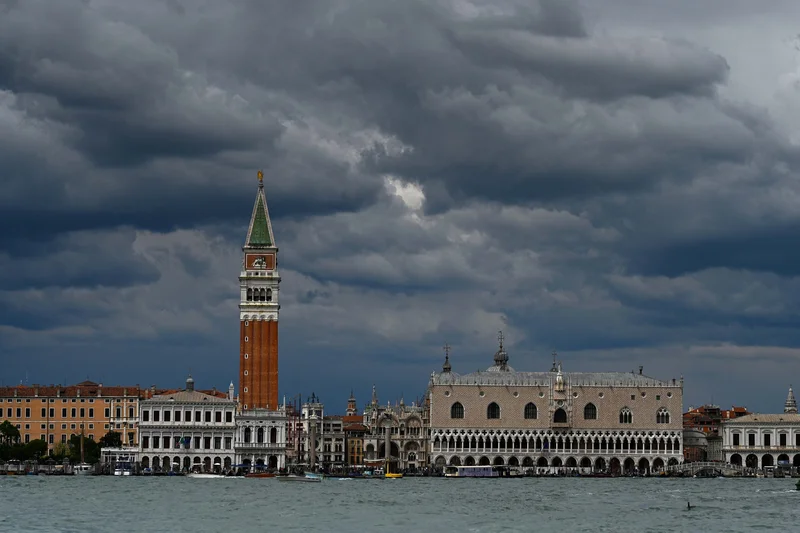
There is a striking historical parallel between the two cities: Palmyra, the caravan city situated between empires, markets and cultures, and Venice, the maritime city that built much of its prominence on its position as an intermediary between East and West.
This was one of the ideas reflected in remarks by Syrian Culture Minister Mohammad Yassin Saleh at the pavilion's opening, when he noted that Venice had historically served as a bridge of communication between peoples and cultures, placing Syria's presence there within a civilizational context that extended beyond the artistic participation itself.
The most intriguing part of the culture minister's speech, however, was his invocation of three figures: Zenobia, Apollodorus of Damascus and the Syrian jurist Papinian.
These names are not simply historical references inserted into a ceremonial speech. Taken together, they can be read as an attempt to define how Syria wishes to present itself culturally.
Zenobia represents Palmyra and its ability to transform itself from a city along trade routes into a major political and civilizational center. Apollodorus of Damascus represents the transfer of Syrian knowledge and architectural imagination into the heart of the Roman Empire. Papinian, meanwhile, represents the contribution of people from this geography to the formation of one of the most important legal traditions to leave its mark on European history.
In other words, the implicit message is not merely: We possess an ancient civilization.
It is: We were partners in the making of human civilization.
That distinction is fundamental.
Conventional discourse about antiquities often transforms ancient countries into vast museums that take pride in what they have inherited from the past. Invoking figures whose ideas and achievements traveled into other cultural spaces, however, presents Syrian history as a history of movement, interaction and reciprocal influence.
This is entirely consistent with the choice of Palmyra itself: a city whose greatness did not arise from isolation, but from its location along the routes of the world.
From this perspective, Syria's participation can be understood as part of what might be called the reclamation of narrative.
During the war, it was not only Syria's archaeological heritage that was destroyed. Syria's image was also reduced and compressed. In the international imagination, the country became a site of catastrophe more than a place capable of producing culture.
Placing a Palmyrene tower at the heart of a global artistic event such as the Venice Biennale reverses that relationship. Instead of the world coming to Syria to witness the traces of destruction, Syria takes part of its memory out into the world and asks the world to enter it.
The difference between these two images is enormous.
In the first, Syria is an object to be observed.
In the second, Syria is the author of its own discourse.
This year's participation also differs in format from previous Syrian appearances. The pavilion is dedicated to a single Syrian artist, Sara Shamma, curated by renowned Japanese curator Yuko Hasegawa and commissioned by the Syrian Ministry of Culture, whereas previous editions relied on group exhibitions featuring multiple artists.
The work itself thus becomes the discourse, rather than the pavilion merely functioning as a collection of artworks gathered under the name of a country.
There is another dimension inseparable from this participation: the return of Syrian culture to the international arena.
The Venice Biennale is no ordinary art exhibition. Founded in 1895, it has evolved into one of the world's most important institutions of contemporary art, and its 61st edition includes 100 national participations. The Syrian pavilion is officially registered under the name of the Syrian Arab Republic, with Wassim Abdel Hamid, director of fine arts at the Ministry of Culture, serving as commissioner; Yuko Hasegawa as curator; and Sara Shamma as the artist. The pavilion is located at a venue within Venice's IUAV University.
From this perspective, Syria's participation acquires a significance that extends beyond art into the realm of cultural diplomacy.
States enter such arenas not only under their flags, but through the narratives they want the world to know about them.
What is striking is that Syria did not choose a work celebrating a political victory or an explicitly propagandistic work about a "new Syria." It chose a tomb.
Yet that tomb became one of the most powerful symbols through which to speak about life.
It is a structure destroyed by war and rebuilt through art; a memory subjected to looting and now returning to demand its place; faces from the past summoned again through the faces of the present.
The issue of Syria's looted antiquities also remains present in the background of the project, as the work is connected to calls for the restitution of artifacts looted and smuggled out of the country during the war.
The protection of heritage is thereby linked to the idea of cultural sovereignty: A country's recovery is not completed merely by recovering territory and institutions, but also by recovering its memory.
Perhaps this is why the distance between Palmyra and Venice seems shorter than it appears on the map.
Both built their histories upon passage and movement.
Both flourished because they were not the end of a road, but places where roads converged.
Seen in this light, the culture minister's description of Venice as a bridge between peoples can be read in parallel with his invocation of Palmyra as a center of human civilization and cultural exchange.
The message carried by the Syrian pavilion is not a glorification of the past simply because it is past. Rather, it is a recovery of the philosophy of place: Great civilizations arise when borders are crossed, when languages, religions and cultures enter into dialogue - not when borders are transformed into walls.
This is also why Zenobia, Apollodorus and Papinian do not seem at all remote from the theme of the exhibition. Each of them, in a different way, was a child of that movement between Syria and the world.
Ultimately, the strength of Syria's participation in the 2026 Venice Biennale lies in the fact that it does not attempt to deny the catastrophe through which the country has passed, while simultaneously refusing to allow that catastrophe to become Syria's sole definition.
The tower bears the traces of death, but it is not a monument to death.
Palmyra bears the traces of destruction, but it is not a city of destruction.
Syria bears the wounds of many long years, but it is not the sum of those wounds.
Here, Shamma's vision converges with the ideas articulated in the culture minister's speech: the reclamation of Syria as a producer of meaning rather than merely the object of events, and the understanding of culture as a means of restoring the country's place in the world rather than as an appendage to politics.
In Venice, the Palmyrene tower was not built to restore the past exactly as it once was; that would be impossible. It was built to demonstrate that what is destroyed in history can return through memory, that what is scattered across exiles can be brought together within a work of art, and that civilization is measured not only by what peoples have succeeded in preserving of their stones, but also by their ability to give those stones new meaning.
Perhaps the most striking paradox is that Syria chose, at a moment when it was searching for a new language with which to address the world, a tower for the dead in order to speak about life.
From the heart of Venice, the Palmyrene tower seemed not merely to restore a monument that had disappeared from the Syrian desert, but to raise a larger question: What remains of peoples after devastation?
The Syrian pavilion's answer was at once simple and profound:
Memory remains, and art remains capable of giving it a body once again.