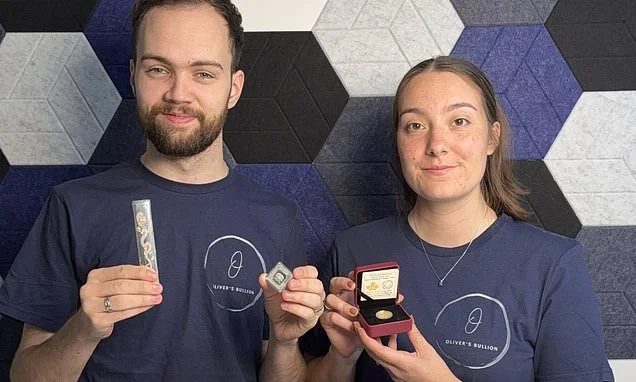
A young couple who quit their NHS and software jobs to sell gold and silver online are now turning over up to £1million a month, but say they can lose £10,000 to £15,000 a month when the precious metals market turns against them.
Sat outside a restaurant in Paris in October 2024, Oliver and Anna drained their phone batteries watching livestreams selling coins and precious metals.
With no major interest in coins prior to this moment, the couple, then 23, were mesmerised by this new and engaging way to teleshop.
Anna was working as a nurse on around £24,000 while Oliver was a software engineer making £31,000 a year.
Living in west London and desperate to earn some extra cash, the couple felt inspired by how much money they could make selling coins and decided to take a leap of faith.
Just over a year later, both are now 25 and take £50,000 salaries from their business, while Oliver's sister also works for the company.
They are hoping to sell their London flat and move back to their native Dorset, where they can be closer to family and have more space to expand the business.
The couple say they are now closing in on £1million turnover months, with their biggest individual livestream generating around £320,000 in sales.
Oliver and Anna Mills got married in August 2024. The following year, they quit their jobs to sell gold and silver online, and now turn over up to £1million a month
‘It all kind of happened by accident,’ they say. ‘But it is like a little safety net. If something really bad happened, we could take £5,000 or £10,000 out of the business if we really needed to.
‘That's my favourite part about having the business – having that access to money in an emergency.’
Both from Weymouth and together since 2020, the couple didn’t bond over a mutual interest in coins. Although Oliver collected the odd 5ps and £1s as a child, for Anna it was totally new.
With their new jobs as a nurse and software engineer, the couple bought their two-bed London flat through a shared ownership scheme, with plans to rent out the spare room on Airbnb.
However, rising service charges and the cost of living in the capital meant their outgoings ‘skyrocketed’.
‘I think our living costs were around £2,000 a month for all the standard mortgage, rent, service charge, all that sort of stuff,’ says Oliver.
Keen to secure a side hustle, one plopped into their hands when Oliver’s father sent him a link to a Whatnot livestream while on holiday in Paris.
It was the first time Oliver had ever heard of the app but nevertheless, he downloaded it and spent much of the rest of the holiday watching livestreams.
Whatnot is a live shopping marketplace where sellers can auction products, offer fixed prices and run flash sales to viewers.
The couple were struck by the apparent scale of the sales, with Oliver estimating that one seller appeared to have sold around £10,000-worth of gold and silver in an hour.
Just weeks after discovering the platform, on November 30, 2024, Oliver hosted his first livestream.
He had started buying old coins in bulk, including by the kilo, through Facebook groups and eBay. He would then separate them into individual listings, with condition and year helping determine their value.
Oliver watched a livestream on Whatnot – a live shopping marketplace where sellers can auction products – in which one user sold around £10,000-worth of gold and silver
‘I’d sit down and I would literally break out every single individual coin into its own listing and sell the coins one by one.’
During his first Whatnot livestream, Oliver made £1,300 in sales in around 45 minutes.
He'd show viewers the coins, explain what they are, and answer any questions.
‘After my first stream, I went off and spent thousands of pounds on any ounce of silver I could find,‘ he says.
‘It was quite sketchy back in the day. I'd meet people from Facebook marketplace and hand over like four grand in cash that I literally just withdrew from a petrol station ATM or whatever.
‘And then I'd bring it home and I'd sell it. It kind of just escalated from there and we started doing it on a weekly basis.’
Oliver also began putting stock purchases on a credit card and regularly asked his dad to lend him £1,000 until the next day to help fund purchases.
The early sales grew rapidly: around £3,500 in the following stream, then £5,500 and £6,000 in successive weeks.
By August 2025, Anna quit her job and became full-time in the business on a £34,000 salary.
Four months later, in December 2025, Oliver quit his job too and started on £34,000.
He says: ‘I was very, very anxious about leaving a secure job into something that could change any point. But we did eventually take the leap after I had probably two months of hard thinking about it.’
Anna adds: ‘It was absolutely horrifying. For me, I wanted to be a nurse. I wanted a very stable job. So it was very overwhelming initially.’
But the worst was yet to come.
Things took a turn in early 2026 due to a major market downturn in the precious-metals market.
The couple had bought some coins at around £92 and could later sell them for only £70.
Oliver said: ‘Everything we sold, we were losing 10, 20 quid on the coin. And we still had the sale because we couldn't just sit on the stock because it wasn't going back up any time soon.’
The couple have been exposed to movements in underlying gold and silver prices and can be forced to sell stock at a loss, joking, 'We are at the mercy of Donald Trump's Twitter account'
They estimate that for roughly three months they were running at a net loss of around £10,000 to £15,000 a month.
Oliver said: ‘We lost about £30,000 overnight on market loss and then from then about £10,000 to 15,000 a month of actualised losses.’
Ultimately, there can be a large difference between turnover and profit.
Although the pair may generate hundreds of thousands of pounds in sales, they are also exposed to movements in the underlying gold and silver prices and can be forced to sell stock at a loss.
Oliver said: 'The markets can be incredibly volatile. We are completely at the mercy of the stock market, completely at the mercy of Donald Trump's Twitter account.'
Thankfully, the stronger trading period before the downturn helped absorb those losses.
Now, the couple buy roughly 1,000 to 2,000 items a week, spending between £100,000 and £350,000 on stock.
Their highest calendar month was February at £780,000. Meanwhile their actual annual turnover for the latest financial year was £3.7million.
This year, their 12-month rolling revenue is £6.5million (August 1, 2025 to July 31, 2026).
And part of their success comes down to such strong relationships with suppliers that allow them to receive stock on 24-hour payment terms.
This means they can receive a delivery, sell the goods on a livestream and pay the supplier the following day.
Oliver said those terms were built up after doing millions of pounds of business with suppliers.
Laying it bare, Oliver and Anna have had to put in a lot of time and money into making their business work.
Oliver says Anna is the chief packager. He jokes: ‘She wakes up, makes a cup of tea, packs, sits down, has lunch, packs, sits down, has dinner, packs, goes to bed.’
Per week they slog for around 70 to 80 hours and once held a 24-hour livestream. That stream generated around £320,000 in sales, with 3,017 individual items sold and a peak of 1,351 viewers.
On a typical stream, they get around 250 to 500 viewers, while they now have roughly 54,000 followers.
How the business works
The couple currently schedule livestreams up to 20 weeks in advance, running them on Monday, Wednesday, Friday and Saturday evenings, as well as Tuesday and Thursday lunchtimes.
And the process is ‘simple,’ says Oliver. ‘I go on to Whatnot on my computer and I whip up a live stream. It's all done through OBS [open broadcaster software]. It's like a live streaming software, so I have my nice camera and all the overlays with the spot prices and stuff.
‘I go live and pick up an item and run it. That is literally as simple as it goes.’
The couple photograph their stock and list the item, before selling it through a livestream on Whatnot. (Pictured: One-ounce silver Britannia coin)
They receive deliveries roughly three times a week from distributors, wholesalers, manufacturers, mints and other suppliers in the UK and overseas. The stock is photographed and listed before being sold through their livestreams.
Oliver takes requests for specific items and also runs flash sales.
He explains: ‘If we have like 500, one-ounce silver Britannias [special bullion coins issued by the Royal Mint], rather than sitting there for an hour and running through them one by one, if we know they're roughly the same condition and stuff like that, I will just hold one up on screen and say, here you go, bargain for you.
‘You've got two minutes to take one if you want one. The price is reduced from £62 down to £58 and then sell them that way. And that's a really, really good way of selling through large amounts of stock very quickly.
‘We've got quite a notorious social media post where we did on Black Friday. We did a flash sale on Britannias and we sold, I think it was 150 in six seconds or something.’
The couple's stock ranges from mainstream bullion to more collectible coins, including silver Britannias, Mexican Libertads, gold sovereigns and proof coins.
They also sell special-edition ‘privy’ coins, which have a small additional mark or design and can command higher prices than standard versions. Oliver gave the example of Sakura privy Britannias, which he said can sell for several times the price of a standard coin.
At the higher end, they have sold a 5oz gold coin for around £18,000. Oliver said he had seen the same coin listed elsewhere for around £24,000 at the time.
They have also sold a full ‘monster box’ of 500 one-ounce 2026 South African Krugerrands for £39,000. Oliver said that, at the time, individual coins were selling for around £85 to £90, while the bulk deal worked out at around £78 per ounce.
From side hustle to business
The business has now grown far beyond the couple's original plan to make a little extra money.
They have increased their salaries from £34,000 each when they first went full-time to £50,000 each today, while also employing Oliver's sister. They have also brought in an accountant to handle their books and reporting.
Oliver and Anna say the sheer volume of coin stock means their flat now resembles 'a warehouse', as the business has expanded well behind what they originally imagined
The accountant is costing around £32,000 a year, which is a significant expense, but one Oliver says was necessary as the complexity of the business grew.
The business has to deal with different VAT and tax treatments for precious metals, including VAT-free investment gold, VAT on certain new silver products and the margin scheme for qualifying second-hand goods.
Oliver jokes that their current home is ‘less a flat now and more a warehouse’.
Moving would give them more space and put them closer to family, while also allowing them to expand the business.
For Anna, the switch from a stable NHS career has been difficult at times.
She says she misses being around colleagues and patients and the social side of her old job. While Oliver says he misses the simplicity of employment.
‘I miss the fact that you can just sort of rock up, get paid a salary and go home again,’ he says. ‘But no, I wouldn't go back. Just put it that way.’